Band 5.0 IELTS Writing Task 1 Model Answer
Overall Band Score: 5.0 · Cambridge IELTS 12 · 2026-11-20
IELTS Writing Task 1 question
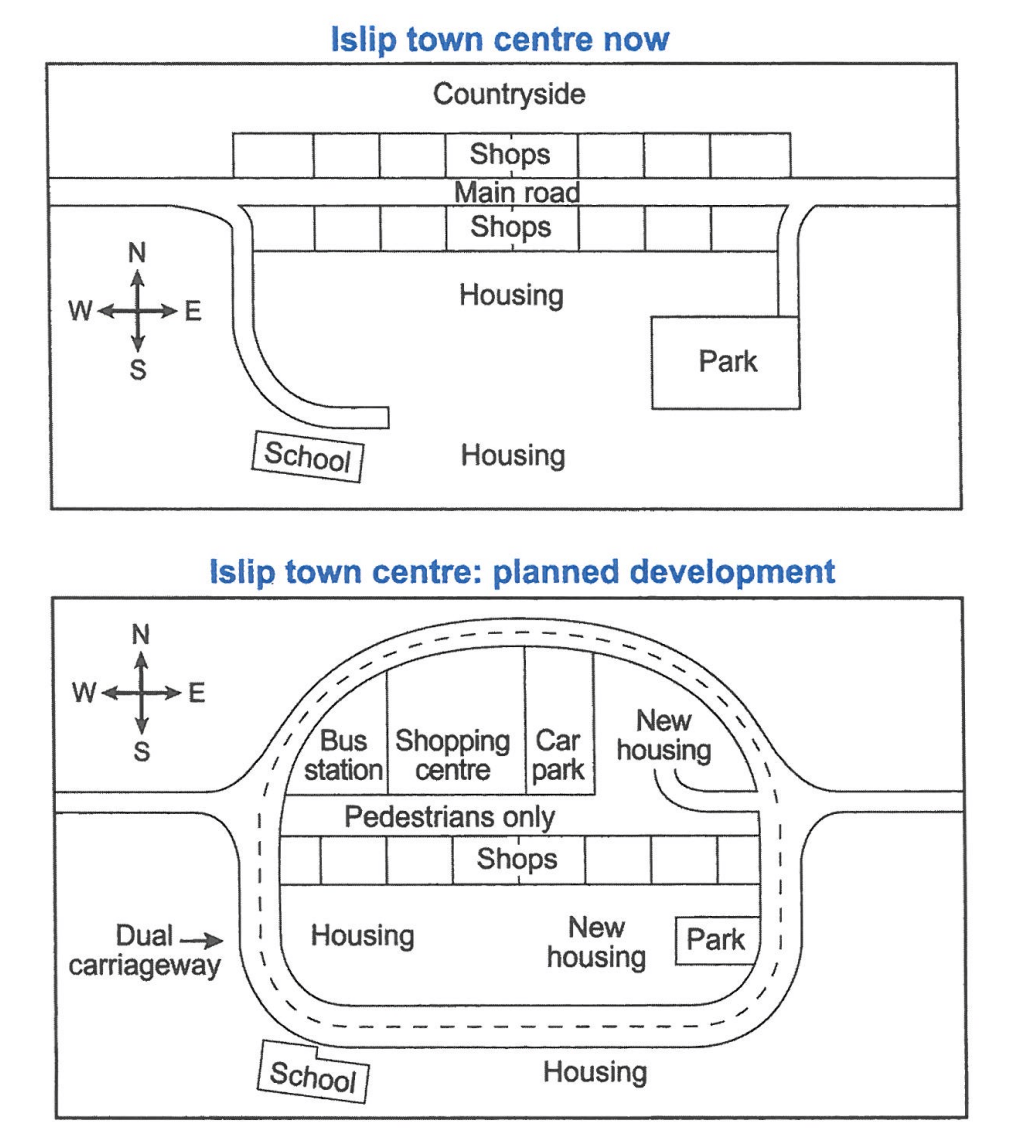
The maps below show the centre of a small town called Islip as it is now, and plans for its development.
Summarise the information by selecting and reporting the main features, and make comparisons where relevant.
Student answer (Band 5.0)
Well we assume to develop our small town and make it mpre advanced ,as we can see we have a plan for how it is now .
In addition in the north , we have the main road beyond it we have shops in the countryside and the housing .
In the east , we see like there is park in the space of housing while un the opposite side west there is school .
In town plan we should rebuild it to better one and to do that we shoild follow the planned development which is give us more space and better forms.
First thing we change is dual carriageway that has a circle shape and thats seems more practicual way from the other road , insides its may be a large place which we can replace shopes in the countryside with a lot of thing and among them are bus station , shoping centre also car park and finally a new housing and in front of them there will be pedestrians only and just bellow we rebuild for new housing and park and finally housing and that much better from the old plan .
However in the soud we put the school and housing and i think thats all for this plan who has a lot of advantages from the first plan
AI examiner evaluation
| Criterion | Band |
|---|---|
| Task Achievement / Task Response | 5.0 |
| Coherence and Cohesion | 4.5 |
| Lexical Resource | 5.0 |
| Grammatical Range and Accuracy | 5.0 |
| Overall | 5.0 |
Task Achievement / Task Response: Band 5.0
You identify the broad purpose of the plans and mention several key changes, including the dual carriageway, pedestrian-only street, bus station, shopping centre, car park, and new housing. However, the account only partially reports the maps: the present layout is described inaccurately or unclearly, for example, the shops are not “in the countryside,” and the school is not on the west side of the town centre. The planned arrangement is also difficult to follow, and important comparisons are missing, such as the southern shops remaining, the park becoming smaller, and the school and existing housing staying outside the loop. The claim that the plan gives “more space” is not clearly supported. A concise overview of the main transformations, followed by accurate location details, would make the response more complete.
Coherence and Cohesion: Band 4.5
There is an attempt to move from the current map to the proposed plan, and phrases such as “In addition,” “First thing,” and “However” signal some progression. However, the response does not have a clear overall structure: the opening is difficult to interpret, and details about the current map and future plan are mixed or expressed in a confusing order. Long sentences joined by “and” make relationships between features unclear, particularly in the paragraph beginning “First thing we change.” Some references, such as “inside its” and “in front of them,” do not clearly identify the places being discussed. Organise the response into an introduction and overview, then separate paragraphs for the existing and planned layouts. Use linking words sparingly and make each location reference explicit.
Lexical Resource: Band 5.0
You use some relevant map vocabulary, including “dual carriageway,” “pedestrians only,” “bus station,” and “car park,” so the reader can recognise several planned features. However, the range is limited and some choices are inaccurate or informal for a map summary. For example, “circle shape” is less precise than “loop,” while “a lot of thing” and “better forms” do not describe the development clearly. There are also noticeable spelling errors, including “mpre,” “practicual,” “shopes,” and “shoping,” which can slow the reader. Aim for precise location and change vocabulary, such as “to the north of,” “is replaced by,” and “remains unchanged,” and check spelling carefully.
Grammatical Range and Accuracy: Band 5.0
The response attempts to combine ideas in longer sentences, but these structures are often faulty, and errors frequently make the intended relationships difficult to understand. For instance, “In the north, we have the main road beyond it we have shops…” joins clauses without clear punctuation or a grammatical link. The sentence beginning “First thing we change is dual carriageway” also has problems with articles and sentence construction, while “which is give us” shows an incorrect verb form. Basic sentence patterns are attempted, but control of articles, verb forms, prepositions, and punctuation is inconsistent. Use shorter, complete sentences first, then add carefully controlled complex structures—for example, “The main road will become pedestrian-only, while a dual carriageway will loop around the centre.”
See this exact question answered at other band scores. The same prompt compared across bands.
Browse more IELTS Writing model answers or get your own writing scored by the same AI examiner.