Band 6.0 IELTS Writing Task 1 Model Answer
Overall Band Score: 6.0 · Cambridge IELTS 12 · 2026-11-21
IELTS Writing Task 1 question
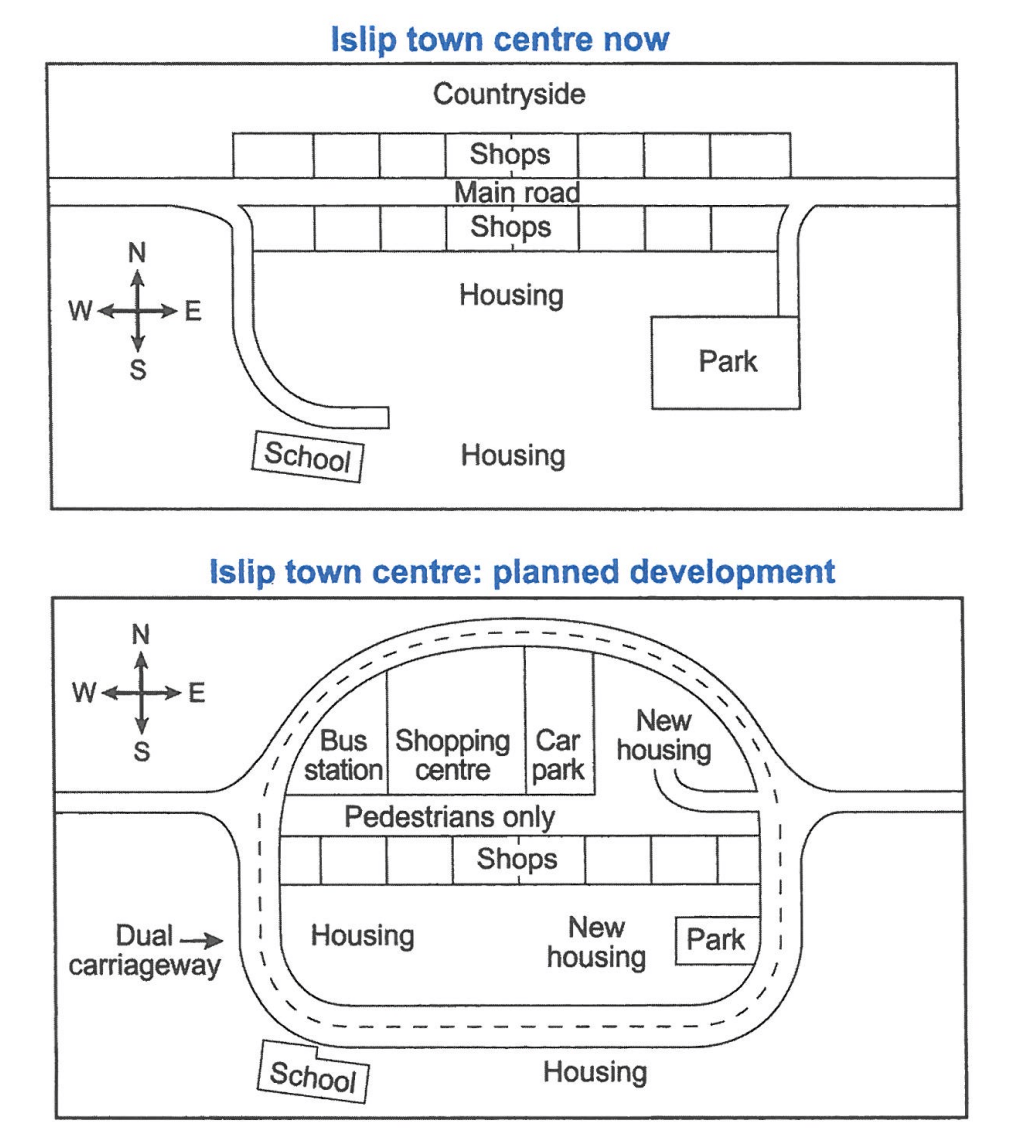
The maps below show the centre of a small town called Islip as it is now, and plans for its development.
Summarise the information by selecting and reporting the main features, and make comparisons where relevant.
Student answer (Band 6.0)
The two images indicates the development which will take place to the Islip town centre compared to the current day.
At a first glance, the major changes which I can see here is the development of the Dual carriageway around the centre and the addition of some new facilities such as Bus station, Shopping centre and Car park close to the shops.
Firstly, a large dual carriageway is being planned which will facilitate the more visitors; which also connects School to the park and new housing, because currently there is no direct way that connect those.
Secondly, the shops which is on the north side of the main road is set to remove completely, and new Bus station, Shopping centre and Car park is being constructed at the same place in the future.Similarly, more new housing is planned to take place around the shops and park. The old main road, which was middle of the centre is completely assign for pedestrians only in the planned development.
AI examiner evaluation
| Criterion | Band |
|---|---|
| Task Achievement / Task Response | 6.0 |
| Coherence and Cohesion | 6.5 |
| Lexical Resource | 6.0 |
| Grammatical Range and Accuracy | 5.5 |
| Overall | 6.0 |
Task Achievement / Task Response: Band 6.0
You identify the main direction of change, especially the dual-carriageway loop, the replacement of the northern shops, and the pedestrian-only central road. These are relevant features and give the reader a basic picture of the plan. However, some important comparisons are missing or unclear: the southern shops remain, the park becomes smaller, and the school and some housing stay outside the loop. The claim that the carriageway “connects School to the park and new housing” is not an accurate description of the layout; the school is outside the loop, and the road encircles the centre. The overview is also brief and does not summarise the broader reorganisation. More precise coverage of what remains, changes, and is added would make the response more complete.
Coherence and Cohesion: Band 6.5
The response has a clear overall sequence: an introduction, a brief overview, and then details introduced by “Firstly” and “Secondly.” This makes the main points easy to locate, and the comparison between the current and planned layouts is generally understandable. To strengthen progression, organise the details by area—for example, describe the northern side, the central road, and then the southern area—rather than grouping several changes into broad statements. Some links are mechanical, and “Similarly” does not clearly show how the new housing relates to the preceding replacement of shops. The final sentence adds another central feature but would fit more naturally before the southern-area details. Clearer referencing and more purposeful transitions would improve flow.
Lexical Resource: Band 6.0
You use a suitable range of map-related vocabulary, including “development,” “dual carriageway,” “facilities,” and “pedestrians only,” so the main changes can be understood. There are also attempts at more specific phrasing, such as “on the north side” and “at the same place.” However, some word choices and collocations are awkward or imprecise: “facilitate the more visitors” and “set to remove completely” do not express the intended ideas naturally, while “assign for pedestrians only” is not the appropriate phrase for a road’s planned use. Aim for concise, conventional map language such as “accommodate more visitors,” “will be removed,” and “will be reserved for pedestrians.” More precise vocabulary would help distinguish the features and changes.
Grammatical Range and Accuracy: Band 5.5
You attempt a mix of simple and complex sentences, including relative clauses such as “which was middle of the centre” and a reason clause beginning “because.” The overall meaning is usually recoverable, but some grammatical errors recur. For example, “The two images indicates” has subject–verb disagreement, and “the major changes … is” also needs plural agreement. In “the shops which is,” the verb should agree with the plural noun. Articles and sentence boundaries also need attention: “a Bus station” is inconsistent with the other listed facilities, and there is no space after the full stop before “Similarly.” Review agreement, article use, and punctuation, and simplify sentences when several ideas are joined with semicolons or relative clauses. This would make your varied structures more controlled.
See this exact question answered at other band scores. The same prompt compared across bands.
Browse more IELTS Writing model answers or get your own writing scored by the same AI examiner.