Band 5.0 IELTS Writing Task 1 Model Answer
Overall Band Score: 5.0 · Cambridge IELTS 12 · 2026-11-22
IELTS Writing Task 1 question
The maps below show the centre of a small town called Islip as it is now, and plans for its development.
Summarise the information by selecting and reporting the main features, and make comparisons where relevant.
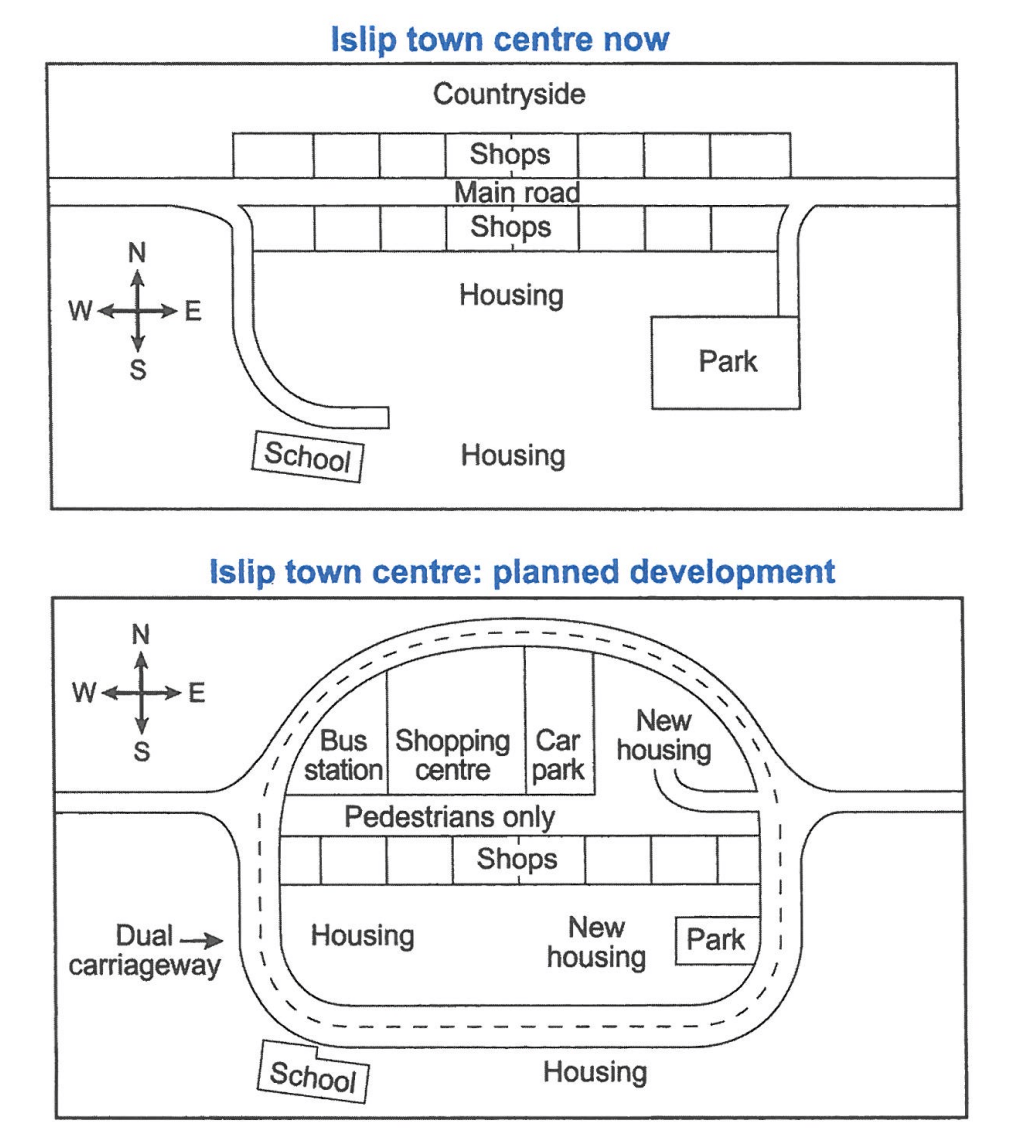
Student answer (Band 5.0)
The maps represents the centre of a small town called Islip as it is now, and plans fro its achievement. Overall, for talking about Islip town center noe there is a main road where shop is located in the north side of mai road and shops were located in southern side. Opposite of shops there is housing and park are. Next map shows the Islip town centre which were planned for its development the small area is managable in better way by bus station, shopping centre and card park in northern side of map. There is a dual carriageway its like a ring road and shops were also located there and parking area is also inside the dual carriageway. I conluded from this map that its planned development is projected very well and managed in a systematic manner which helps in overall development of the town centre.
AI examiner evaluation
| Criterion | Band |
|---|---|
| Task Achievement / Task Response | 4.5 |
| Coherence and Cohesion | 5.0 |
| Lexical Resource | 5.0 |
| Grammatical Range and Accuracy | 5.0 |
| Overall | 5.0 |
Task Achievement / Task Response: Band 4.5
You identify the maps as showing Islip now and a planned development, and mention several relevant features, including the main road, shops, bus station, shopping centre and dual carriageway. However, the account is incomplete and some details are inaccurate or unclear: the planned map’s car park is called a “card park,” and you do not explain key changes such as the pedestrian-only street, the new housing, or the reduced park. The overview mainly gives an unsupported judgement that the plan is “projected very well” rather than summarising the main physical changes. The response also falls 17 words short of the 150-word minimum. To improve, give a concise overview of the major changes, then compare the locations and features in both maps accurately.
Coherence and Cohesion: Band 5.0
There is a basic attempt to organise the response: you introduce the maps, describe some current features, and then move to the planned layout using “Next map.” This gives the reader a general sense of the sequence. However, the response is a single paragraph, and the progression between details is often unclear. For example, “Opposite of shops there is housing and park are” does not clearly show which features are where, while “shops were also located there” leaves the location of “there” uncertain. The final evaluative sentence does not connect smoothly to a factual summary. Use separate paragraphs for the overview and map details, and group information by area or by changes, with clear references such as “to the north” and “in the southern section.”
Lexical Resource: Band 5.0
You use some relevant map vocabulary, including “main road,” “north side,” “bus station,” “shopping centre” and “dual carriageway,” so the reader can recognise several features. However, the range is limited, and some word choices or spelling errors make the description less precise: “plans fro its achievement,” “town center noe,” “card park” and “conluded.” Phrases such as “managed in a systematic manner” and “projected very well” are evaluative rather than useful for describing map changes. Aim for accurate, neutral terms for locations and transformations, such as “was replaced by,” “remains,” “to the east of” and “is enclosed by.” Proofreading spelling and choosing precise map-description collocations would make the information easier to follow.
Grammatical Range and Accuracy: Band 5.0
The response includes simple statements and attempts to link ideas, for example, “Next map shows the Islip town centre…” and “there is a dual carriageway…”. However, the range of sentence structures is limited, and frequent errors affect clarity. The opening has subject–verb disagreement in “The maps represents,” while “shops is located” also has incorrect agreement. Tense and clause forms are inconsistent in “which were planned” and “where shop is located,” and articles and plurals are often missing or inaccurate. The sentence beginning “Overall, for talking about…” is also difficult to parse. Practise accurate present-tense descriptions and past-to-present comparisons, and build sentences with clear subjects and correctly matched verbs before adding more complex clauses.
See this exact question answered at other band scores. The same prompt compared across bands.
Browse more IELTS Writing model answers or get your own writing scored by the same AI examiner.