Band 6.0 IELTS Writing Task 1 Model Answer
Overall Band Score: 6.0 · Cambridge IELTS 12 · 2026-11-24
IELTS Writing Task 1 question
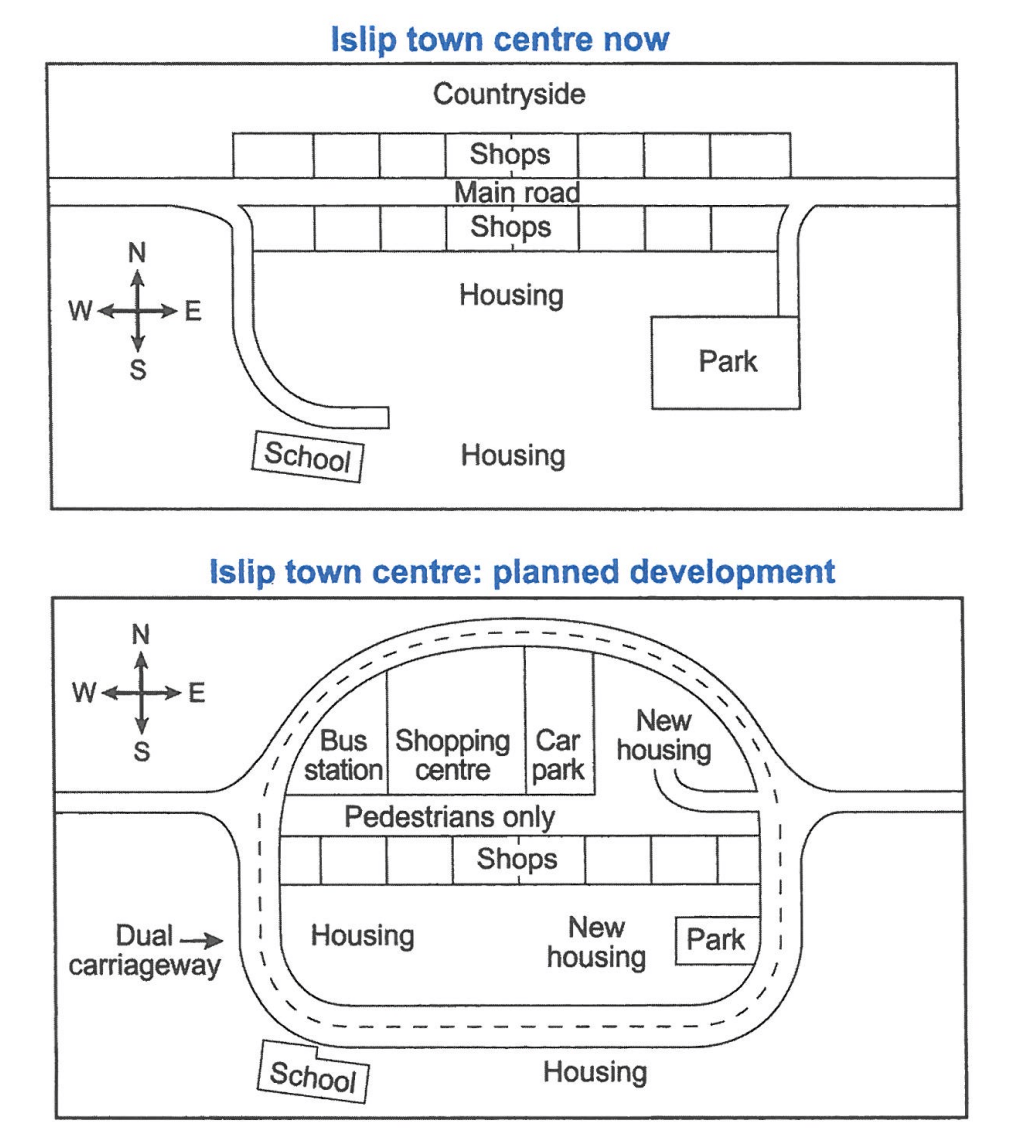
The maps below show the centre of a small town called Islip as it is now, and plans for its development.
Summarise the information by selecting and reporting the main features, and make comparisons where relevant.
Student answer (Band 6.0)
The maps given below illustrate the centre of a small town called Islip before and after the development.
Specifically, the major changes in the former and later map is that in the former map a main road is at the center of the town with shops on its both sides. While in the later map road is to be developed at the side with bus station, car parking and shops at the center. Initial map shows a single roadway in the middle of the town. Then after the development there will be a dual roadway.
The present structure of the Islip town centre shows a main road at the middle with the shops at its north and south side. Moreover, at the northern part of town is the countryside. At the southern side there are dwellings with a park at the eastern side and school at the western side.
The planned development map shows no countryside with dual carriageway, school at the south-west side and housing at the southern side. While in the middle there is a bus station,a shopping centre, a car parking area and a new housing area at the northern side. Then there's a footpath with shops. The southren part has new housing area and park at south-west side. The changes made in planned development map are significant and many new areas are mentioned that changes the outlook of the town.
AI examiner evaluation
| Criterion | Band |
|---|---|
| Task Achievement / Task Response | 6.0 |
| Coherence and Cohesion | 5.5 |
| Lexical Resource | 6.0 |
| Grammatical Range and Accuracy | 5.5 |
| Overall | 6.0 |
Task Achievement / Task Response: Band 6.0
You identify the main contrast between the existing central road and the planned pedestrian street and dual carriageway, and you mention several key additions, including the bus station, shopping centre and car park. This gives the reader a relevant account of the redevelopment. However, some details are unclear or inaccurate: the planned bus station, shopping centre and car park are north of the pedestrian street, not simply “at the center,” and the new housing is northeast of the car park as well as south of the shops. The park is on the southeast, not the southwest, and the school remains outside the southern loop. Your overview also says the countryside disappears, but does not clearly summarise the broader reorganisation of traffic and land use. Develop these comparisons more precisely and consistently.
Coherence and Cohesion: Band 5.5
The response has a recognisable structure: an introduction, a brief overview, and separate descriptions of the current and planned layouts. This helps the reader distinguish the two maps. However, progression within paragraphs is sometimes uneven, and several linking words create fragments or awkward transitions. For example, “While in the later map…” and “While in the middle…” are not complete sentences in this context. “Then” is also used repeatedly, while “Moreover” introduces a detail without clearly connecting it to the main comparison. Group information by location—north of the pedestrian street, then south of it—and use clear comparisons between the maps. This would make the organisation more coherent and cohesion less mechanical.
Lexical Resource: Band 6.0
You use a suitable range of map vocabulary, including “dual carriageway,” “pedestrian,” “dwellings,” and “planned development,” and the reader can generally understand the changes you describe. Some word choices and collocations are imprecise, however. “Car parking” and “car parking area” are less natural here than “car park,” the map’s label; “roadway” is vague when you mean a specific road or street. There are also spelling errors, including “southren,” and “footpath” does not accurately describe the street designated for pedestrians only. Aim for precise labels and natural collocations, and check spelling carefully. This will make your descriptions more exact without requiring unnecessarily complex vocabulary.
Grammatical Range and Accuracy: Band 5.5
You attempt both simple and more complex sentence forms, and most of the intended meaning remains understandable. Some grammatical errors occur in sentence construction, agreement and articles. For instance, “the major changes … is” has a plural subject with a singular verb, while “shops on its both sides” has an awkward determiner pattern. The opening overview also contains a fragment: “While in the later map road is to be developed…”; connect this clause to a complete sentence and use a suitable article before “road.” Punctuation and spacing need attention in “bus station,a shopping centre,” and the final sentence is long and loosely joined. Review agreement, articles and complete clause structure, while retaining your attempts at complex sentences.
See this exact question answered at other band scores. The same prompt compared across bands.
Browse more IELTS Writing model answers or get your own writing scored by the same AI examiner.