Band 5.5 IELTS Writing Task 1 Model Answer
Overall Band Score: 5.5 · Cambridge IELTS 12 · 2026-11-26
IELTS Writing Task 1 question
The maps below show the centre of a small town called Islip as it is now, and plans for its development.
Summarise the information by selecting and reporting the main features, and make comparisons where relevant.
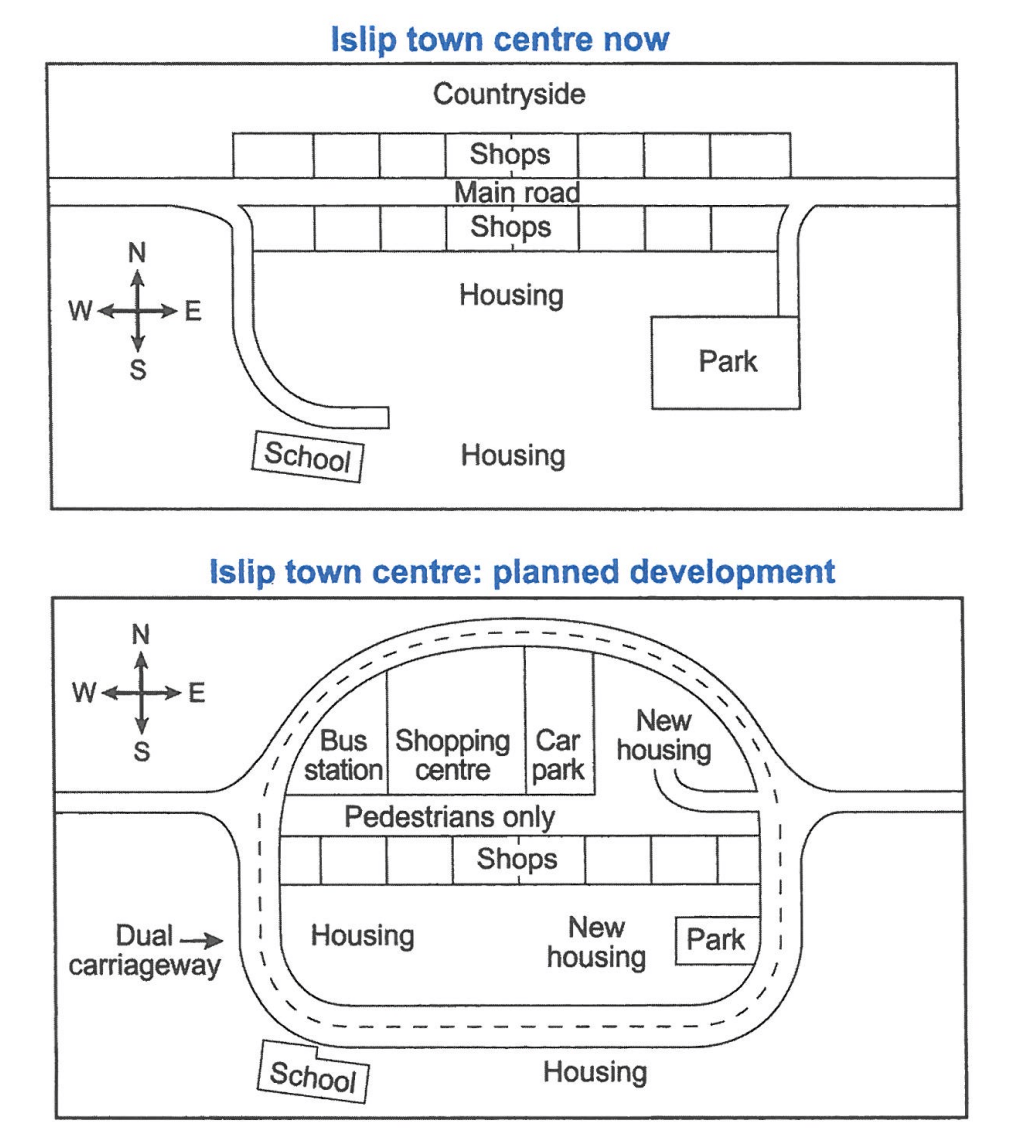
Student answer (Band 5.5)
The given maps show how small Islip town use to look like and what plans are taken for its development.
It is pretty evident form the given maps that the Islip town is small and simple with some basic amenities like one main road passing from west side to east side. In south-west side there is a school and on the other south-east side there is a park. Several shops are available which are adjecent to each other and present on both side of the road. There are many plans will take for its development in which the main road will constructed in new round shape with dual carriageway. in this development plans the new bus station, shopping centre car park and new housing will added on the north side of the town. In center there will be pedestrians for people. Some shops remain same. housings also remains same but some new housing will be added. While park and school remain on its own place with minor changes.
In a nutshell, Islip town will become more advanced with more leisure fecilities like new circular road and in its center there will be more developments like
AI examiner evaluation
| Criterion | Band |
|---|---|
| Task Achievement / Task Response | 5.5 |
| Coherence and Cohesion | 5.5 |
| Lexical Resource | 5.5 |
| Grammatical Range and Accuracy | 5.0 |
| Overall | 5.5 |
Task Achievement / Task Response: Band 5.5
You identify the broad contrast between the town as it is and its planned redevelopment, and you mention several key additions, including the dual carriageway, bus station, shopping centre and new housing. However, important details are inaccurate or unclear: the school is not in the south-west of the current map, and the planned school remains outside the new road loop rather than simply staying in its original place. The park is reduced in size, not just subject to unspecified “minor changes.” The overview also calls the town “more advanced” without clearly summarising the main spatial changes, and the final sentence is unfinished. Select the most significant changes and describe their locations and what is retained or replaced more precisely.
Coherence and Cohesion: Band 5.5
The response has a basic overall structure: it introduces the maps, describes the existing town and proposed changes, and attempts a concluding summary. This gives the reader a general sense of the comparison. However, progression within the main paragraph is difficult to follow because present and future features are mixed together, and several ideas are joined in a long sequence. Phrases such as “In this development plans” and “In center” do not clearly connect the information, while the final sentence stops after “like,” leaving the conclusion incomplete. Organise the response into a clear overview and separate paragraphs for the current layout and planned changes. Use location-based links such as “to the north” and “by contrast” accurately.
Lexical Resource: Band 5.5
You use some relevant map vocabulary, including “dual carriageway,” “pedestrians,” “adjacent” (intended), and “remain,” so the reader can recognise the main subject. However, the range is limited and several choices are inaccurate or imprecise, such as “new round shape” for the road arrangement and “leisure facilities” for the listed transport and commercial developments. Spelling errors such as “form,” “adjecent,” and “fecilities” are noticeable, and repeated general words like “development” and “same” reduce precision. Aim to use standard map-description terms and exact labels from the plan, for example “loop,” “pedestrianised street,” “shops retained,” and “park reduced in size.”
Grammatical Range and Accuracy: Band 5.0
The response attempts both simple statements and longer sentences, but control is inconsistent, and errors often make relationships between features difficult to understand. Examples include “small Islip town use to look like,” “there are many plans will take,” and “the new bus station … will added,” where verb forms and sentence construction are faulty. Agreement and tense are also inconsistent in “housings also remains” and “park and school remain on its own place.” The final sentence is incomplete, and punctuation and capitalisation are unreliable, particularly after full stops. Practise forming clear future passive structures (“will be added”) and checking subject–verb agreement. Shorter, complete sentences would help you communicate the map changes more accurately.
See this exact question answered at other band scores. The same prompt compared across bands.
Browse more IELTS Writing model answers or get your own writing scored by the same AI examiner.