Band 6.0 IELTS Writing Task 1 Model Answer
Overall Band Score: 6.0 · Cambridge IELTS 12 · 2026-11-26
IELTS Writing Task 1 question
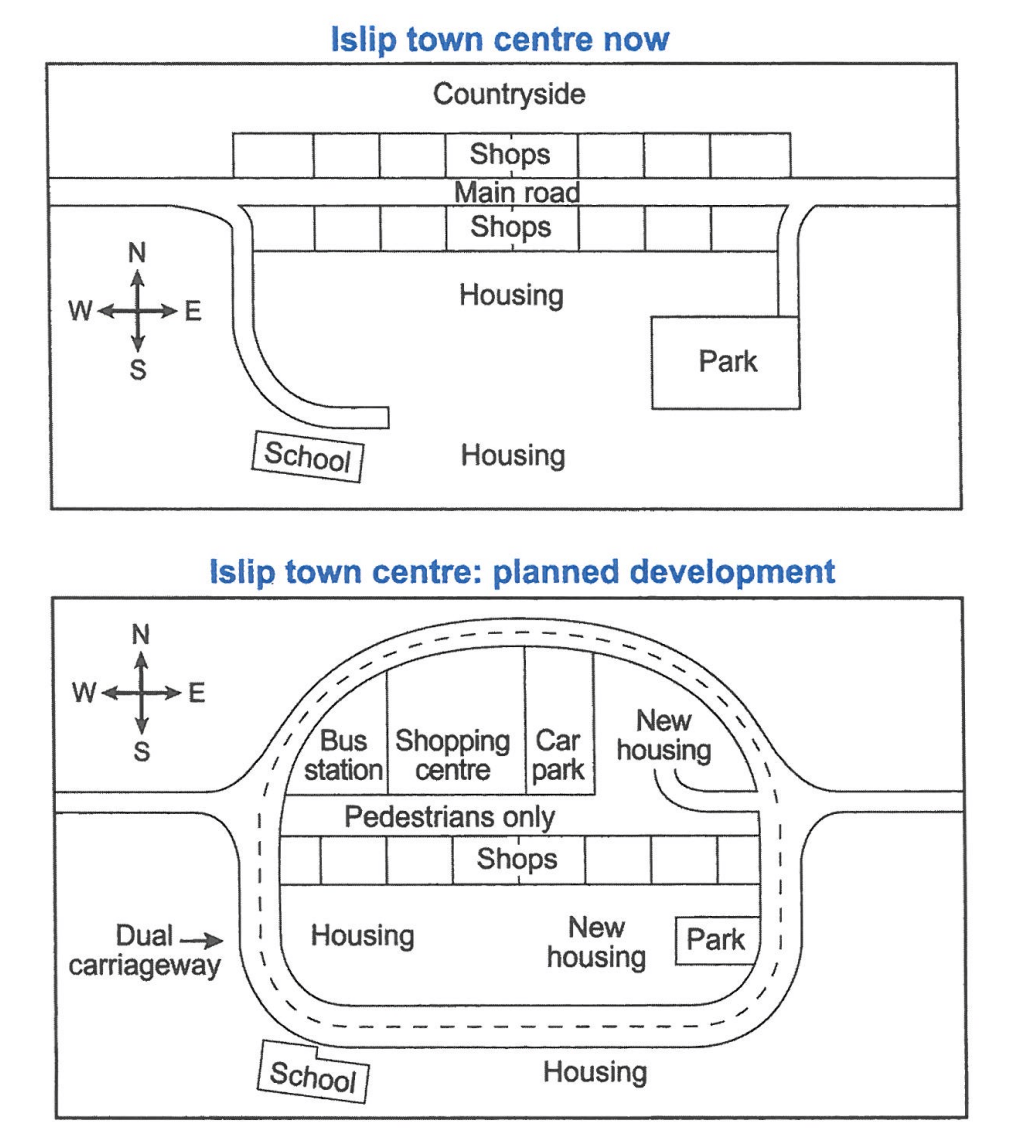
The maps below show the centre of a small town called Islip as it is now, and plans for its development.
Summarise the information by selecting and reporting the main features, and make comparisons where relevant.
Student answer (Band 6.0)
The two maps illustrate the down town of a small town called Islip as it looks like nowadays, and plans for its improvement.
From the first look we can see large differences between the two maps, futhermore we will talk about them.
For the first thing, the main road will be the most changeable thing in future due to the map of future development, it will be transformed to be for the pedestrians only and make two streets around the centre instead. Shops that are located southest from the main road today will be still the same in the coming days, meanwhile the northern ones will replaced with many sections such as: bus station, shopping centre, car park and new housing area. School will be in the same place with a light change in the shape of its building in addition to that, the park will be smaller than it is now.
Finally, there are two spaces for housing in the recent map, whilst hte planned one they will be four if we calculate both of two new housing with the old ones.
In conclusion, there will be a huge enahncement in the future Islip centre compared to its features right now.
AI examiner evaluation
| Criterion | Band |
|---|---|
| Task Achievement / Task Response | 6.0 |
| Coherence and Cohesion | 6.0 |
| Lexical Resource | 5.5 |
| Grammatical Range and Accuracy | 5.5 |
| Overall | 6.0 |
Task Achievement / Task Response: Band 6.0
You identify the main contrast between the existing and planned centre: the central road becomes pedestrian-only, northern shops are replaced by facilities, and the park is reduced. These are relevant features, and the response addresses both maps. However, the overview is vague (“large differences”) and the final claim of a “huge enhancement” is an unsupported judgement rather than a summary of the changes. Some details are unclear or inaccurate: the new housing is not part of the northern replacement of shops, and the planned layout includes a dual-carriageway loop rather than simply “two streets around the centre.” The housing comparison is also difficult to follow. A clearer overview and more precise coverage of the road layout and land-use changes would make the account more complete.
Coherence and Cohesion: Band 6.0
The response has a recognisable progression, moving from an introduction to changes around the main road, then housing and a conclusion. This gives the reader an overall structure. However, several linking phrases sound mechanical or do not clarify the relationship between ideas, including “From the first look,” “For the first thing,” and “Finally.” The long middle sentence combines several changes, making the information harder to follow, while “whilst the planned one they will be four” has unclear referencing. Grouping the changes by location or by what remains and what is replaced, and using more precise transitions, would improve the flow. The paragraphing is limited, but the overall arrangement remains understandable.
Lexical Resource: Band 5.5
You use some relevant map vocabulary, such as “pedestrians only,” “shopping centre,” “car park,” and “housing,” so the main changes can generally be understood. There are also attempts at more descriptive language, but several choices are inaccurate or unnatural: “down town,” “changeable thing,” “coming days,” and “huge enhancement” do not fit this map description well. Spelling errors such as “futhermore,” “hte,” and “enahncement” also reduce accuracy. Aim for precise, neutral terms commonly used to describe plans, such as “redeveloped,” “replaced by,” and “remain unchanged.” This would make the vocabulary more appropriate and controlled without requiring unnecessarily elaborate wording.
Grammatical Range and Accuracy: Band 5.5
You attempt both simple and more complex sentences, including a comparison with “whilst” and a clause beginning “due to.” The main message is usually recoverable, but some grammatical errors affect clarity. For example, “the northern ones will replaced” is missing “be,” and “School will be in the same place” needs an article. The sentence “whilst the planned one they will be four” has an incomplete structure and unclear pronoun reference. There are also awkward tense and clause patterns in “it will be transformed to be for the pedestrians only.” Practise forming passive constructions and checking that each clause has a clear subject and verb. More accurate sentence patterns would help you express the map comparisons clearly.
See this exact question answered at other band scores. The same prompt compared across bands.
Browse more IELTS Writing model answers or get your own writing scored by the same AI examiner.