Band 5.5 IELTS Writing Task 1 Model Answer
Overall Band Score: 5.5 · Cambridge IELTS 12 · 2026-11-27
IELTS Writing Task 1 question
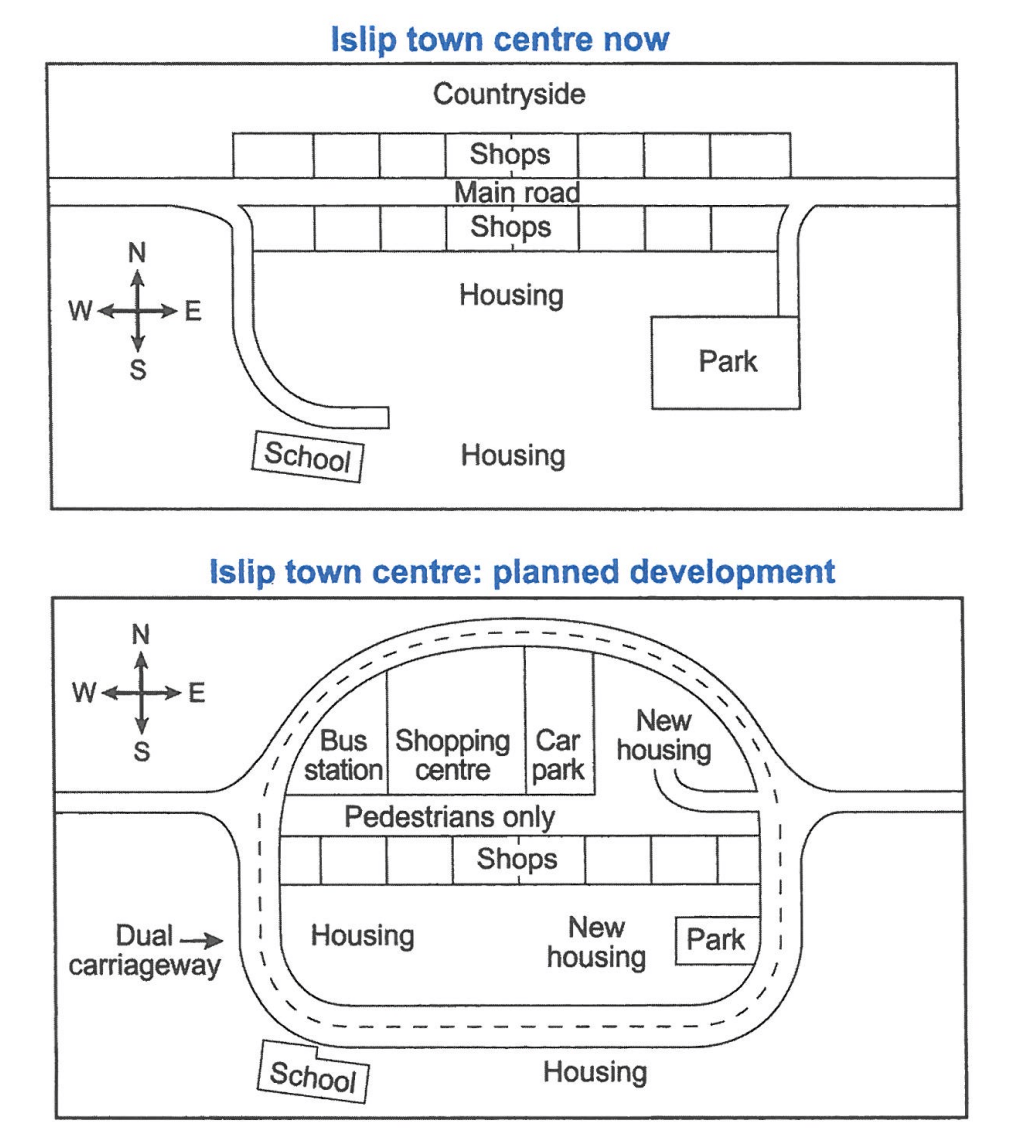
The maps below show the centre of a small town called Islip as it is now, and plans for its development.
Summarise the information by selecting and reporting the main features, and make comparisons where relevant.
Student answer (Band 5.5)
The illustration gives the information about development plan of lslip town center now and in future.Overall,In persent the small town has look old but after future development it look modern.
it is quit evident from the map of lslip town center in present, there are main road in the center of small town,In North and south side of road,there was a large number of shops and the back side of north shops has a country side area,On the other hand,the south side shops behind a housing and the west,south corner of shops are small path that link with school and in west south side of shops are small path that connect with large park.
However,In the future development, the central path change into round shape and in north side, bus stand ,shopping center and car park are established but also build a new housing sceam and shops has center of the town, in the south side of shops the housing and park has build and the outside of around path will be build school and housing in future development
AI examiner evaluation
| Criterion | Band |
|---|---|
| Task Achievement / Task Response | 5.5 |
| Coherence and Cohesion | 5.5 |
| Lexical Resource | 5.0 |
| Grammatical Range and Accuracy | 5.0 |
| Overall | 5.5 |
Task Achievement / Task Response: Band 5.5
You identify the broad contrast between the town’s current layout and its planned redevelopment, and you mention several relevant features, including the shops, bus station, shopping centre, car park, housing and park. However, the overview is vague: saying the town will look “modern” does not explain the main spatial changes. Some details are also inaccurate or unclear. The central east–west road becomes pedestrian-only, while a dual carriageway forms a loop around the centre; it does not become a “round shape.” The planned northern facilities are arranged from west to east, and the southern shops remain. To strengthen the response, summarise these major changes clearly and describe the locations of the new facilities more precisely.
Coherence and Cohesion: Band 5.5
The response has a basic overall structure: an introduction and overview are followed by a description of the present map and then the future plan. This helps the reader recognise the comparison being attempted. However, progression within the paragraphs is difficult to follow because several locations and changes are combined in long, loosely connected sentences. For example, the present-day description moves from the shops to housing, paths, the school and park without clear separation or consistent directional organisation. Linking phrases such as “On the other hand” and “However” are used, but they do not always clarify the relationship between details. Group features by area—north, central street and south—and use clear sentence boundaries and references.
Lexical Resource: Band 5.0
You use some relevant map vocabulary, including “main road,” “shops,” “housing,” “school” and “park,” so the reader can identify many of the features being described. There are also attempts to use development-related terms, such as “established” and “development.” However, the range is limited and several choices or spellings make the meaning less precise: “central path” does not accurately name the pedestrian street, “bus stand” is less suitable than “bus station,” and “round shape” does not describe the dual-carriageway loop clearly. Spelling errors such as “persent,” “sceam” and “lsl ip” also affect clarity. Practise accurate map terminology and use precise verbs for what is retained, replaced or added.
Grammatical Range and Accuracy: Band 5.0
You attempt to connect ideas in longer sentences, but these structures are often difficult to control, and many sentences contain errors that interrupt the description. For example, “the small town has look old” has an incorrect verb form, while “there are main road” has an agreement and article problem. Tense is also inconsistent: the present map is described with “there was,” and future changes are expressed with forms such as “will be build.” Sentence boundaries and punctuation are frequently unclear, particularly where several clauses are joined by commas. Build accuracy first with clear present-tense descriptions of the existing map and consistent future forms for planned changes, then combine ideas using correctly structured clauses.
See this exact question answered at other band scores. The same prompt compared across bands.
Browse more IELTS Writing model answers or get your own writing scored by the same AI examiner.