Band 5.5 IELTS Writing Task 1 Model Answer
Overall Band Score: 5.5 · Cambridge IELTS 12 · 2026-11-28
IELTS Writing Task 1 question
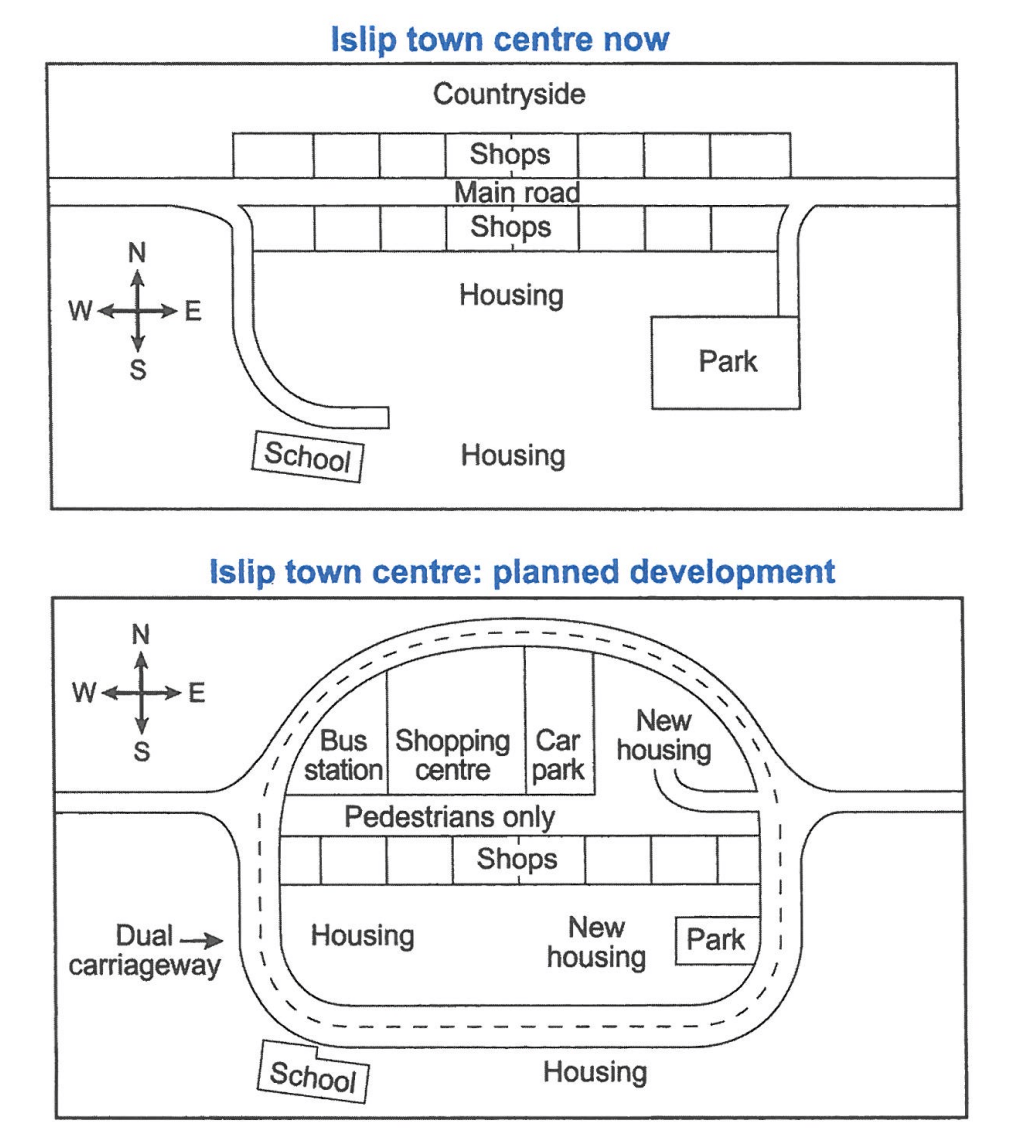
The maps below show the centre of a small town called Islip as it is now, and plans for its development.
Summarise the information by selecting and reporting the main features, and make comparisons where relevant.
Student answer (Band 5.5)
The maps compare a small town called Islip at present and after its development.
Overall, the current layout of plan has a straight road and shops on it both side. Whereas, the new plan provide more facilities like bus station, shopping centre and a separate car parking. School is the only place which remain the same.
The town centre now has a main road and shops on its both sides. A school at the south side having a separate road to school and a park on the south-east side. The country side is at the north side of the road and housing at the south side between school and park.
The new development plan provide more facilities like a dual carriageway around the town. The main road replaced with pedestrians only. A car park, shopping centre, a bus station and two new housing are added. Housing area replace from centre to the north side.The park area is conjusted and put it next to the dual carriageway.
AI examiner evaluation
| Criterion | Band |
|---|---|
| Task Achievement / Task Response | 6.0 |
| Coherence and Cohesion | 6.0 |
| Lexical Resource | 5.5 |
| Grammatical Range and Accuracy | 5.0 |
| Overall | 5.5 |
Task Achievement / Task Response: Band 6.0
You identify the main contrast between the present town centre and the proposed redevelopment, including the pedestrian-only street, dual carriageway and new facilities. The overview also notes that the school remains unchanged, which is a relevant comparison. However, some details are inaccurate or unclear: the school is not described as having a separate road, and the park is east of the town centre rather than south-east. The statement that housing is moved to the north is misleading; the plan shows new housing in more than one location, while existing housing remains in the south-west. The response covers the main changes, but several features—such as the bus station, shopping centre and car park’s relative positions—could be reported more precisely.
Coherence and Cohesion: Band 6.0
The response has a clear overall arrangement: an introduction, an overview, a description of the current map and a paragraph on the proposed plan. This makes the comparison easy to follow at a general level. Some linking is effective, particularly the contrast introduced by “Whereas,” but the connection between the overview and the later details is occasionally mechanical, with repeated references to “the new development plan” and “facilities.” A few sentences also group several map features without showing their spatial relationships, such as the list of new facilities and housing. Use clearer sequencing language—such as “to the north,” “further east” and “in the southern section”—to guide the reader through each map.
Lexical Resource: Band 5.5
You use relevant map vocabulary, including “dual carriageway,” “pedestrians only,” “shopping centre” and “housing,” so the main changes are generally understandable. There is some useful variety in describing the plans, but several word choices and collocations are inaccurate or awkward: “separate car parking” is less natural than “a car park,” and “the park area is conjusted” does not clearly express that the park becomes smaller. “The country side” is also incorrectly written as two words in this context, and “two new housing” uses the wrong form. Aim for precise, conventional map-description phrases and check spelling and countability; this will make your descriptions clearer and more natural.
Grammatical Range and Accuracy: Band 5.0
You communicate the broad comparison using both simple sentences and some attempts at more complex structures. However, errors in sentence construction and agreement recur, and they sometimes make relationships between features unclear. For example, “the current layout of plan has” needs an article and a more suitable construction, while “the new plan provide” and “the school … remain” have subject–verb agreement errors. The sentence beginning “A school at the south side having…” is a fragment rather than a complete sentence. Articles and prepositions also need attention in phrases such as “on its both sides.” Practise building complete sentences around each map feature, and check verb forms, articles and agreement during revision.
See this exact question answered at other band scores. The same prompt compared across bands.
Browse more IELTS Writing model answers or get your own writing scored by the same AI examiner.