Band 5.5 IELTS Writing Task 1 Model Answer
Overall Band Score: 5.5 · Cambridge IELTS 12 · 2026-11-10
IELTS Writing Task 1 question
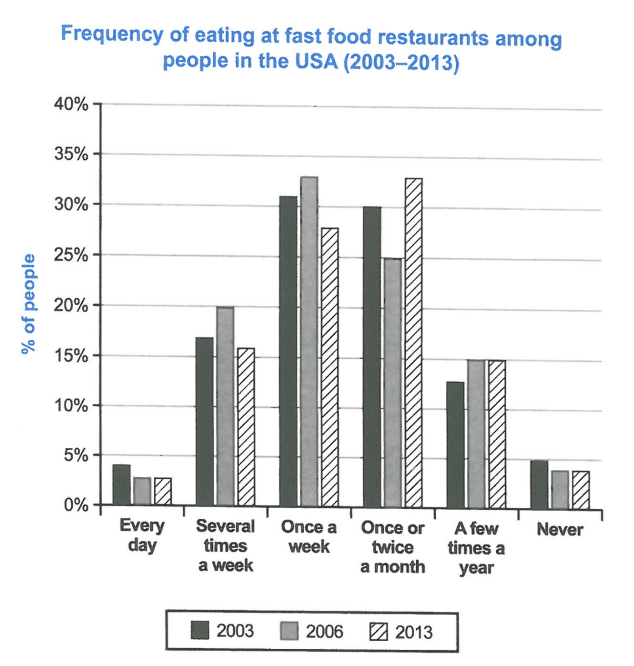
The chart below shows how frequently people in the USA ate in fast food restaurants between 2003 and 2013.
Summarise the information by selecting and reporting the main features, and make comparisons where relevant.
Student answer (Band 5.5)
The bar chart depicts the individual In USA , who eats junk food in restaurants between 2003 and 2013.
Overall , it can be seen that significant number of people consume fast food at once a week , whereas every day went people and never went people showed less number for consuming fast food.
Regarding to the bar chart, in 2003 and 2006 individuals ,who went restaurants once a week represented considerable increased aproximately 31% and 33% , while in 2013 people went once or twice a month was similar with people who went once a week in 2006 at 33%. In addition, several times a week people went in 2006 showed considerable increased than other year at 20% and in 2013 it dropped apppoximately 16%.
Surprisingly, every day , never and a few times a year , who went restaurants for consuming fast food between 2006 and 2013 accounted for comparable position , where every day went people were less proportion approximately 3% and never was around 4% , a few times a year went people showed 15% between these two years.
AI examiner evaluation
| Criterion | Band |
|---|---|
| Task Achievement / Task Response | 6.0 |
| Coherence and Cohesion | 6.0 |
| Lexical Resource | 5.5 |
| Grammatical Range and Accuracy | 5.0 |
| Overall | 5.5 |
Task Achievement / Task Response: Band 6.0
You identify the main pattern that weekly or monthly visits were common, and you report several relevant figures, including 31% and 33% for weekly visits and 33% for monthly visits in 2013. The overview also notes that daily eating and never eating were among the least common categories. However, some comparisons are unclear or incomplete: the overview does not capture the shift from weekly visits being highest in 2006 to monthly visits being highest in 2013, and the final paragraph focuses on 2006–2013 while omitting the 2003 figures for those categories. A few statements are difficult to interpret, such as “every day went people.” Make the key changes across all three years explicit and ensure each comparison clearly identifies its category and year.
Coherence and Cohesion: Band 6.0
The response has a recognisable structure: an introduction, an overview, and two paragraphs of supporting details. This gives the information an overall arrangement, and linking expressions such as “Overall,” “In addition,” and “Surprisingly” help signal relationships. However, progression within the detail paragraphs is sometimes hard to follow because several categories and years are combined in long, awkward sentences. For example, the sentence beginning “Surprisingly, every day, never and a few times a year” does not clearly separate the three comparisons. Some references, including “these two years,” require the reader to infer which years are meant. Group the data more consistently and use clear year/category references to make the comparisons easier to track.
Lexical Resource: Band 5.5
You use a reasonable range of task-related vocabulary, including “represented,” “accounted for,” “proportion,” and “approximately,” and the reader can generally identify the categories being discussed. However, several word choices and collocations are unnatural or imprecise, such as “significant number,” “considerable increased,” and “comparable position.” “Junk food” is also less suitable than the chart’s neutral term, “fast food,” and spelling errors such as “apppoximately” reduce accuracy. These issues sometimes make the intended comparison less clear, even though the main topic remains understandable. Aim for precise, natural phrases such as “the proportion was higher” or “the figure fell,” and check spelling and word forms carefully.
Grammatical Range and Accuracy: Band 5.0
You attempt both simple and more complex sentence forms, including clauses introduced by “whereas,” “while,” and “who,” and the overall meaning is usually recoverable. However, some sentence structures are faulty, particularly when clauses are joined or modified: “people went once or twice a month was similar with people” lacks a clear grammatical subject, while “every day went people” has an incorrect word order. There are also errors with articles, agreement, and punctuation, as in “significant number” and the inconsistent spaces before commas. These problems make some comparisons difficult to understand. Build each sentence around a clear subject and verb, and use shorter sentences when comparing several categories or years.
See this exact question answered at other band scores. The same prompt compared across bands.
Browse more IELTS Writing model answers or get your own writing scored by the same AI examiner.