Band 5.0 IELTS Writing Task 1 Model Answer
Overall Band Score: 5.0 · Cambridge IELTS 12 · 2026-11-10
IELTS Writing Task 1 question
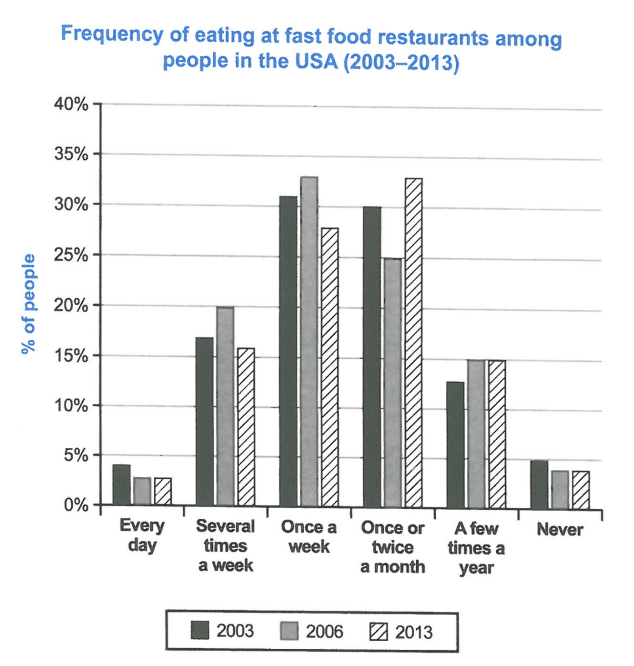
The chart below shows how frequently people in the USA ate in fast food restaurants between 2003 and 2013.
Summarise the information by selecting and reporting the main features, and make comparisons where relevant.
Student answer (Band 5.0)
The chart below show how frequently people in USA ate in fast food restaurants everyday, several times a week, once a week, once or twice a month, a few times year, never between 2003 to 2013.
Overall, every day eating 5% in USA its not change they ae same in 2003 and 2004 and 2005 and whose never eat their rtio are same in this years.
In 2003, around 31% ate fast food once a week and in 2006, around 35% ate fast food once a week. In 2003, around 24% ate fast food. Once or twice a month in 2003, around 30% ate fast food in 2006 it dropped like 5% and came to 25% and in 2013, its ratio grew up and came to 35%.
In 2003, around 17% ate fast food several times a week and in 2006, its ratio grew up and came to 20%. In 2023 around 16% ate fast food several times a week.
AI examiner evaluation
| Criterion | Band |
|---|---|
| Task Achievement / Task Response | 4.5 |
| Coherence and Cohesion | 5.0 |
| Lexical Resource | 5.0 |
| Grammatical Range and Accuracy | 4.5 |
| Overall | 5.0 |
Task Achievement / Task Response: Band 4.5
You identify the topic and report several relevant comparisons, including the rise in monthly eating from about 30% in 2003 to 33% in 2013 and the figures for eating several times a week. However, the response only partially covers the chart: it omits the “a few times a year” category and gives no reliable account of the 2013 weekly figure. Several details are inaccurate or unclear: the chart compares 2003, 2006 and 2013, not 2004 or 2005, and the once-a-week figure in 2006 is about 33%, not 35%. The overview is also unclear and does not identify the main pattern across the categories. Select the key highs, lows and changes, and check each figure against the chart.
Coherence and Cohesion: Band 5.0
The response has a basic sequence: an introduction, an attempted overview, and paragraphs reporting figures. This gives the reader some organisation, and phrases such as “In 2003” help signal comparisons. However, there is no clear overall progression because the overview is difficult to understand and the details are grouped inconsistently. The sentence beginning “In 2003, around 24% ate fast food” is incomplete in meaning, while the following sentence repeats the monthly category and shifts between years without clear separation. The final paragraph introduces 2023, which disrupts the time sequence. Use one paragraph for the overview and group the remaining comparisons by frequency or by year, with clear links between sentences.
Lexical Resource: Band 5.0
You use relevant basic terms such as “ate fast food,” “once a week,” and “ratio,” so the subject is generally recognisable. However, vocabulary is limited and repetitive, and several choices are inaccurate or unnatural for describing chart data. For example, “its ratio grew up” and “came to 35%” do not express the change naturally, while “everyday” is not the same form as the frequency label “every day.” Errors such as “a few times year” and “their rtio” also reduce clarity. Build a small range of accurate reporting language, including verbs such as “rose,” “fell,” and “remained stable,” and use “proportion” or “percentage” rather than repeatedly relying on “ratio.”
Grammatical Range and Accuracy: Band 4.5
The response attempts some longer sentences to compare years, but control is weak and the range of sentence structures is limited. Errors frequently affect clarity, as in “Overall, every day eating 5% in USA its not change” and “In 2023 around 16% ate fast food several times a week.” The latter also uses a year that is not part of the chart. There are recurring problems with subject–verb agreement, missing verbs and articles, and sentence boundaries; for example, “In 2003, around 24% ate fast food. Once or twice a month in 2003…” leaves the first statement incomplete. Practise complete subject–verb sentences and use consistent past-tense reporting, checking punctuation when joining comparisons.
See this exact question answered at other band scores. The same prompt compared across bands.
Browse more IELTS Writing model answers or get your own writing scored by the same AI examiner.