Band 5.0 IELTS Writing Task 1 Model Answer
Overall Band Score: 5.0 · Cambridge IELTS 12 · 2026-11-11
IELTS Writing Task 1 question
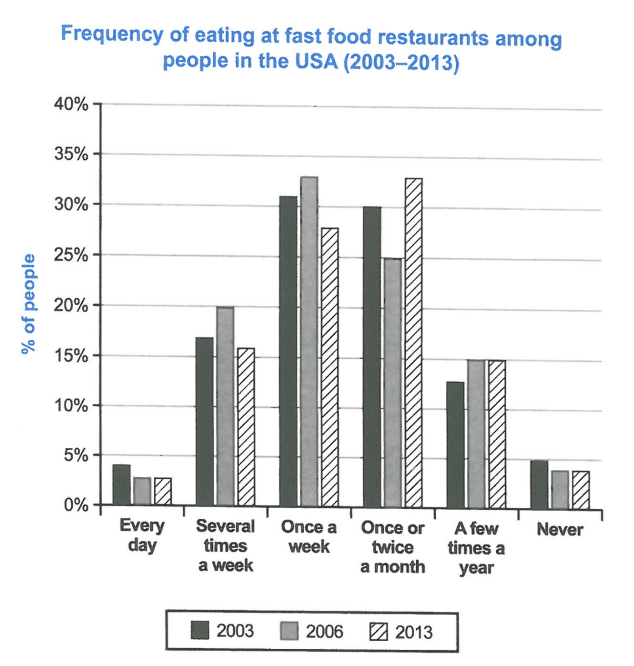
The chart below shows how frequently people in the USA ate in fast food restaurants between 2003 and 2013.
Summarise the information by selecting and reporting the main features, and make comparisons where relevant.
Student answer (Band 5.0)
The bar chart gives the information five different activities people ate in the USA fast food restaurants from 2003 to 2013.
Overall, it is clear that once a week and once or twice a month had the highest among the diffrent catagories in the USA. While, Never and Every day were same experrience teh lowest entire the fram.
In generally, once a week and once a twice or month was highest. in 2003 once a week stood at just above 30% of people and in 2006 and also in 2006 once a week was 33% people of eating at fast food restaurants in USA between 2003 and 2013. Furthermore, in 2013 once awee and twice a month registered from 33% to 27%. However, in 2006 twice a month was 26%. in 2003 had 30% of eating at fast food restraunts people in the USA . In contrast, A few times a year were similar from 2006 to 2013.Moreover, Never and Everyday were similar frequency of fast food in the USA between 2003 and 2013.
AI examiner evaluation
| Criterion | Band |
|---|---|
| Task Achievement / Task Response | 5.5 |
| Coherence and Cohesion | 4.5 |
| Lexical Resource | 5.0 |
| Grammatical Range and Accuracy | 5.0 |
| Overall | 5.0 |
Task Achievement / Task Response: Band 5.5
You identify the main pattern that weekly and monthly visits were the most common, while daily visits and never eating fast food were among the least common. You also include several relevant figures, such as 31% for weekly visits in 2003 and 33% in 2006. However, the overview is unclear and some comparisons are inaccurate: weekly visits fell to 28% in 2013, not 27%, while monthly visits rose to 33%; the sentence saying “from 33% to 27%” confuses these categories. The claim that “Never and Every day were same” is also too broad, as their values differ slightly in 2003. Covering the main changes more accurately and clearly would make the summary more complete.
Coherence and Cohesion: Band 4.5
The response has an opening, an overview, and a further paragraph, so there is an attempt to organise the information. However, the progression is difficult to follow because the overview is repeated in “In generally” and “once a week and once a twice or month was highest,” and several comparisons are presented in a confusing order. Connectors such as “Furthermore,” “However,” and “In contrast” do not always show a clear relationship between the figures. The sentence about “from 33% to 27%” is especially hard to interpret because it does not identify which category each figure describes. Group the data by the main trends and use linking words only when their relationship is clear.
Lexical Resource: Band 5.0
You use some task-relevant terms, including “registered,” “frequency,” and “categories,” and the reader can generally recognise that you are describing restaurant visits. However, the range is limited and several word choices or collocations make the meaning unclear, such as “five different activities people ate,” “highest among,” and “same experience.” There are also noticeable spelling errors, including “diffrent,” “catagories,” and “restraunts.” Use precise phrases for frequency and proportions, and check spelling carefully. For example, describe the categories as “frequency of visits” and say that a figure “accounted for” a percentage rather than that people “were” that percentage.
Grammatical Range and Accuracy: Band 5.0
You attempt both simple and more complex sentences, including a contrast beginning with “While” and a sentence introduced by “Furthermore.” However, many sentences contain errors in structure, agreement, or tense that make the comparisons difficult to understand. For example, “once a week and once a twice or month was highest” has an unclear construction and mismatched agreement, while “in 2003 had 30%” lacks a clear subject. The sentence beginning “While” is also incomplete as written. Practise forming complete sentences with a clear subject and verb, and check agreement and articles—for instance, “Once-a-week visits were the most common category.”
See this exact question answered at other band scores. The same prompt compared across bands.
Browse more IELTS Writing model answers or get your own writing scored by the same AI examiner.