Band 5.0 IELTS Writing Task 1 Model Answer
Overall Band Score: 5.0 · Cambridge IELTS 12 · 2026-11-20
IELTS Writing Task 1 question
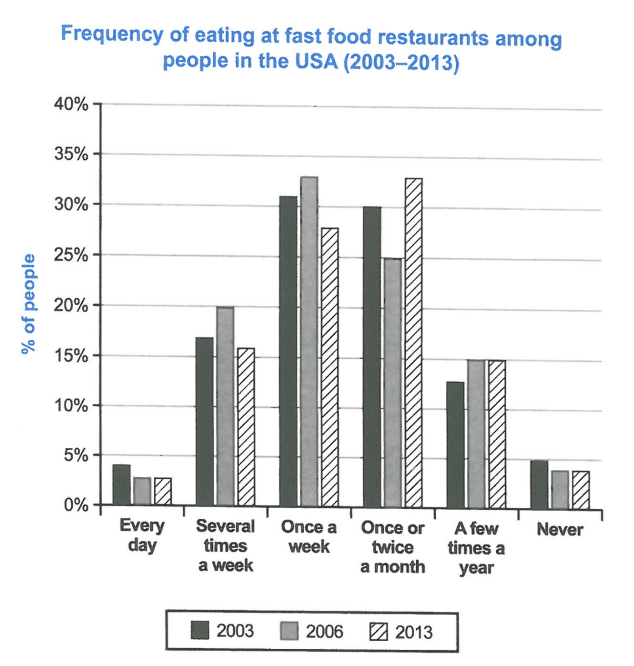
The chart below shows how frequently people in the USA ate in fast food restaurants between 2003 and 2013.
Summarise the information by selecting and reporting the main features, and make comparisons where relevant.
Student answer (Band 5.0)
The bar chart illustrates how often Amricans ate fast food from 2003 to 2013. The data is measured in percentages.
Overall, genrelly people who ate one a week showed the highest percentages over the given period. While, those who went every day were the lower figures .
In 2003, around one third of the total went to fast food restaurants once a week, followed up with approximatly the same amount going once or twice a month, people who went every day and who never been in fast food recorded the smallest propotions at below 5%.
In 2006, vistors of fast food once week peaked at around 35%, and those who never went or did daily vist declined.
In 2013, who went once or twice month were at their peak, making up above one third of the total. and the samllest number was for those who never been in fast food
AI examiner evaluation
| Criterion | Band |
|---|---|
| Task Achievement / Task Response | 5.0 |
| Coherence and Cohesion | 5.5 |
| Lexical Resource | 5.0 |
| Grammatical Range and Accuracy | 5.0 |
| Overall | 5.0 |
Task Achievement / Task Response: Band 5.0
You identify the chart’s subject and report several relevant comparisons, including the high figures for weekly visits and the rise in monthly visits by 2013. However, the overview is incomplete and partly inaccurate: daily visits were not consistently the lowest, since “never” was lower in 2006 and 2013. Some figures are also imprecise; for example, weekly visits peaked at about 33% in 2006, not around 35%. The response omits the important decline in weekly visits by 2013 and gives little account of the “several times a week” and “a few times a year” categories. A clearer overview of the main shifts, supported by accurate comparisons across all three years, would make the report more complete.
Coherence and Cohesion: Band 5.5
The response has a recognisable sequence: an introduction, an overview, and separate comments on 2003, 2006 and 2013. This gives the reader a basic framework for following the data. However, progression is limited because the body largely lists years rather than grouping related trends, and some links are awkward or inaccurate. “While” begins a fragment after the overview sentence, while “followed up with” does not clearly connect the comparison. The final sentence also starts with “and” after a full stop. Organise the body around contrasting patterns—for example, weekly versus monthly visits—and use clear linking phrases to show changes over time.
Lexical Resource: Band 5.0
You use some relevant task vocabulary, including “percentages,” “peaked,” “recorded,” and “making up,” so the topic is generally understandable. However, the range is limited and several spelling and word-choice errors are noticeable: “Amricans,” “genrelly,” “approximatly,” “vistors,” “propotions,” and “samllest.” Some expressions are also unnatural or unclear, such as “those who went every day were the lower figures” and “never been in fast food.” Prefer precise chart language such as “the proportion of people who ate fast food daily” and “the lowest percentage.” Proofread spelling and use consistent, natural terms for the frequency categories.
Grammatical Range and Accuracy: Band 5.0
You attempt both simple and more complex forms, including a contrast with “While” and time-based clauses beginning “In 2003” and “In 2006.” However, the range is limited, and errors in sentence construction and grammatical patterns are frequent enough to make some statements difficult to follow. “While, those who went every day were the lower figures” is an incomplete and awkwardly formed contrast, and “people who went every day and who never been” lacks the required verb form. The final sentence begins with a lowercase “and” after a full stop, and “who went once or twice month were at their peak” has an unclear subject and missing article. Build complete sentences and check verb forms, articles, and punctuation.
See this exact question answered at other band scores. The same prompt compared across bands.
Browse more IELTS Writing model answers or get your own writing scored by the same AI examiner.