Band 5.0 IELTS Writing Task 1 Model Answer
Overall Band Score: 5.0 · Cambridge IELTS 12 · 2026-11-20
IELTS Writing Task 1 question
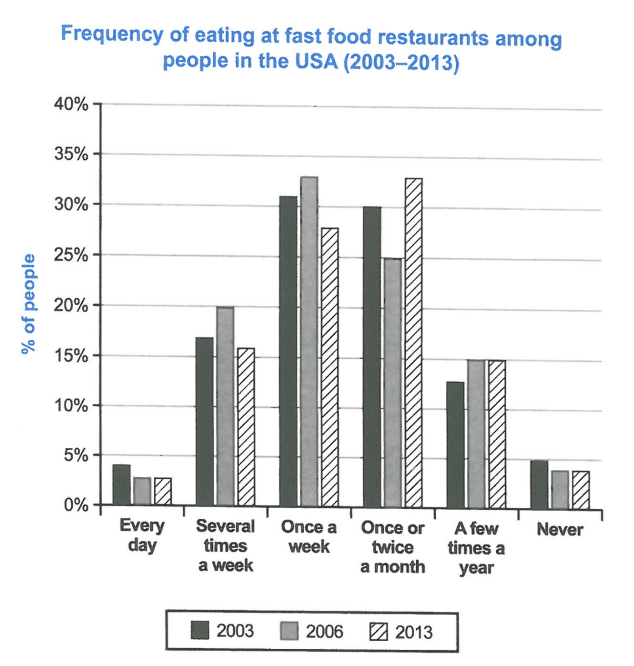
The chart below shows how frequently people in the USA ate in fast food restaurants between 2003 and 2013.
Summarise the information by selecting and reporting the main features, and make comparisons where relevant.
Student answer (Band 5.0)
The following bar chart illustrates the fast food eating habits in the USA and their significant increased sales in fast food restaurants from 2003 to 2013.
Firstly, we will discuss about the frequency of eating at fast food restaurants among people in the USA people who are eating once a week in the fast food restaruant had higher percentage such as in 2003 the percentage was approximately 31% and 2006 the figure increased to 33% and in 2013 it goes down to 27% approximately. Next, the chart shows the daily and never categories people which are going to several times a week are on 17% in 2003 and in 2006 the figure rose slightly to exactly 20% which was a good jump.
Overall, the figures of eating at fast food restaurants is increasing now a a days which is not good for our health especially for underage childrens they will easily effect by these kind of food.
AI examiner evaluation
| Criterion | Band |
|---|---|
| Task Achievement / Task Response | 4.5 |
| Coherence and Cohesion | 5.5 |
| Lexical Resource | 5.0 |
| Grammatical Range and Accuracy | 5.0 |
| Overall | 5.0 |
Task Achievement / Task Response: Band 4.5
You identify one important feature: eating once a week was among the most common frequencies, and you report its approximate figures for 2003 and 2006. However, the response only partially summarises the chart. The 2013 figure is given as about 27%, while the chart shows approximately 28%, and the key shift to eating once or twice a month becoming the most common category in 2013 is omitted. Several other categories are mentioned without reporting their figures or trends. The final claim that fast-food eating is generally increasing is not supported: the once-a-week share falls by 2013, and the chart records frequency, not sales or health effects. A clear overview of the main changes, supported by accurate comparisons, is needed.
Coherence and Cohesion: Band 5.5
There is some organisation: the response begins with an introduction, moves to selected chart details, and ends with an overall statement. Sequencing words such as “Firstly” and “Next” help signal movement between points. However, the progression is difficult to follow because the second detail combines unrelated categories in the phrase “the daily and never categories people which are going to several times a week.” The overview also shifts from chart description to an unsupported health opinion, so it does not effectively conclude the summary. Use separate paragraphs for an overview and the main comparisons, and connect each figure clearly to its category and year. More precise referencing would make the relationships between the data easier to understand.
Lexical Resource: Band 5.0
The response uses some relevant chart vocabulary, including “percentage,” “figure,” “frequency,” and “increased,” so the topic is generally recognisable. However, the range is limited and several choices are inaccurate or informal for an academic chart summary. “Significant increased sales” misrepresents the chart, which shows eating frequency rather than sales, while “a good jump” is conversational and imprecise. There are also noticeable spelling and word-form errors, such as “restaruant,” “childrens,” and “effect” where “affected” is intended. Aim for precise terms such as “proportion,” “rose,” “fell,” and “accounted for,” and use them to describe the data rather than add personal judgements.
Grammatical Range and Accuracy: Band 5.0
You attempt to combine ideas in longer sentences, for example by linking figures with “and,” but control is inconsistent and the range of sentence structures remains limited. Errors in agreement and sentence construction appear in “the figures … is increasing” and “people which are going to several times a week,” making parts of the meaning unclear. The opening phrase “we will discuss about” also uses an awkward grammatical pattern, and the final sentence contains problems with articles, plurals, and clause structure. Tense and comparison forms need closer control when describing past data. Build accurate simple sentences first, then add subordinate clauses where useful; check that each sentence has a clear subject and verb.
See this exact question answered at other band scores. The same prompt compared across bands.
Browse more IELTS Writing model answers or get your own writing scored by the same AI examiner.