Band 4.5 IELTS Writing Task 1 Model Answer
Overall Band Score: 4.5 · Cambridge IELTS 12 · 2026-11-20
IELTS Writing Task 1 question
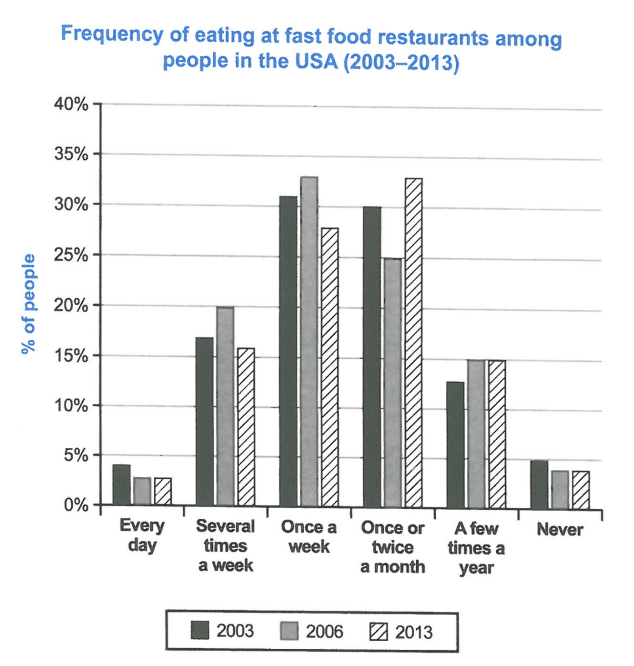
The chart below shows how frequently people in the USA ate in fast food restaurants between 2003 and 2013.
Summarise the information by selecting and reporting the main features, and make comparisons where relevant.
Student answer (Band 4.5)
The bar chart represent the how frequently of the people in the america ate in fast food on resturants between 2003 to 2013. Overall most of the people will be eating on the fast food on the resturants. Where all of the people will be eaten on the fast.
Im the frequency of the people whjo eaten everyday of the fast food is decreases trend on the 2003 to 2013. When the time most of the people will be lasy and now many people dwill be like to make own food and geting the healthy food in the life. Than the people will be on the decreases trend on the eating fast food.
Furthermore, Once or Twice of a month will be on increasing trend and it will be gone on the upward or downward. In 2003 it will be reach on 30% and after some years it will be on downwardss and reach on 25%. Then some of the years it will be on increases and reach on the around 33%.
AI examiner evaluation
| Criterion | Band |
|---|---|
| Task Achievement / Task Response | 4.0 |
| Coherence and Cohesion | 5.0 |
| Lexical Resource | 4.5 |
| Grammatical Range and Accuracy | 4.5 |
| Overall | 4.5 |
Task Achievement / Task Response: Band 4.0
The response identifies the chart’s subject and attempts an overview, but it reports the main features only minimally, which limits its coverage of the task. The statement that daily fast-food eating “decreases” is broadly supported, and the monthly category is correctly described as falling from 30% to 25% before rising to about 33%. However, the overview that “most of the people” ate fast food is too general and does not identify the key pattern: weekly eating was the most common frequency in 2003 and 2006, while monthly eating was highest in 2013. Several categories are omitted, and the explanation about people becoming “lazy” or choosing healthy food is not shown by the chart. Focus on accurate comparisons and avoid unsupported causes.
Coherence and Cohesion: Band 5.0
There is some organisation: the response begins with an introduction and overview, then uses separate paragraphs to discuss daily and monthly eating. Connectors such as “Overall” and “Furthermore” also signal the intended structure. However, progression is limited because the overview is unclear and the body covers only two of the six frequency categories. Some links are inaccurate or confusing, particularly “it will be gone on the upward or downward,” which does not clearly explain the sequence of change. Repeated use of “will” also makes the account sound less like a report of past chart data. Group the categories into clear comparisons and use straightforward links such as “by contrast” and “then” to show changes over time.
Lexical Resource: Band 4.5
The vocabulary is basic and repetitive, with frequent reliance on “people,” “fast food,” “trend,” and “reach.” Some chart-related language is attempted, including “increasing trend” and “decreases trend,” but these phrases are not used naturally or consistently. Spelling errors such as “resturants,” “lasy,” and “geting” also make the writing less clear. The phrase “eating on the fast food on the resturants” shows difficulty selecting natural collocations. Build a small set of accurate terms for describing proportions and movement, such as “accounted for,” “rose,” “fell,” and “remained stable,” and use them to report the chart rather than adding unsupported descriptions.
Grammatical Range and Accuracy: Band 4.5
The response attempts simple statements and some longer sentences, but grammatical errors are frequent and sometimes make the intended meaning difficult to follow. For example, “The bar chart represent” has subject–verb disagreement, while “Im the frequency of the people whjo eaten everyday” is not a complete, clear sentence. Past chart data is often described with “will be,” as in “it will be reach,” rather than an appropriate past tense. Articles, prepositions, and sentence boundaries are also unreliable, as in “on the fast food on the resturants.” Aim first for accurate, complete sentences in the past tense, then add longer comparisons using controlled clauses such as “while” or “whereas.”
See this exact question answered at other band scores. The same prompt compared across bands.
Browse more IELTS Writing model answers or get your own writing scored by the same AI examiner.