Band 4.0 IELTS Writing Task 1 Model Answer
Overall Band Score: 4.0 · Cambridge IELTS 12 · 2026-11-23
IELTS Writing Task 1 question
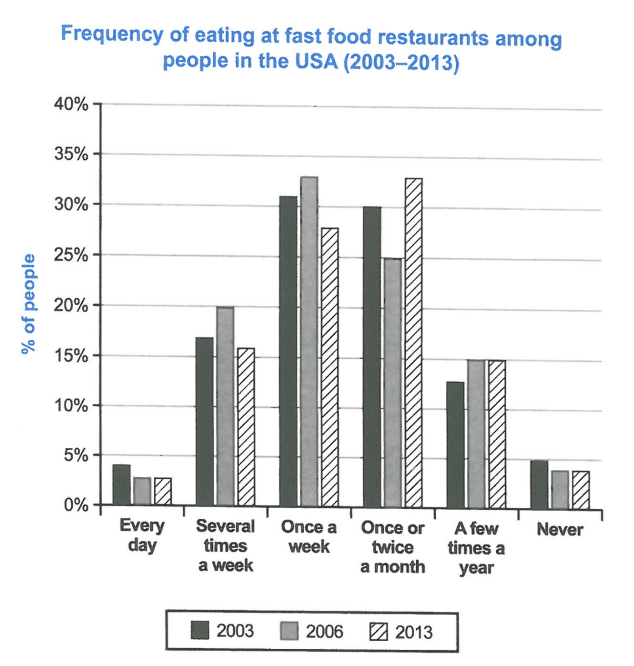
The chart below shows how frequently people in the USA ate in fast food restaurants between 2003 and 2013.
Summarise the information by selecting and reporting the main features, and make comparisons where relevant.
Student answer (Band 4.0)
The given chart illustrates the proportion of often people in the USA ate in fast food restaurants between 2003 and 2013.
To begin with, frequency of eating at fast food restaurants amoug people in USA were as follow, where in 2003, 4% of people consume fast food every day. along with, 17% of people were consume it several times a week . follwing that, 32% individual were once a week, 30%
AI examiner evaluation
| Criterion | Band |
|---|---|
| Task Achievement / Task Response | 3.0 |
| Coherence and Cohesion | 4.0 |
| Lexical Resource | 4.5 |
| Grammatical Range and Accuracy | 4.5 |
| Overall | 4.0 |
Task Achievement / Task Response: Band 3.0
The response begins to report relevant chart information, including the 2003 figures for daily eating and eating several times a week, and it identifies weekly eating as a prominent category. However, it stops partway through a sentence and does not provide a complete summary, an overview of the main trends, or comparisons across all three years. The stated 32% for eating once a week is close to the chart’s approximate 2003 value, but the following figure is left unfinished. The response contains only 58 words, so it does not meet the 150-word minimum; 13 words copied from the prompt were excluded from that count. To improve, complete the report and summarise the key shifts, such as monthly eating becoming the most common frequency in 2013.
Coherence and Cohesion: Band 4.0
There is a basic attempt to organise the response: an opening sentence introduces the chart, followed by a paragraph beginning “To begin with” that starts reporting figures. The sequence from daily eating to several times a week and then weekly eating is understandable. However, the response ends abruptly after “30%,” so there is no completed progression, concluding overview, or clear comparison between years. Linking phrases such as “along with” and “following that” do not clearly express the relationships between the data points. Use separate, purposeful paragraphs for an overview and the main details, and connect figures with precise comparisons such as “by contrast” or “whereas.”
Lexical Resource: Band 4.5
The response uses some task-relevant vocabulary, including “proportion,” “frequency,” and “fast food restaurants,” and it attempts to describe categories of frequency. However, the range is very limited in this short response, and several word choices or forms are inaccurate: “proportion of often people” is not a natural way to describe the chart, while “individual” is awkward for referring to the people represented. There are also spelling errors in “amoug” and “follwing.” These issues make the description less clear and precise. Prefer standard chart language such as “the percentage of people,” “participants,” and “ate once a week,” and check spelling before submitting.
Grammatical Range and Accuracy: Band 4.5
The response attempts both an introductory sentence and a longer reporting sentence, but grammatical control is inconsistent. For example, “people … were as follow” has an incorrect verb form and agreement, and “4% of people consume” shifts into the present tense despite describing past years. The phrase “17% of people were consume it” uses an incorrect verb construction, and “along with” is not integrated into a complete sentence. Capitalisation after the full stop in “every day” is also incorrect. The unfinished final clause prevents the reader from seeing a complete sentence. Practise past-tense reporting structures, for example, “In 2003, 4% of people ate fast food every day,” and proofread each sentence for a complete subject and verb.
See this exact question answered at other band scores. The same prompt compared across bands.
Browse more IELTS Writing model answers or get your own writing scored by the same AI examiner.