Band 5.5 IELTS Writing Task 1 Model Answer
Overall Band Score: 5.5 · Cambridge IELTS 12 · 2026-11-26
IELTS Writing Task 1 question
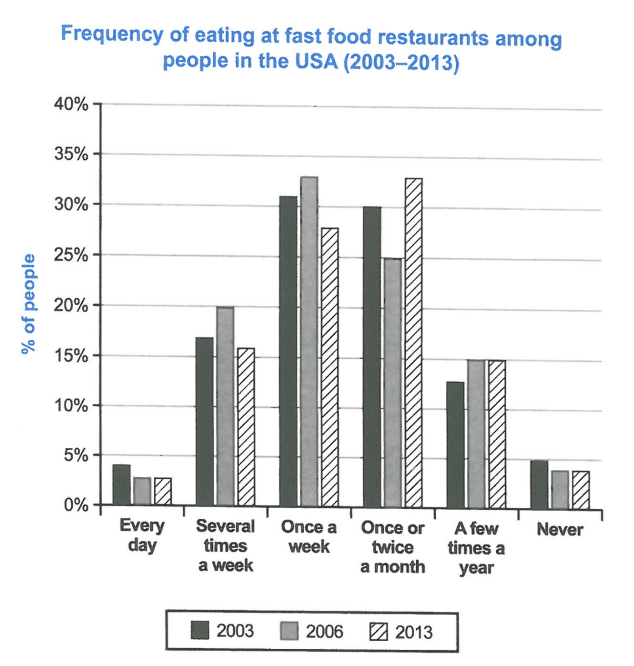
The chart below shows how frequently people in the USA ate in fast food restaurants between 2003 and 2013.
Summarise the information by selecting and reporting the main features, and make comparisons where relevant.
Student answer (Band 5.5)
The chart below compares the number of people in USA who ate in fast food restaurants between 2003 and 2013.
Overall, it can be seen that people in 2003 and 2006 mostly likes to ate fast once a week but people in 2013 likes to ate food once or twice.
Among these, if we talk about the interest of people in eating fast food in 2003 we came to see that people loves to ate once a week food roughly about 31% while, people who ate once or twice have slightly less percent about 30%. On the other hand, if we discuss about the civilians of 2006 we observe that mostly people loves to ate fast food once a week about 33% as same as the people of 2003. Morever, in 2006 individuals likely to ate 25% once or twice and so on.
Secondly, if we analyze the bars of people of 2013 we saw that peole have more interest to eat once or twice of about 33% while, on the other hand, people have less interest in eating food once a week but all people less agree to never eat fast food in decade.
AI examiner evaluation
| Criterion | Band |
|---|---|
| Task Achievement / Task Response | 5.5 |
| Coherence and Cohesion | 5.5 |
| Lexical Resource | 5.0 |
| Grammatical Range and Accuracy | 5.0 |
| Overall | 5.5 |
Task Achievement / Task Response: Band 5.5
You identify the chart’s subject and give a relevant overview: weekly eating was most common in 2003 and 2006, while monthly eating led in 2013. Several key figures are also reported accurately, including 31% and 30% in 2003, 33% and 25% in 2006, and 33% for monthly eating in 2013. However, the account is only partly developed: it omits the changes in less frequent categories and gives no clear comparison of the low daily and never figures. The final claim that “all people less agree to never eat fast food” is unclear and does not accurately describe the small, broadly stable percentages. Select a few more important trends and explain how they change across all three years.
Coherence and Cohesion: Band 5.5
The response has a basic structure, with an opening, an overview and separate discussion of the years, so the reader can identify the general topic and some comparisons. However, progression is uneven: the first body paragraph moves from 2003 to 2006, while “Secondly” introduces 2013 without a clear organising principle for the whole report. Linking phrases such as “Among these,” “On the other hand,” and “and so on” are either vague or do not clearly show the relationship between the data. Some ideas are repeated, particularly the preference for weekly or monthly eating. Group the figures by meaningful patterns—such as the most common frequency and the less common categories—and use precise references to connect comparisons.
Lexical Resource: Band 5.0
You use some task-related vocabulary, including “chart,” “percent,” “interest,” and “analyze,” and the reader can generally understand which eating frequencies you mean. However, the range is limited and several expressions are unnatural or imprecise, such as “likes to ate,” “once or twice,” and “all people less agree to never eat.” Repetition of “people,” “ate,” and “fast food” also makes the report less precise. There are spelling errors, including “Morever” and “peole,” and “civilians” is not an appropriate term for people represented in a survey. Use standard chart language and accurate category labels, such as “the proportion who ate out once or twice a month,” rather than vague paraphrases.
Grammatical Range and Accuracy: Band 5.0
You attempt both simple and longer sentences, including clauses introduced by “while” and “if,” but control is inconsistent. Errors occur frequently in verb forms and agreement: “people … mostly likes,” “likes to ate,” and “people loves” should use plural agreement and an appropriate verb form. The sentence beginning “Among these, if we talk…” is difficult to follow because its clause structure is not completed cleanly, and the final sentence has unclear grammatical relationships between its clauses. Punctuation around “while” is also awkward, with commas separating parts that should be joined more clearly. Practise accurate present-tense reporting and build comparisons in shorter, complete sentences before adding subordinate clauses.
See this exact question answered at other band scores. The same prompt compared across bands.
Browse more IELTS Writing model answers or get your own writing scored by the same AI examiner.