Band 4.5 IELTS Writing Task 1 Model Answer
Overall Band Score: 4.5 · Cambridge IELTS 12 · 2026-11-26
IELTS Writing Task 1 question
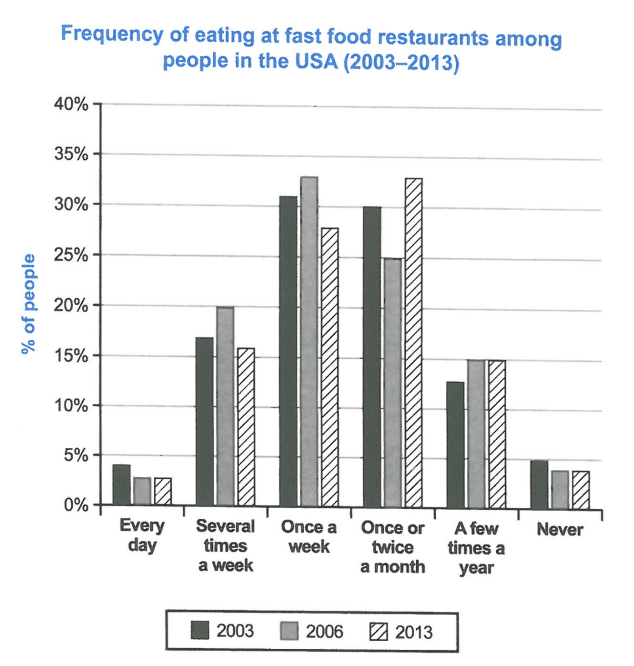
The chart below shows how frequently people in the USA ate in fast food restaurants between 2003 and 2013.
Summarise the information by selecting and reporting the main features, and make comparisons where relevant.
Student answer (Band 4.5)
The bar chart presents the precentage of usa people that frequently ate in fast food restaurents between 2003 and 2013.
Overall, in 2013 the percentage of people whom ate in restaurents once or twice a month had a noticable increase and overcomed both people from 2003 and 2008, moreover, in the same year people whom ate every day had a significant fall.
in 2003 and 2006, the precentage of people whom ate one a week and once ot twice a month where nearly constant at 30 percent, furthermore, the percentage of whom
AI examiner evaluation
| Criterion | Band |
|---|---|
| Task Achievement / Task Response | 4.0 |
| Coherence and Cohesion | 4.5 |
| Lexical Resource | 5.0 |
| Grammatical Range and Accuracy | 5.0 |
| Overall | 4.5 |
Task Achievement / Task Response: Band 4.0
You identify the chart’s subject and attempt an overview, noting that monthly eating became the most common pattern in 2013. However, the response covers the data only minimally and ends before completing its final comparison. The claim that monthly eating “overcomed both people from 2003 and 2008” is inaccurate: the chart compares 2003, 2006 and 2013, and the 2013 figure of 33% is higher than the 2003 and 2006 figures. You also say daily eating had a significant fall, although it changes only from 4% to 3%. The weekly and monthly figures are not all nearly constant. The response is 92 words, below the required 150. To improve, report the main patterns accurately and support the overview with key comparisons.
Coherence and Cohesion: Band 4.5
There is a basic attempt to organise the response: an opening sentence is followed by an overview and a further comparison. This gives the reader some sense of the intended structure. However, the final sentence breaks off at “the percentage of whom,” so the information is incomplete and progression cannot be followed. Linking words such as “moreover” and “furthermore” are used, but they do not create clear relationships between complete ideas; the latter introduces a point that is never finished. Capitalisation at the start of the third sentence is also inconsistent. Use separate, complete paragraphs for the introduction, overview and details, and connect comparisons explicitly—for example, contrast the weekly peak in 2006 with the monthly peak in 2013.
Lexical Resource: Band 5.0
The response uses some task-relevant vocabulary, including “percentage,” “bar chart,” “once or twice a month” and “every day,” so the topic is generally recognisable. However, the range is limited and several noticeable spelling and word-choice errors make the writing less clear, such as “precentage,” “restaurents” and “overcomed.” The phrase “people whom ate” is also an unsuitable choice for referring to people in this context, while “significant fall” overstates a small change. Aim for accurate, natural chart language and vary verbs such as “rose,” “fell,” “remained” and “accounted for.” Check spelling carefully and choose descriptions that match the size of the change.
Grammatical Range and Accuracy: Band 5.0
You attempt to combine ideas in longer sentences, using clauses and connectors such as “whom ate” and “moreover.” However, the range of sentence structures is limited, and the longer attempts are often faulty or incomplete. For example, “the percentage of people whom ate” has an incorrect relative pronoun, and “in 2003 and 2006 … where nearly constant” has an incorrect verb form. The final sentence is unfinished, and the opening of the overview begins with a lowercase letter. These errors sometimes make the intended comparisons difficult to follow. Practise writing complete, controlled sentences first, then add subordinate clauses; check subject–verb agreement, relative clauses, verb forms and sentence boundaries.
See this exact question answered at other band scores. The same prompt compared across bands.
Browse more IELTS Writing model answers or get your own writing scored by the same AI examiner.