Band 5.5 IELTS Writing Task 1 Model Answer
Overall Band Score: 5.5 · Cambridge IELTS 12 · 2026-11-06
IELTS Writing Task 1 question
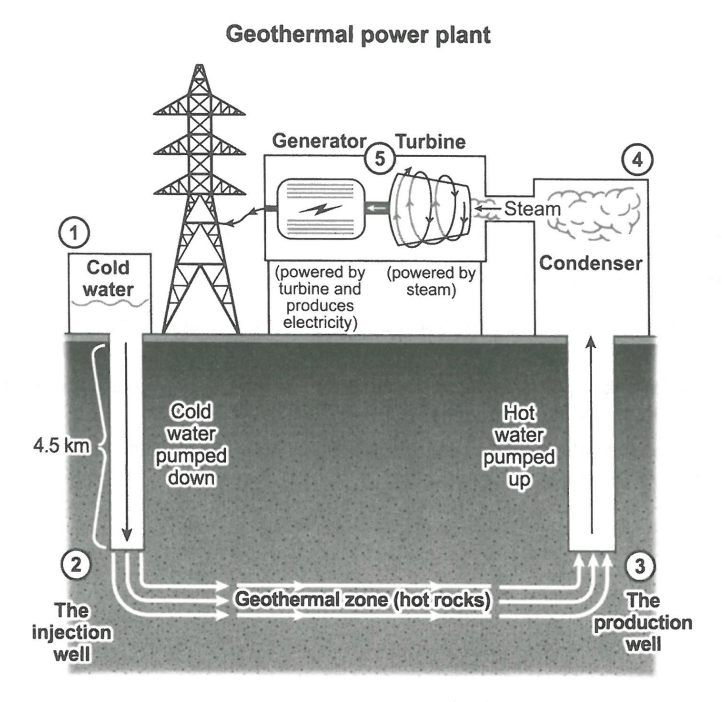
The diagram below shows how geothermal energy is used to produce electricity.
Summarise the information by selecting and reporting the main features, and make comparisons where relevant.
Student answer (Band 5.5)
The chart illustrates how geothermal energy is used to make electricity. The whole method will be discused in upcoming paeagraphs.
Overall, there are few steps that take place to produce electricity. First of all cold water is heated, when water becomes hot it turns into steam and steam then powers turbine which then makes electricity with the help of generator.
To begin with, to produce electricity, In first step cold water water is pumped down in ground to injection well. The distance between the dam that stores water and injection well is about 4.5km. Geothermal zone is placed underneath from which cold water passes and become hot.
On the other hand, production well pumps hot into condenser. In condender hot is heated to maximum temprature and turn into steam. Steam is then used to power turbine. Turbine runs generator which produces electricity. This electricity is sent to stations. These stations then give electricity to homes, factories and malls etc.
AI examiner evaluation
| Criterion | Band |
|---|---|
| Task Achievement / Task Response | 5.5 |
| Coherence and Cohesion | 5.5 |
| Lexical Resource | 5.0 |
| Grammatical Range and Accuracy | 5.0 |
| Overall | 5.5 |
Task Achievement / Task Response: Band 5.5
You identify the process and give a basic overview of its main sequence: water is pumped underground, heated by the geothermal zone, and ultimately used to generate electricity. The 4.5 km depth is also reported correctly. However, some details are inaccurate or unsupported: the diagram shows water being heated as it passes through hot rocks, not that it is heated in the condenser, and it does not show electricity being sent to stations or homes, factories and malls. The condenser is described as releasing steam. The overview is useful but general, and the stages are not always explained precisely. To strengthen the response, report only what the diagram shows and clarify the roles of the condenser, turbine and generator.
Coherence and Cohesion: Band 5.5
The response has a recognisable introduction, overview and description of the process, and the sequence from pumping water underground to generating electricity is broadly understandable. However, progression is weakened by mechanical transitions such as “To begin with” and “On the other hand”; the latter suggests a contrast, although the next stage simply continues the process. Some references are unclear, including “from which cold water passes,” and the final sentences move beyond the diagram to electricity distribution. The opening promise that the method will be discussed in “upcoming paragraphs” is also unnecessary. Use a clear chronological structure, connect each stage directly to the next, and keep the final paragraph focused on the process shown.
Lexical Resource: Band 5.0
You use relevant process vocabulary, including “injection well,” “production well,” “geothermal zone,” “condenser,” and “turbine,” which helps communicate the subject. However, the range of verbs and descriptions is limited, with repeated use of “water,” “hot,” and “produces.” Some word choices are inaccurate or imprecise: “dam” is not the storage tank shown, and “heated to maximum temperature” is not supported by the diagram. Spelling errors such as “discused,” “paeagraphs,” “condender,” and “temprature” are noticeable and reduce control. Aim for precise process language, such as “flows through,” “is converted into steam,” and “drives the generator,” and check spelling carefully.
Grammatical Range and Accuracy: Band 5.0
The response communicates the general sequence using both simple sentences and some longer structures, for example, “when water becomes hot it turns into steam.” However, attempts to combine stages often produce faulty or awkward sentences. In “First of all cold water is heated, when water becomes hot,” the comma joins two clauses incorrectly; “cold water water is pumped” repeats a noun, and “production well pumps hot into condenser” omits necessary words. There are also inconsistent capitalisation and punctuation, such as “In first step,” and missing articles in phrases like “powers turbine.” Use complete, clearly punctuated sentences and check articles, prepositions and verb forms when describing each stage.
See this exact question answered at other band scores. The same prompt compared across bands.
Browse more IELTS Writing model answers or get your own writing scored by the same AI examiner.