Band 5.5 IELTS Writing Task 1 Model Answer
Overall Band Score: 5.5 · Cambridge IELTS 12 · 2026-11-08
IELTS Writing Task 1 question
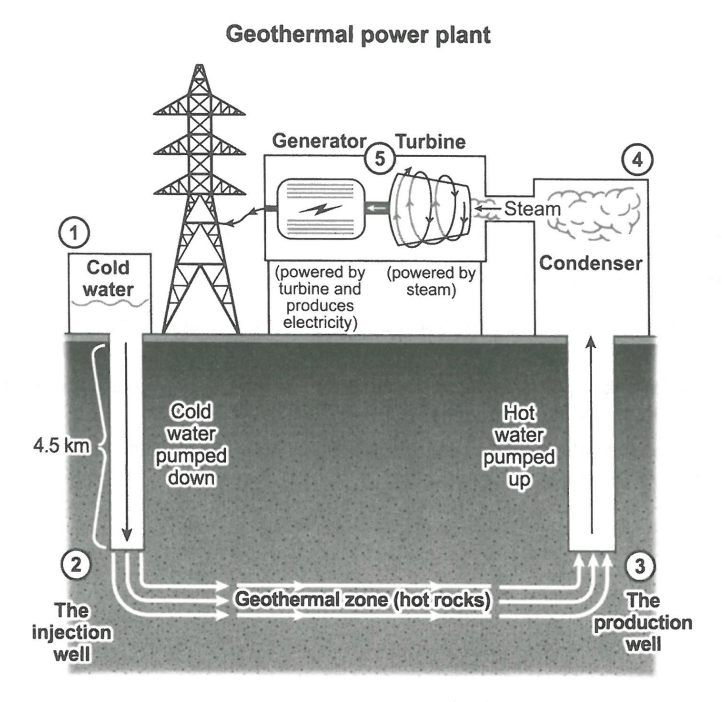
The diagram below shows how geothermal energy is used to produce electricity.
Summarise the information by selecting and reporting the main features, and make comparisons where relevant.
Student answer (Band 5.5)
These pictures illustrates how electricity is produced by using geothermal energy.
Overall, there are 5 stages in the process in which electricity is produced beginning with cold water and ending with electricity.
Initially , cold water is collected and then it pupmped down. Afterthat, cold water is pumped into injection well to a depth of 4.5km. Subsequently, cold water is passed through geothermal zone and here it absorbed heat .Additionally , hot water is is pumped up through the production well.
In the next stage there is a unit which is labelled as a condenser in which water is converted into a steam. In condenser steam is produced it is a power house for steam. With the help of steam pressure turbine rotates. When the turbine rotates it produces electricity in generator and when the electricity is produced in the generator then it passes the electricity to homes, electricity and other places through power lines.
AI examiner evaluation
| Criterion | Band |
|---|---|
| Task Achievement / Task Response | 6.0 |
| Coherence and Cohesion | 6.0 |
| Lexical Resource | 5.5 |
| Grammatical Range and Accuracy | 5.0 |
| Overall | 5.5 |
Task Achievement / Task Response: Band 6.0
The response covers the main sequence from cold water being sent underground to electricity generation, and it correctly includes the 4.5 km depth and the geothermal zone. The overview identifies the process’s beginning and end, which helps address the task. However, some stages are less clearly or accurately described: the opening says cold water is collected and pumped down before later explaining the injection well, while the condenser description is confusing (“it is a power house for steam”). The final claim that electricity is sent to homes and other places is not shown; the diagram only indicates transmission via power lines. To strengthen the report, describe each stage once, clarify how the condenser produces steam, and avoid adding outcomes not represented in the diagram.
Coherence and Cohesion: Band 6.0
The response follows the process in a broadly logical order, using markers such as “Initially,” “Subsequently,” and “In the next stage.” This gives the reader a clear sense of progression from water collection to electricity generation. However, cohesion is sometimes mechanical, and several transitions connect ideas that are repeated or unclear. For example, the injection well is introduced after the water has already been said to be pumped down, and the condenser section repeats that steam is produced before moving to the turbine. The final sentence is overloaded with repeated references to electricity, making the endpoint difficult to follow. Organising the stages into clearer paragraphs and using concise links between each stage would make the progression smoother.
Lexical Resource: Band 5.5
The response uses relevant process vocabulary, including “injection well,” “geothermal zone,” “production well,” “condenser,” “turbine,” and “generator.” These terms show an adequate range for describing the diagram. However, some word choices and collocations are inaccurate or unclear, particularly “it is a power house for steam” and “steam pressure turbine rotates.” There are also spelling and form errors, such as “pupmped,” which reduce precision. Repetition of “electricity” and “produced” limits flexibility, especially in the final sentence. Aim for precise process verbs and natural combinations, such as “the steam drives the turbine” and “the generator produces electricity,” while checking spelling carefully.
Grammatical Range and Accuracy: Band 5.0
The response attempts both simple and more complex sentences, including a sequence of clauses beginning “When the turbine rotates…” and “when the electricity is produced…”. However, control is inconsistent, and several errors make parts of the description awkward or difficult to follow. Examples include the subject–verb disagreement in “These pictures illustrates,” the missing auxiliary in “it pupmped down,” and the duplicated verb in “hot water is is pumped up.” The long final sentence also joins several clauses without clear punctuation or structure. Use a consistent present simple for process descriptions, check subject–verb agreement and auxiliary verbs, and divide long sentences so each stage is expressed clearly.
See this exact question answered at other band scores. The same prompt compared across bands.
Browse more IELTS Writing model answers or get your own writing scored by the same AI examiner.