Band 5.5 IELTS Writing Task 1 Model Answer
Overall Band Score: 5.5 · Cambridge IELTS 12 · 2026-11-09
IELTS Writing Task 1 question
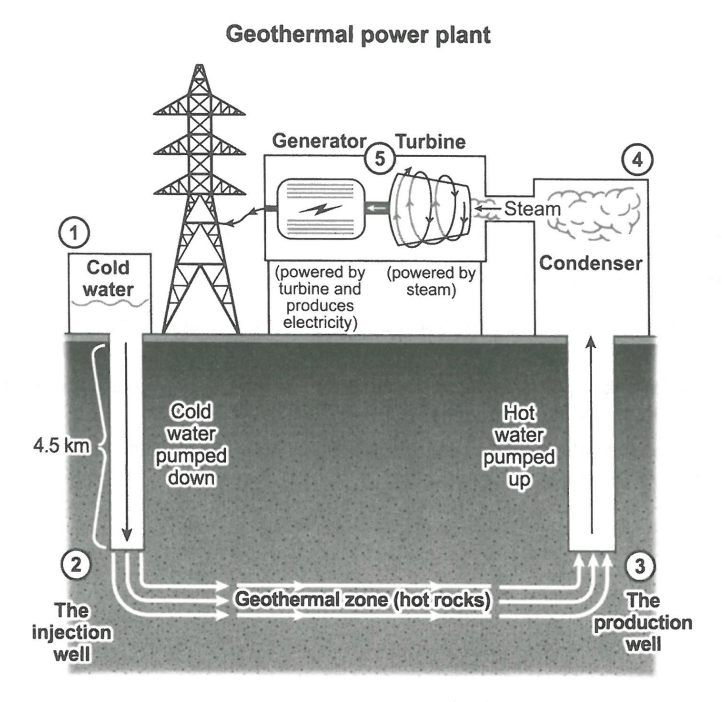
The diagram below shows how geothermal energy is used to produce electricity.
Summarise the information by selecting and reporting the main features, and make comparisons where relevant.
Student answer (Band 5.5)
The diagram depicts how electricity is produced from using geothermal energy.
Overall, the diagram show how cold water change into electricity using particular methods. It goes through a method in which cold water change into hot water and becomes steam, then go through from turbine and generator then ending up into electricity that we use for different things.The process go through from five different stages to become electricity.
As diagram shows that cold water pumped down into the well and passed from geothermal zone then reached into the producton well, where water became hot because of geothermal zone. Then that hot water go up into condenser and tranform into steam, next that steam enter into tubine. the turbine send that steam into generator that produce electricity for all of us. As we can see its a whole process to make electricity from geothermal energy. This process required alot of patience.
AI examiner evaluation
| Criterion | Band |
|---|---|
| Task Achievement / Task Response | 5.5 |
| Coherence and Cohesion | 5.5 |
| Lexical Resource | 5.0 |
| Grammatical Range and Accuracy | 5.0 |
| Overall | 5.5 |
Task Achievement / Task Response: Band 5.5
You identify the main transformation from cold water to steam and then electricity, and you mention the geothermal zone, both wells, the condenser, turbine and generator. This gives the reader a basic account of the process. However, the description is only partly complete and some details are unclear or inaccurate: the water is heated as it passes through hot rocks, then rises through the production well; the condenser is not described as the point where steam is released. The overview also says the process has five stages without clearly summarising the key underground heating and surface power-generation phases. The closing comment that it requires “alot of patience” is unsupported by the diagram. A more precise overview and accurate explanation of each stage would strengthen the response.
Coherence and Cohesion: Band 5.5
The response has a recognisable structure: an introduction, an overview and a paragraph describing the sequence. The stages are generally presented in the correct order, and words such as “then” and “next” help signal progression. However, the progression is not consistently clear because several ideas are crowded into long sentences, especially the overview, which runs together from “different things” into the stage count. The final paragraph repeats the general point that this is a process, rather than adding useful information. Some references are also difficult to follow, such as “that steam” being said to enter the turbine and then be sent into the generator. Use shorter, clearly punctuated sentences and organise the stages into a more direct sequence.
Lexical Resource: Band 5.0
You use relevant process vocabulary, including “geothermal zone,” “condenser,” “turbine” and “generator,” so the topic is identifiable. However, the range is limited and several words or phrases are repeated, particularly “cold water,” “hot water,” “steam” and “process.” Some choices are imprecise: “producton well” should be “production well,” and “the turbine send that steam into generator” does not accurately express the turbine’s role in driving the generator. There are also noticeable spelling errors such as “tranform,” “tubine” and “alot,” which reduce clarity and control. Build a more precise set of process verbs and check spelling; for example, distinguish water being pumped, heated, converted to steam and used to drive machinery.
Grammatical Range and Accuracy: Band 5.0
The response attempts both simple and longer sentence forms, including a sequence joined with “where” and “then.” However, grammatical errors are frequent and sometimes make relationships between stages difficult to understand. Subject–verb agreement is inconsistent in “the diagram show,” “water change,” and “the turbine send.” Verb forms are also faulty in “then go through” and “water became hot,” while articles are missing in phrases such as “into generator.” The overview contains a run-on sentence, and punctuation does not reliably separate complete ideas. Practise accurate present-simple descriptions of processes, checking that each subject has the correct verb form and that clauses are separated with full stops or appropriate conjunctions.
See this exact question answered at other band scores. The same prompt compared across bands.
Browse more IELTS Writing model answers or get your own writing scored by the same AI examiner.