Band 5.0 IELTS Writing Task 1 Model Answer
Overall Band Score: 5.0 · Cambridge IELTS 12 · 2026-11-10
IELTS Writing Task 1 question
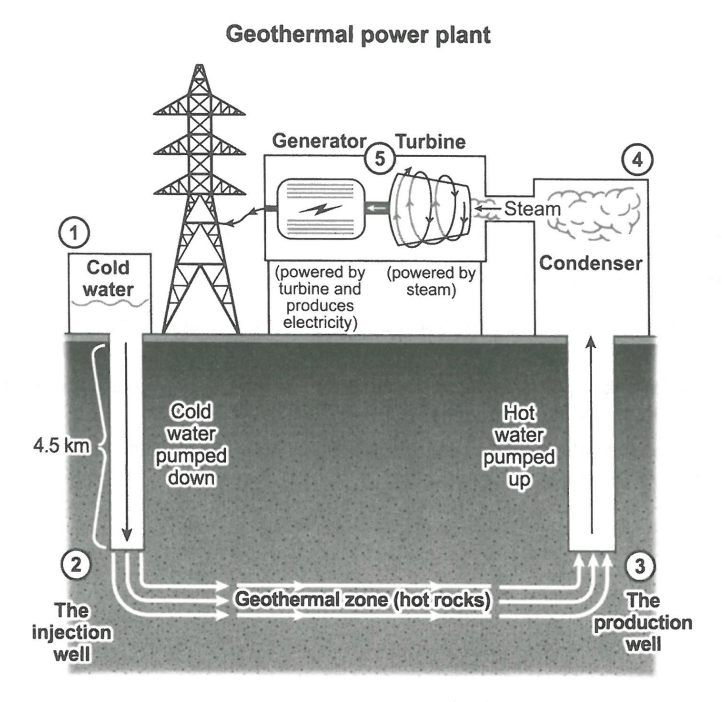
The diagram below shows how geothermal energy is used to produce electricity.
Summarise the information by selecting and reporting the main features, and make comparisons where relevant.
Student answer (Band 5.0)
The diagram represents and shows how geothermal energy is used to produce electricity.
First, the cold water is pumped deep down in the soil from around 4 to 5 km straight long hole which is called 'The injection well' from which the water is transfered into the geothermal zone where the hot rocks are present which turns the cold water into hot water. Next, the hot water is goes to the another straight long hole which is called 'the production well' from which the hot water is pumped up into the condenser. In that condenser, the hot water is gets vaporised, and the steam of the hot water gets into the turbine which helps the generator work to produce the electricity. The generator is directly connected to the tower of the electricity, which is connected through another towers by which the electricity travels and is reached where it is needed.
AI examiner evaluation
| Criterion | Band |
|---|---|
| Task Achievement / Task Response | 4.5 |
| Coherence and Cohesion | 5.5 |
| Lexical Resource | 5.5 |
| Grammatical Range and Accuracy | 5.0 |
| Overall | 5.0 |
Task Achievement / Task Response: Band 4.5
You identify the main sequence—from pumping cold water underground to using steam to drive a turbine and generator—and mention the 4–5 km depth, which is close to the diagram’s 4.5 km. However, the response is under the required minimum: it contains 141 words, so it is 9 words short. More importantly, the task is only partly covered: there is no clear overview of the process as a whole, and some details are imprecise. For example, the condenser is described as vaporising hot water, whereas the diagram shows steam emerging from it; the turbine is powered by that steam. The final reference to electricity travelling through “another towers” is also not clearly supported. Add a concise overview and report the stages accurately to develop the summary more fully.
Coherence and Cohesion: Band 5.5
The stages are presented in a generally understandable order, and “First” and “Next” help signal movement through the process. The reader can follow the water from the injection well to the production well and then to the machinery. However, the response is one paragraph, with no distinct overview or clear separation between the underground and electricity-generation stages. Several long sentences contain multiple steps, making the progression harder to follow; for instance, the sentence beginning “First” combines pumping, the well, the geothermal zone and heating. Some linking is also repetitive or awkward. Organise the response into an introduction and overview, followed by a clearly sequenced description, and use concise links such as “After this” or “Finally” where they clarify the stages.
Lexical Resource: Band 5.5
You use relevant process vocabulary, including “injection well,” “production well,” “geothermal zone,” “condenser,” “turbine” and “generator,” so the basic subject is clear. There is also some attempt to describe movement with phrases such as “pumped deep down” and “pumped up.” However, the range is limited and several choices are inaccurate or unnatural, including “straight long hole,” “tower of the electricity” and “the steam of the hot water.” “Transfered” is also misspelled. These expressions sometimes make the technical description less precise. Use standard process terms and natural collocations—for example, “well,” “electricity transmission pylon” and “steam”—and avoid repeating “hot water” when a more exact term is available.
Grammatical Range and Accuracy: Band 5.0
The response attempts to connect stages using longer sentences and relative clauses, which shows some range beyond simple statements. However, these structures are often faulty, and errors occur frequently enough to make parts of the description awkward. Examples include “the hot water is goes,” “the hot water is gets vaporised,” and “which turns the cold water,” where verb forms or the subject reference are incorrect. Articles and sentence construction also need attention in “goes to the another straight long hole.” The final sentence joins several ideas without clear grammatical control. Practise forming accurate passive structures for processes, such as “water is pumped” and “steam is produced,” and check subject–verb agreement and sentence boundaries before submitting.
See this exact question answered at other band scores. The same prompt compared across bands.
Browse more IELTS Writing model answers or get your own writing scored by the same AI examiner.