Band 6.5 IELTS Writing Task 1 Model Answer
Overall Band Score: 6.5 · Cambridge IELTS 12 · 2026-11-10
IELTS Writing Task 1 question
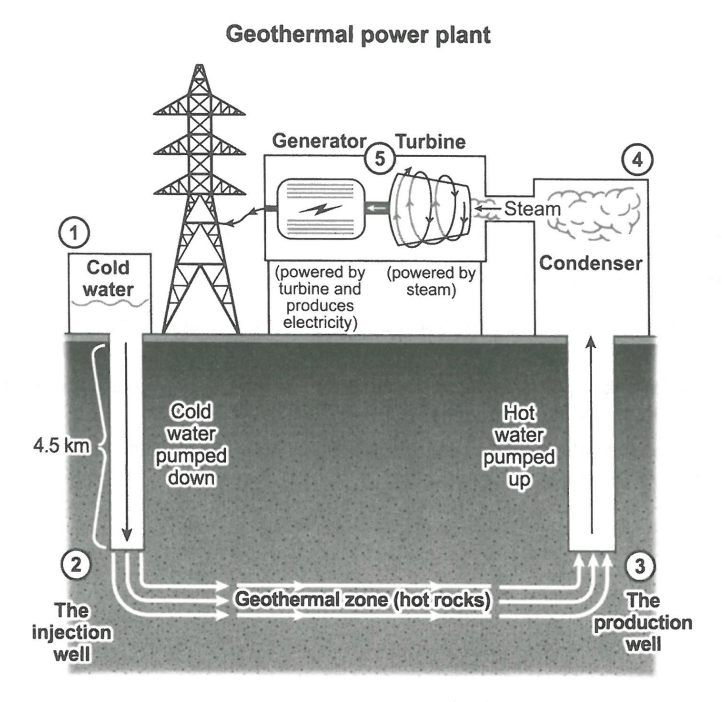
The diagram below shows how geothermal energy is used to produce electricity.
Summarise the information by selecting and reporting the main features, and make comparisons where relevant.
Student answer (Band 6.5)
The process chart illustrates how electricity is produced by using geothermal energy through several stages.
Overall, it is evident that the geothermal power plant is used to produce electricity and it consists of five different stages which starts with storing the cold water and ends with producing electricity.
Firstly, The cold water is stored into the container and pumped down into the earth, also travel upto 4.5 km towards the injection well. After that, it pass by the geothermal zone or hot rocks to heat the water naturally. Later, the hot water is pumped through the production well.
Moreover, the hot water is again stored above the ground level in the condenser. Therefore, it produces the steam, which is utilized to provide power to turbine for the rotation. Consequently, turbine gives power to the generator to produce electricity, then the end product of process has been supplied to the tower for futher commerical uses.
AI examiner evaluation
| Criterion | Band |
|---|---|
| Task Achievement / Task Response | 6.5 |
| Coherence and Cohesion | 7.0 |
| Lexical Resource | 6.0 |
| Grammatical Range and Accuracy | 5.5 |
| Overall | 6.5 |
Task Achievement / Task Response: Band 6.5
The response covers the main sequence from cold-water storage through underground heating to electricity generation, and the overview identifies the start and end points. It also correctly includes the 4.5 km depth and the roles of steam, turbine and generator. This gives a clear account of the process, though some details are less fully or precisely described: the water is not simply stored “above the ground level in the condenser”; rather, hot water enters the condenser, where steam is produced. The final reference to a “tower” for commercial use is not supported by the diagram, which shows a transmission pylon and power lines. To strengthen the summary, describe the key transformations and equipment more accurately and avoid adding an unsupported destination.
Coherence and Cohesion: Band 7.0
The information is arranged in a clear chronological order, moving from the initial water supply to the final electricity output. The paragraphing separates the overview from the process details, and transitions such as “Firstly,” “After that,” “Later,” and “Consequently” help the reader follow the stages. This is a logical progression, although the sequence markers are somewhat repetitive and occasionally make the account feel like a list. The link “Therefore” between the condenser and steam also suggests a result without clearly explaining the equipment’s role. Use a wider range of natural links and make each transition reflect the actual relationship between stages; for example, explain directly that the condenser produces steam, which then powers the turbine.
Lexical Resource: Band 6.0
The response uses an adequate range of process vocabulary, including “geothermal zone,” “production well,” “condenser,” “turbine,” and “generator.” These terms make the stages recognisable, and “pumped down” and “pumped through” are relevant descriptions. However, some choices are imprecise or unnatural: “process chart” is less suitable for a diagram, “stored above the ground level in the condenser” misrepresents the equipment, and “the end product … supplied to the tower” is unclear. There are also spelling errors in “futher” and “commerical.” Aim for precise technical descriptions and check spelling; for instance, describe electricity as being transmitted through power lines rather than supplied to a tower.
Grammatical Range and Accuracy: Band 5.5
The response attempts both simple and more complex sentences, including clauses with “which” and “to produce,” and the overall meaning remains understandable. However, some errors in agreement, verb forms, articles and sentence construction limit accuracy. For example, “five different stages which starts” should use a plural verb, while “it pass by” needs “passes” or a different construction. In “also travel upto 4.5 km,” the subject and verb relationship is unclear, and “the hot water is again stored” does not accurately express the process. Capitalisation after “Firstly” is also inconsistent. Review subject–verb agreement and ensure each clause has a clear subject and correctly formed verb; these changes would make the process easier to follow.
See this exact question answered at other band scores. The same prompt compared across bands.
Browse more IELTS Writing model answers or get your own writing scored by the same AI examiner.