Band 6.0 IELTS Writing Task 1 Model Answer
Overall Band Score: 6.0 · Cambridge IELTS 12 · 2026-11-11
IELTS Writing Task 1 question
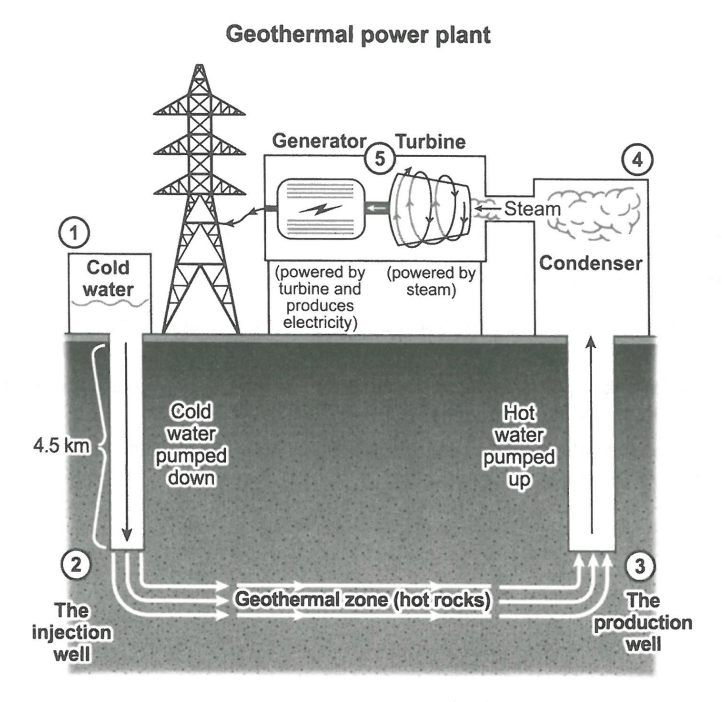
The diagram below shows how geothermal energy is used to produce electricity.
Summarise the information by selecting and reporting the main features, and make comparisons where relevant.
Student answer (Band 6.0)
The diagram illustrates a geothermanl power plant and the stages involved in electricity production.
Overall, the process begins with pumping cold water underground, which then pass through hot rocks and converted to steam that drives the turbine to generate electricity.
The initial stage involves heating water, firstly the cold water stored in container above the ground is pumped underground accurately 4.5 km below the surface. Through injection well it reaches geothermal zone.
Therefore, in geothermal zone (a region surronded by hot rocks) cold waters passes through this and at the end a production well is constructed, water reaches high temperatures then moves to condenser, it evaporates due to heat and changes it form similar to gas called stream.
Then this stream, powers the turbine by creating a rotational force.This momentum, which helps the generator to produce electricity by converting kinetic energy to electrical energy. Later it is stored or transfered using grids and towers.
AI examiner evaluation
| Criterion | Band |
|---|---|
| Task Achievement / Task Response | 6.5 |
| Coherence and Cohesion | 6.5 |
| Lexical Resource | 6.0 |
| Grammatical Range and Accuracy | 5.5 |
| Overall | 6.0 |
Task Achievement / Task Response: Band 6.5
You cover the main stages and provide a clear overview: cold water is pumped underground, heated by the hot rocks, returned to the surface, and used to drive a turbine and generator. The 4.5 km depth is also reported accurately. This gives the response a relevant, well-focused account of the process. Some details, however, are less precise or developed: the condenser is said to make the water evaporate “due to heat,” whereas the diagram shows steam being released there, and the final claim that electricity is “stored” is not supported by the visual. The overview could also state more directly that the generator produces electricity. More exact reporting of the condenser and final output would strengthen the coverage.
Coherence and Cohesion: Band 6.5
The response has a recognisable progression from an introduction and overview through the underground stages to electricity generation. Paragraphing helps separate the overview from the detailed sequence, and connectors such as “Overall,” “Therefore,” and “Then” guide the reader. However, some links are mechanical or unclear: “Therefore” does not express the relationship between the preceding and following stages, while “this” in “passes through this” has an imprecise reference. The final sentence also shifts to storage and transmission without a clear link to the diagram’s sequence. To improve, use stage markers consistently and make each sentence’s subject explicit, so the process advances smoothly from water movement to steam, turbine, and generator.
Lexical Resource: Band 6.0
You use a suitable range of process vocabulary, including “injection well,” “geothermal zone,” “production well,” “condenser,” and “turbine.” Terms such as “rotational force” and “kinetic energy” show an attempt to be precise, although the latter adds an explanation not needed to describe the diagram. Some word-choice and spelling errors reduce accuracy: “geothermanl,” “surronded,” “stream” for steam, and “transfered” are noticeable, while “container” is less precise than “tank.” “Changes it form” is also an awkward expression. The meaning remains generally clear, but careful proofreading and more natural process collocations would make the vocabulary more controlled and precise.
Grammatical Range and Accuracy: Band 5.5
There is some variety in sentence structure, including a relative clause in “This momentum, which helps the generator…” and a sequence of clauses describing the process. However, several grammatical errors remain, and some sentences are incomplete or awkwardly formed. In the overview, “which then pass” needs subject–verb agreement, and “and converted to steam” lacks a matching passive verb form. “Through injection well it reaches” needs an article and clearer sentence construction. The fragment beginning “This momentum, which helps…” lacks a main clause, while “cold waters passes” has agreement and number problems. Improve control by checking complete clauses, verb agreement, articles, and parallel verb forms, especially in longer sentences.
See this exact question answered at other band scores. The same prompt compared across bands.
Browse more IELTS Writing model answers or get your own writing scored by the same AI examiner.