Band 6.0 IELTS Writing Task 1 Model Answer
Overall Band Score: 6.0 · Cambridge IELTS 12 · 2026-11-11
IELTS Writing Task 1 question
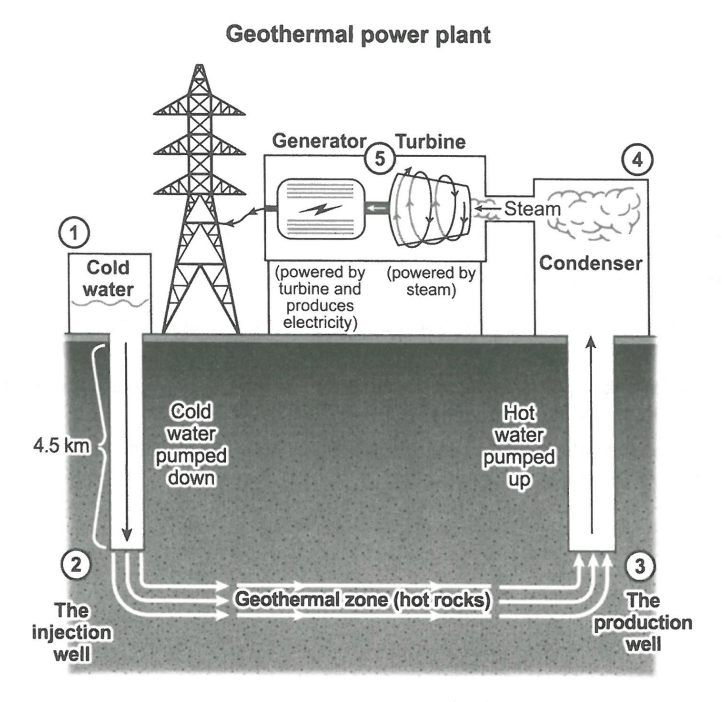
The diagram below shows how geothermal energy is used to produce electricity.
Summarise the information by selecting and reporting the main features, and make comparisons where relevant.
Student answer (Band 6.0)
The process illustrates how electricity is made in geothermal power plant.
Overall, the diagram consist of 5 stages from the storage of cold water till the production of electricity. The process also shows the movement of cold water beneath the surface and how it is pumped up than moved toward different stages to form electricity.
In first step, cold water is stored in a big tank after that this cold water in pumped down approximately 4.5 kilometer under the earth surface. In second step, low temperature water is injected into the injection well where geothermal zone (hot rocks) transform water into hot. In third step water is moved toward the production well and than again hot water is pumped upward.
In fouth stage, hot water moved toward condenser where it is transformed into steam. The steam goes forward in a turbine and start rotating after that the rotated steam moved toward the generator which is powered by turbine and produces electricity and finally electricity is given to the poles.
AI examiner evaluation
| Criterion | Band |
|---|---|
| Task Achievement / Task Response | 6.5 |
| Coherence and Cohesion | 6.5 |
| Lexical Resource | 6.0 |
| Grammatical Range and Accuracy | 5.5 |
| Overall | 6.0 |
Task Achievement / Task Response: Band 6.5
The response covers the main stages and gives a relevant overview, identifying the movement of cold water underground and the eventual production of electricity. It also includes the important 4.5-kilometre depth and correctly names the injection well, geothermal zone, production well, condenser, turbine and generator. This is a solid account of the process, but some details are unclear or imprecise: the geothermal zone heats the water, rather than simply “transform[ing] water into hot,” and the account does not clearly explain that steam powers the turbine, which in turn drives the generator. The final reference to electricity being sent to “the poles” is also less precise than describing transmission lines. More exact explanations of these relationships would make the coverage fuller.
Coherence and Cohesion: Band 6.5
The response has a clear overall sequence, moving from the water tank through the underground wells and then to the equipment that generates electricity. The opening overview helps orient the reader, and stage markers such as “In first step” and “In fouth stage” make the order easy to follow. However, the progression is sometimes mechanical, and several stages are crowded into long sentences joined by “after that” and “and than.” The division into paragraphs is helpful, but the middle stages could be separated and linked more naturally. Use a wider range of sequencing and cause-and-effect links, and make references such as “the rotated steam” clearer, to improve cohesion and precision.
Lexical Resource: Band 6.0
The response uses an adequate range of process vocabulary, including “injection well,” “geothermal zone,” “production well,” “condenser,” “turbine” and “generator.” These terms make the stages recognisable, and the writer attempts relevant technical language. Some word choices and collocations are inaccurate or imprecise, however: “transform water into hot” is not natural, “rotated steam” misdescribes what rotates, and “electricity is given to the poles” is vague. There are also spelling errors in “fouth” and “kilometer.” Aim for precise process verbs and standard collocations, such as saying that hot water is converted into steam and that steam drives the turbine. This would make the description more fluent and exact.
Grammatical Range and Accuracy: Band 5.5
The response attempts both simple and more extended sentence forms, and its meaning is generally understandable. However, some grammatical errors remain across the description. For example, “the diagram consist” needs subject–verb agreement, “in pumped down” has an incorrect verb form, and “In first step” needs an article. The sentence beginning “In first step” also joins several actions without clear punctuation, while “the rotated steam moved toward the generator” has an unclear grammatical relationship between the actions. Use accurate past or present passive forms consistently for the process, check articles and agreement, and break long sequences into controlled sentences. These improvements would strengthen accuracy while retaining the range of structures attempted.
See this exact question answered at other band scores. The same prompt compared across bands.
Browse more IELTS Writing model answers or get your own writing scored by the same AI examiner.