Band 5.5 IELTS Writing Task 1 Model Answer
Overall Band Score: 5.5 · Cambridge IELTS 12 · 2026-11-11
IELTS Writing Task 1 question
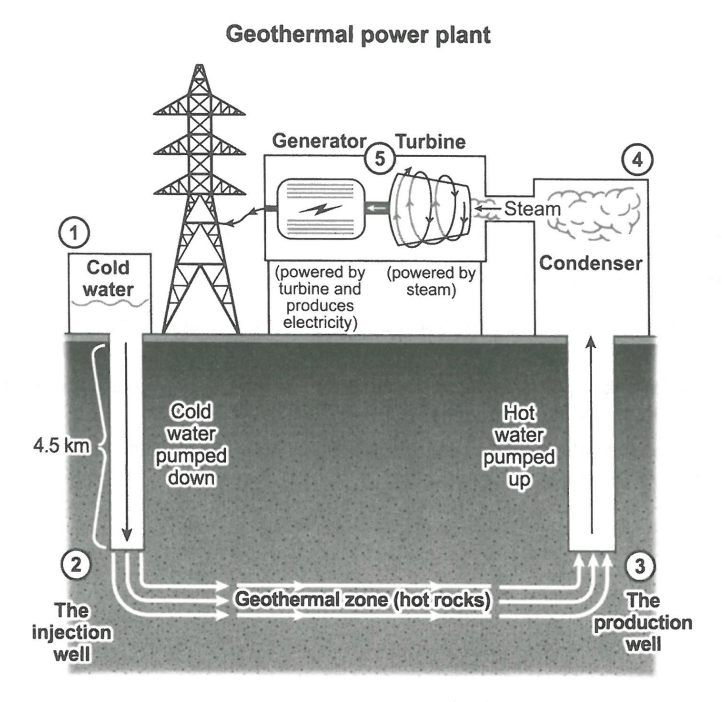
The diagram below shows how geothermal energy is used to produce electricity.
Summarise the information by selecting and reporting the main features, and make comparisons where relevant.
Student answer (Band 5.5)
The diagram illustrates how electricity is produced or how geothermal process takes place.
Overall, the process consists of five stages, beginning withe the cold water and ending with generator. It involves mechanical procedures like generator which use fuel to work.
Initially, the cold water is pumped down into the ground. Once this step has been completed. second step takes place wwhere the water from the injection well move towards geothermal zone (hot rocks). Following this, from the production well hot water is pumped up into the condenser, the resulting material steam is produced.
In the following stage, steam from condenser is moved into the turbine and then the turbine moved in circular motion that is powered by steam. Once this stage has been completed, the generator is powered up by the turbine and produces electricity. Once all this has been completed finally, electricity from the generator is transferred to the electric poles.
AI examiner evaluation
| Criterion | Band |
|---|---|
| Task Achievement / Task Response | 5.5 |
| Coherence and Cohesion | 6.0 |
| Lexical Resource | 5.5 |
| Grammatical Range and Accuracy | 5.5 |
| Overall | 5.5 |
Task Achievement / Task Response: Band 5.5
You identify the process as geothermal electricity production and describe its main sequence: water is pumped underground, heated in the geothermal zone, brought back up, and used to generate electricity. This gives the reader a relevant account of the diagram. However, the overview is not fully accurate: the process is described as five stages, while the diagram labels five numbered stages but also shows the subsequent steam, turbine and generator steps. The claim that the generator “use[s] fuel to work” is unsupported; it is driven by the turbine. Some details are also unclear, particularly how hot water becomes steam in the condenser. To strengthen the response, give a precise overview of the complete cycle and explain the conversion from cold water to hot water, then steam, and finally electricity.
Coherence and Cohesion: Band 6.0
The response follows the diagram’s general order, and sequencing expressions such as “Initially,” “Following this,” and “In the following stage” help the reader track the process. The opening overview also gives the response a basic structure. However, the progression is sometimes interrupted by unclear links: “Once this step has been completed. second step takes place” is incorrectly separated, and “Once all this has been completed finally” is repetitive. The paragraphing is limited, with the stages presented in one long body paragraph, and some references such as “this step” are not precise. Organise the account into clear stages or paragraphs, use transitions selectively, and connect each sentence directly to the preceding process step.
Lexical Resource: Band 5.5
You use relevant process vocabulary, including “injection well,” “geothermal zone,” “production well,” “condenser,” “turbine,” and “generator,” which helps identify the equipment accurately. There is also some attempt to vary wording, for example “pumped down” and “pumped up.” However, several choices are imprecise or unnatural: “mechanical procedures” does not describe the process clearly, “electric poles” is not the best term for the transmission structure, and “the resulting material steam” is awkward. Spelling slips such as “withe” and “wwhere” also reduce accuracy. Aim for precise process collocations and avoid adding vague wording; for example, describe steam as being produced and electricity as being transmitted through power lines.
Grammatical Range and Accuracy: Band 5.5
You attempt a mixture of simple and more complex sentences, including time clauses such as “Once this stage has been completed” and a relative clause in “the turbine … that is powered by steam.” The overall sequence remains understandable, but errors occur in sentence boundaries, verb forms, agreement, and articles. For example, “Once this step has been completed. second step takes place” contains a fragment and needs a capitalised, complete follow-up clause; “the water … move” should use a singular verb; and “the turbine moved” should be “the turbine moves” when describing a process. The sentence about the resulting steam is also structurally incomplete. Use consistent present simple for process descriptions, check subject–verb agreement, and punctuate each complete clause correctly.
See this exact question answered at other band scores. The same prompt compared across bands.
Browse more IELTS Writing model answers or get your own writing scored by the same AI examiner.