Band 6.0 IELTS Writing Task 1 Model Answer
Overall Band Score: 6.0 · Cambridge IELTS 12 · 2026-11-14
IELTS Writing Task 1 question
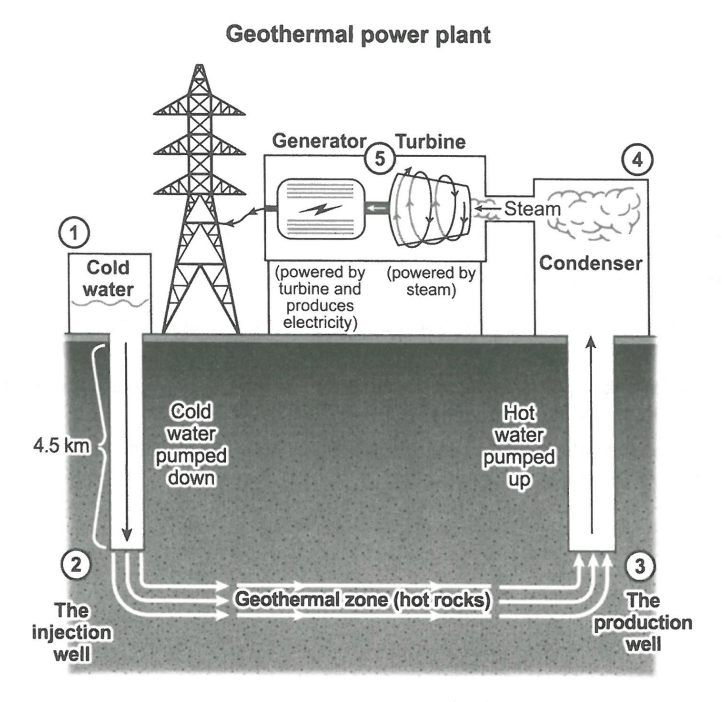
The diagram below shows how geothermal energy is used to produce electricity.
Summarise the information by selecting and reporting the main features, and make comparisons where relevant.
Student answer (Band 6.0)
The given illustration shows the various steps of electricity production by using geothermal energy.
Firstly,cold water is pumped at subterrenean level in an injection well ,located at the depth of approximately 4.5 km.From there the cold water is allowed to run over the hot rocks underneath the ground,absorbing heat energy. This zone is called the geothermal zone dur to the presence of hot rocks.
Secondly, the warm water reaches the production well ,located underground,where hot water is pushed upward into a condenser located at ground level. The hot water is converted into steam in the condenser and supplied to the rotating turbine.
Ultimately,the is a turbine connected to the condenser, at one end .The steam produced in the condenser helps move the turbine at a certain speed.The turbine,on the other hand is connected to a generator which is powered by the movement of turbine, the generator produces electricity.The electricity is supplied via the transformers for consumption.
AI examiner evaluation
| Criterion | Band |
|---|---|
| Task Achievement / Task Response | 6.0 |
| Coherence and Cohesion | 6.5 |
| Lexical Resource | 6.5 |
| Grammatical Range and Accuracy | 5.5 |
| Overall | 6.0 |
Task Achievement / Task Response: Band 6.0
The response covers the main sequence: cold water is sent down the injection well, heated by underground hot rocks, brought up through the production well, and used to generate electricity. The depth of about 4.5 km is also reported accurately. However, the overview is not clearly separated from the stage-by-stage account, and some details are less fully or precisely described. For example, the text says the water is “allowed to run over” the rocks, whereas it passes through the geothermal zone, and it does not clearly explain that steam powers the turbine, which in turn drives the generator. The final reference to “transformers” is not shown in the diagram; the electricity is conveyed by power lines. A concise overview and closer attention to the depicted connections would strengthen the report.
Coherence and Cohesion: Band 6.5
The stages are presented in a generally logical order, and sequencing signals such as “Firstly,” “Secondly,” and “Ultimately” help the reader follow the process. The response also moves from the underground stages to the equipment at ground level. However, the progression becomes less smooth in the final paragraph: “Ultimately, the is a turbine connected to the condenser” is unclear, and the turbine-generator relationship is then repeated in several sentences. Paragraphing is limited, and some links between stages are implicit rather than clearly expressed. To improve, group the description into a brief overview followed by the underground and surface stages, and use precise references such as “the resulting steam” and “this turbine” to avoid repetition and ambiguity.
Lexical Resource: Band 6.5
The response uses a suitable range of process vocabulary, including “injection well,” “production well,” “geothermal zone,” “condenser,” and “generator.” These terms show awareness of the diagram’s technical subject, and the meaning is generally clear. There are, however, some inaccurate or awkward choices: “subterrenean” is misspelled, “dur to” is also misspelled, and “warm water” is less precise than “heated water” in this context. “Run over the hot rocks” and “helps move the turbine at a certain speed” are understandable but not especially precise descriptions of the process. Aim for accurate spelling and natural collocations, and use the diagram’s terminology consistently rather than adding vague wording.
Grammatical Range and Accuracy: Band 5.5
There is some variety in sentence structure, including subordinate clauses such as “where hot water is pushed upward” and the contrastive phrase “on the other hand.” Most stages remain understandable, but some grammatical and punctuation errors reduce accuracy. For instance, “Firstly,cold water” lacks a space after the comma, while “Ultimately,the is a turbine” contains a faulty sentence structure. The sentence beginning “The turbine,on the other hand” also needs spacing and clearer punctuation, and “the generator produces electricity” is joined to the preceding clause with a comma rather than a full stop or conjunction. Review sentence boundaries, articles, and punctuation, and proofread for missing words so that the more complex sentences remain controlled.
See this exact question answered at other band scores. The same prompt compared across bands.
Browse more IELTS Writing model answers or get your own writing scored by the same AI examiner.