Band 6.0 IELTS Writing Task 1 Model Answer
Overall Band Score: 6.0 · Cambridge IELTS 12 · 2026-11-16
IELTS Writing Task 1 question
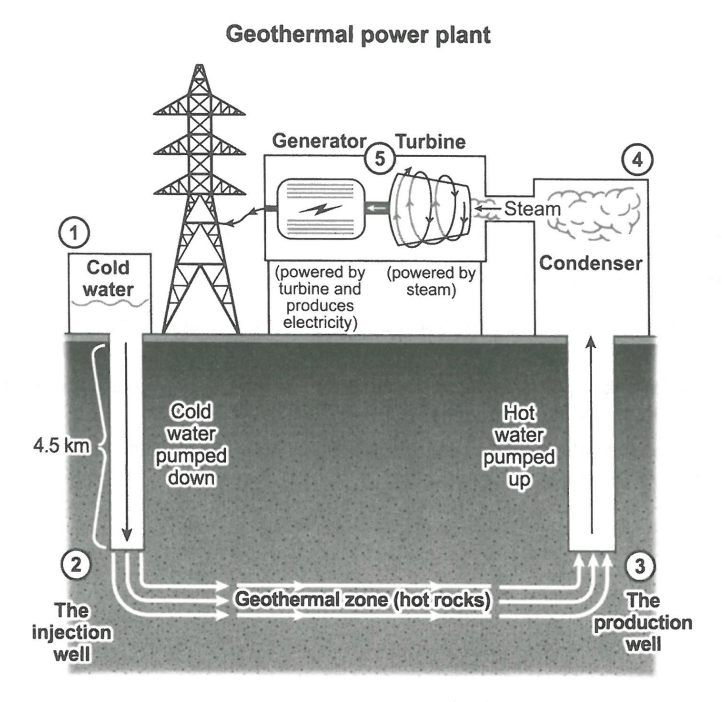
The diagram below shows how geothermal energy is used to produce electricity.
Summarise the information by selecting and reporting the main features, and make comparisons where relevant.
Student answer (Band 6.0)
The diagram illustrates electricity production by a geothermal power plant.
Overall, the diagram gives a step by step illustration of how water is eventually used to power a generator, producing electricity.
In first of the five steps, cold water is collected, and injected 4.5 km underground through the injection well, pushing it into a geothermal zone, consisting of hot rocks. The cold water passes through the rocks heating up until it reaches the production well as extremely hot water. This is a sustainable way to heat the water up without the use of electricity, using the earth's resources.
The hot water is pumped back up through the production well into a condenser,, where the condenser turns it into steam. A turbine is spun by the steam pushing at it, and that movement produces the energy required to power a generator, which then produces electricity. The electricity is sent to electric towers which help send it across the city.
AI examiner evaluation
| Criterion | Band |
|---|---|
| Task Achievement / Task Response | 6.5 |
| Coherence and Cohesion | 6.5 |
| Lexical Resource | 6.0 |
| Grammatical Range and Accuracy | 5.5 |
| Overall | 6.0 |
Task Achievement / Task Response: Band 6.5
The response covers the main sequence accurately: cold water is sent 4.5 km down the injection well, heated by hot rocks, returned through the production well, converted to steam, and used to drive a turbine and generator. The opening overview identifies the overall purpose, and the account includes the electricity transmission stage. Some details, however, are less precise or developed: the diagram shows water entering a condenser, which releases steam, rather than explicitly showing the condenser itself turning water into steam. The claim that the process heats water “without the use of electricity” and that electricity is sent “across the city” goes beyond the information shown. A more complete overview could also highlight the underground heating and the distinct roles of the two wells and the turbine-generator system.
Coherence and Cohesion: Band 6.5
The response is organised in a clear sequence, moving from an introduction and overview to the underground stages and then the surface equipment. Sequencing phrases such as “In first of the five steps” and “The hot water is pumped back up” help the reader follow the process. The paragraphing is also broadly appropriate. However, the overview repeats the general idea of the introduction rather than summarising the process’s key stages, and the final paragraph combines several actions in a long chain, making the relationship between steam, turbine, generator, and transmission less clear. The phrase “In first” is also an awkward transition. More precise stage links and clearer separation of the final steps would make progression smoother and cohesion less noticeable.
Lexical Resource: Band 6.0
Vocabulary is adequate for describing the process, with relevant terms such as “injection well,” “geothermal zone,” “condenser,” “turbine,” and “generator.” The writer also uses process language such as “pumped back up” and “heating up,” so the sequence is generally understandable. However, some choices are informal or imprecise for an academic process description: “pushing it into” and “spun by the steam pushing at it” could be expressed more precisely, while “electric towers” is less suitable than the standard term for the structure shown. “Extremely hot” is also an unnecessary intensifier. Aim for more exact technical collocations and avoid adding unsupported descriptions; this would provide greater flexibility and precision.
Grammatical Range and Accuracy: Band 5.5
The response uses a mix of simple and complex structures, including the relative clause “which then produces electricity” and the participial phrase “consisting of hot rocks.” Most meanings remain clear, but some grammatical and punctuation errors reduce accuracy. “In first of the five steps” is missing an article and uses an incorrect form; write “In the first of the five steps.” The sentence beginning “The cold water passes through the rocks heating up” has an unclear modifier, and the doubled comma in “condenser,, where” is a punctuation error. The long sentence about the turbine and generator also relies on repeated clauses joined by “and,” which weakens control. Review articles, modifier placement, and sentence boundaries while retaining the range of structures attempted.
See this exact question answered at other band scores. The same prompt compared across bands.
Browse more IELTS Writing model answers or get your own writing scored by the same AI examiner.