Band 6.5 IELTS Writing Task 1 Model Answer
Overall Band Score: 6.5 · Cambridge IELTS 12 · 2026-11-17
IELTS Writing Task 1 question
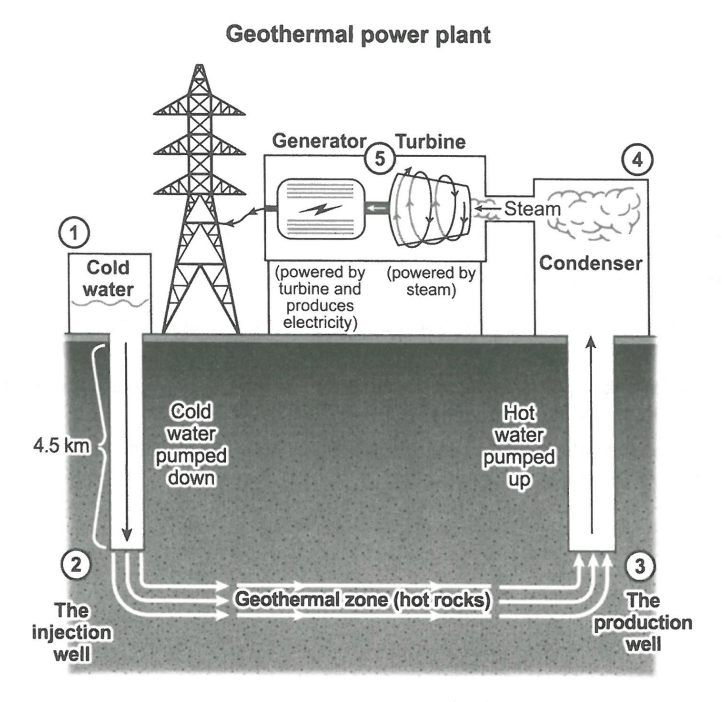
The diagram below shows how geothermal energy is used to produce electricity.
Summarise the information by selecting and reporting the main features, and make comparisons where relevant.
Student answer (Band 6.5)
The process diagram below illustratesa a five sages working principle of a geothermal powerplant to produce electricity.
Overall, cold water is pumped underground which boils due to high temprature of rocks underground. The hot water is then pumped up into a condenser, turns into steam which spins the turnbine connected to generator. Consequently, heat enegry is turned into electricity.
There are two wells (the injection well and the production well) dug into the ground at some distance from each other. Firstly, from the injection well the cold water is pumped down 4.5 Km underground into the geothermal zone. Cold water is injected at high pressure into cracks between the hot rocks in rapidly rising its temprature as a result. The cold water turns super hot after passing through high temprature zone which is collected into the producton well at the second end.
After the water is collected at the production well, sweltering water flash boils and turns into steam instantly. Super hot steam is collected inside a condenser,direcetd towards turbine from a narrow pipe and turns the turbine blades. Turbine blades are connected with an electric generator through a shaft. at the final stage the generator turns the rotational energy into electricity. In the final step electricity generated is carried out by wires towards the grid for further distribution.
AI examiner evaluation
| Criterion | Band |
|---|---|
| Task Achievement / Task Response | 7.0 |
| Coherence and Cohesion | 7.0 |
| Lexical Resource | 6.0 |
| Grammatical Range and Accuracy | 5.5 |
| Overall | 6.5 |
Task Achievement / Task Response: Band 7.0
The response gives a clear overview of the main transformation: water is pumped underground, heated by hot rocks, returned to the surface, and used to generate electricity. It also reports the 4.5 km depth and identifies both wells, the condenser, turbine and generator, so the key stages are covered. The sequence is generally accurate, and the final reference to electricity being carried towards the grid is supported by the diagram’s transmission lines. Some details, however, go beyond the visual evidence: high-pressure injection, water moving through cracks, instant flash boiling, a narrow pipe and a shaft are not shown. Keep the account closely tied to visible stages and avoid adding technical explanations that the diagram does not establish.
Coherence and Cohesion: Band 7.0
The response is organised into an introduction, a useful overview and two paragraphs describing the process in sequence. Time and sequence markers such as “Firstly,” “After the water is collected” and “at the final stage” help the reader follow the stages, while the overview gives the process a clear direction. The progression from underground heating to electricity generation is easy to understand. To make the organisation more controlled, avoid repeating the same stage information in both the overview and the detailed paragraphs, and use transitions that connect each stage without making the sequence sound like a list. The final paragraph also contains several successive actions; dividing or linking them more carefully would improve the flow.
Lexical Resource: Band 6.0
There is an adequate range of process vocabulary, including “injection well,” “geothermal zone,” “condenser,” “turbine” and “generator.” Phrases such as “pumped underground” and “turns into steam” communicate the main actions, and some less common choices, including “sweltering” and “rotational energy,” show an attempt to vary expression. However, several choices are imprecise or overly dramatic for a neutral process description: “sweltering water,” “flash boils” and “super hot” are less suitable than standard technical wording. Spelling errors such as “temprature,” “turnbine” and “direcetd” also reduce accuracy. Prefer precise, conventional terms and check spelling carefully, especially for key process vocabulary.
Grammatical Range and Accuracy: Band 5.5
The response attempts a mix of simple and complex structures, including the overview sentence beginning “Overall” and the clause “which is collected into the production well.” The sequence remains understandable, but grammatical control is uneven. For example, “cold water is injected … in rapidly rising its temperature” has a faulty construction, and “The cold water turns super hot … which is collected” creates an unclear reference. There are also errors in sentence boundaries and punctuation, such as the lowercase “at the final stage” after a full stop and missing spaces after commas. Some sentences are long and combine several actions, making their structure harder to control. Use clearer clause patterns and proofread sentence boundaries, articles and verb forms.
See this exact question answered at other band scores. The same prompt compared across bands.
Browse more IELTS Writing model answers or get your own writing scored by the same AI examiner.