Band 6.0 IELTS Writing Task 1 Model Answer
Overall Band Score: 6.0 · Cambridge IELTS 12 · 2026-11-17
IELTS Writing Task 1 question
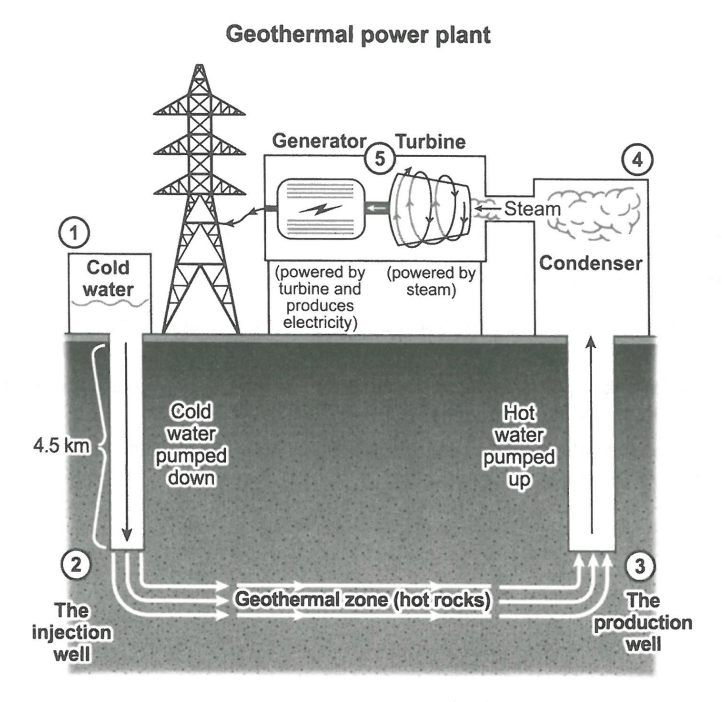
The diagram below shows how geothermal energy is used to produce electricity.
Summarise the information by selecting and reporting the main features, and make comparisons where relevant.
Student answer (Band 6.0)
The diagram presents the process of using geothermal energy to generate electricity.
Overall, the process of producing electricity has five stages, beginning with digging a hole for cold water to pump down and ends with the generator supplying power to the transmission lines.
The process begins with digging a 4.5km long ditch for cold water to be pumped down the soil, in the meantime cold water get through the injection well towards the the geothermal zone also known as hot rocks and in a middly way, it reaches to the production well, where a hot water pump is installed and it throws the hot water towards the condener.
During the fourth stage, stream is produced in huge quantity inside the condenser, during the period a narrow path inside the top left of the condensor transfer the steam to the turbine as a result turbine starts to rotate and transfer power to the generator to produce electricity, which is then transfer to the transmission lines.
AI examiner evaluation
| Criterion | Band |
|---|---|
| Task Achievement / Task Response | 6.5 |
| Coherence and Cohesion | 6.5 |
| Lexical Resource | 5.5 |
| Grammatical Range and Accuracy | 5.5 |
| Overall | 6.0 |
Task Achievement / Task Response: Band 6.5
You identify the diagram as a process and give a clear overall account, including the underground water route and the final production of electricity. The main stages are mostly represented, and the 4.5 km depth is reported accurately. However, some details are unclear or not fully grounded in the diagram: it shows water being pumped down and then heated as it passes through hot rocks, rather than a hole being dug specifically “for cold water”; it does not show a hot-water pump installed at the production well, nor does it quantify steam as being produced “in huge quantity.” The overview also says there are five stages without clearly distinguishing the later conversion steps. A more precise account of the heating, steam, turbine and generator would strengthen coverage.
Coherence and Cohesion: Band 6.5
The response has a recognisable structure: an introduction, an overview and two paragraphs describing the process. Its sequence is generally understandable, moving from the wells to the condenser and then to electricity transmission. This gives the account a coherent overall arrangement. However, the long sentences in the body make several stages difficult to follow, particularly the sentence beginning “The process begins with digging…” and the final paragraph. Linking phrases such as “in the meantime,” “during the period” and “as a result” are not always used to express the relationships clearly, and “the fourth stage” is introduced without a consistently clear stage-by-stage framework. Use shorter sentences and explicit sequencing such as “Next,” “After this” and “Finally” to make progression smoother.
Lexical Resource: Band 5.5
You use relevant process vocabulary, including “geothermal zone,” “injection well,” “production well,” “condenser,” “turbine” and “transmission lines,” which helps identify the main components. There are also attempts at more descriptive wording, but several choices are inaccurate or unnatural for a technical process: “ditch” is not the right term for a deep well, “throws the hot water” is imprecise, and “narrow path” does not clearly describe a pipe. Spelling errors such as “condener,” “condensor” and “middly” also reduce precision. Prefer standard process terms and accurate collocations, for example, water is “pumped” through a well and steam “passes through a pipe” to the turbine. This would make the description clearer and more controlled.
Grammatical Range and Accuracy: Band 5.5
You attempt a mix of simple and complex sentences, including a clear overview and clauses explaining what happens after the water reaches the hot rocks. However, some errors in verb forms, agreement and sentence construction make parts of the process harder to read. For example, “cold water get through” needs subject–verb agreement, while “it reaches to the production well” has an unnecessary preposition. In “the generator supplying power,” the verb form does not fit smoothly with the sentence structure, and “which is then transfer” needs a past participle. Several sentences also run together through comma splices, especially the final paragraph. Break these into shorter sentences and check agreement and verb forms; this will preserve your range while improving accuracy.
See this exact question answered at other band scores. The same prompt compared across bands.
Browse more IELTS Writing model answers or get your own writing scored by the same AI examiner.