Band 6.0 IELTS Writing Task 1 Model Answer
Overall Band Score: 6.0 · Cambridge IELTS 12 · 2026-11-17
IELTS Writing Task 1 question
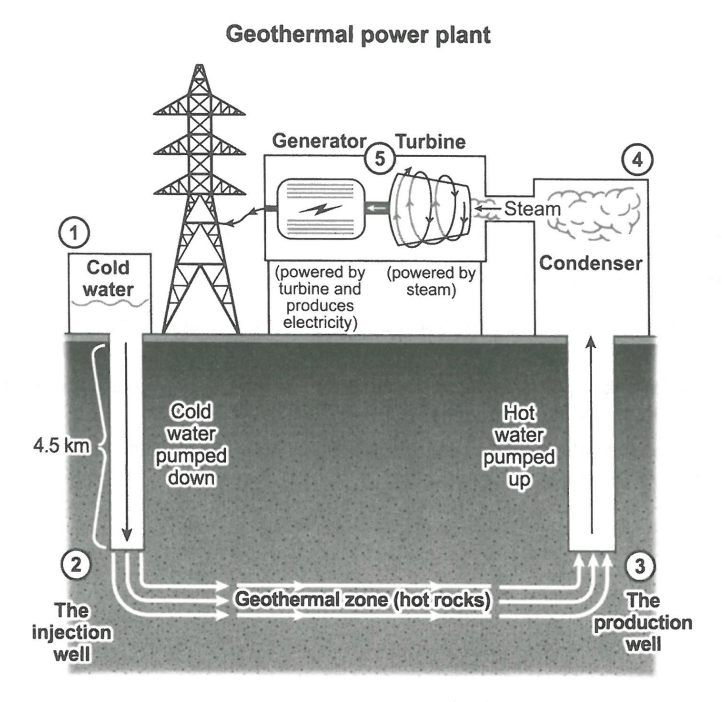
The diagram below shows how geothermal energy is used to produce electricity.
Summarise the information by selecting and reporting the main features, and make comparisons where relevant.
Student answer (Band 6.0)
The pictorial diagram illustrates how the electricity is generated using geothermal energy.
Overall, there are 5 major steps that involve pumping of cold water down in well to condensation of hot water and ultimately production of steam which is used to produce electricity. It is a linear process.
To commence with, in the veru begining of the process the cold water is pumped nearly 4.5 km down in the injection well. The area beneath 4.5 km from earth surface is called as geothermal zone. This zones have hot rocks which heat the cold water that was pumped down. The hot water was pumped upward from the production well toward the condenser.
After the water being pumped out from the well the hot water is passed through a condenser. As a result, steam is released from the hot water. This steam is used to rotate the turbine connected by a small passage. The turbine is connected to generator which produce electricity, as the turbine rotates. Eventually the electricity generated through generator is passed to power house.
AI examiner evaluation
| Criterion | Band |
|---|---|
| Task Achievement / Task Response | 6.5 |
| Coherence and Cohesion | 6.5 |
| Lexical Resource | 6.0 |
| Grammatical Range and Accuracy | 5.5 |
| Overall | 6.0 |
Task Achievement / Task Response: Band 6.5
The response covers the main sequence from pumping cold water underground to generating electricity, and the overview identifies a linear process. It also includes the key depth of about 4.5 km and explains that hot rocks heat the water. These details make the account relevant and generally accurate. However, the overview is not fully precise: condensation is described as involving “hot water,” whereas the diagram shows hot water reaching a condenser and steam then being released. The final destination is also called a “power house,” although the diagram shows transmission lines and a pylon. More precise reporting of the condenser’s role and the electricity’s transmission would make the main features more fully developed.
Coherence and Cohesion: Band 6.5
The response is arranged in a clear sequence: an introduction and overview are followed by the underground stages and then the conversion of steam into electricity. Sequencing phrases such as “To commence with,” “As a result,” and “Eventually” help the reader follow the process. This gives the account a coherent overall progression. Some linking is mechanical, however, and a few references are unclear; for example, “This zones” does not clearly agree with or refer smoothly to the geothermal zone. The transition from the production well to the condenser could also be expressed more directly. Using fewer formulaic transitions and clearer references between stages would make the cohesion more flexible and natural.
Lexical Resource: Band 6.0
The vocabulary is adequate for describing the process, with relevant terms such as “injection well,” “geothermal zone,” “production well,” “condenser,” and “turbine.” The writer also attempts process language, including “pumped upward” and “rotate.” Some word choices and collocations are inaccurate or imprecise: “condensation of hot water” does not clearly describe steam being released, and “small passage” is less suitable than a pipe or channel. Spelling slips such as “veru begining” and “generator” used where the plural is intended also reduce control. More precise technical phrasing and careful proofreading would improve clarity and range.
Grammatical Range and Accuracy: Band 5.5
There is a mix of simple and more complex sentence forms, including the relative clause “which heat the cold water” and the result clause “As a result, steam is released.” The sequence remains understandable despite some grammatical errors. These include agreement problems in “This zones have” and “the turbine is connected to generator which produce electricity,” as well as the awkward construction “After the water being pumped out.” Articles and tense choices are also inconsistent, as in “from earth surface” and “the hot water was pumped upward” within a general process description. More consistent present-tense forms, accurate subject–verb agreement, and complete verb patterns would strengthen accuracy.
See this exact question answered at other band scores. The same prompt compared across bands.
Browse more IELTS Writing model answers or get your own writing scored by the same AI examiner.