Band 5.5 IELTS Writing Task 1 Model Answer
Overall Band Score: 5.5 · Cambridge IELTS 12 · 2026-11-17
IELTS Writing Task 1 question
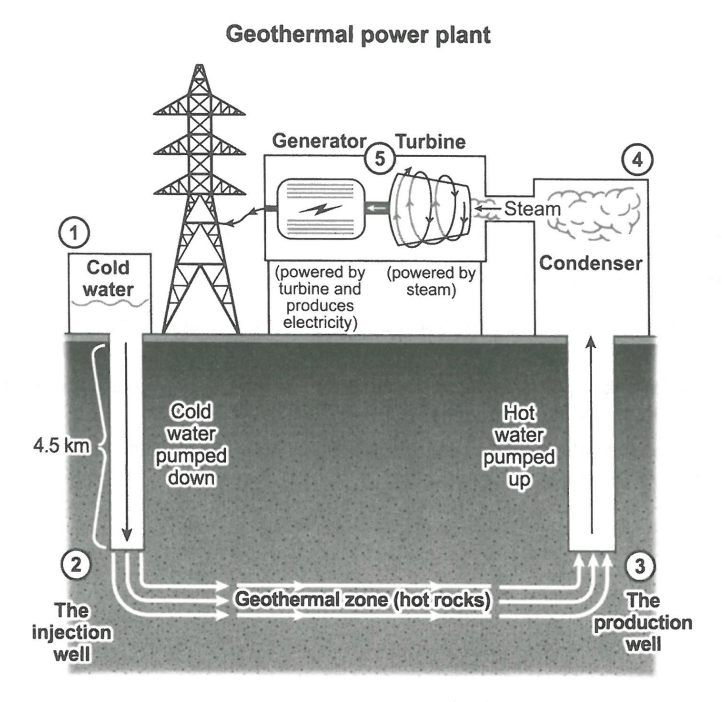
The diagram below shows how geothermal energy is used to produce electricity.
Summarise the information by selecting and reporting the main features, and make comparisons where relevant.
Student answer (Band 5.5)
The process diagram shows the process of producing electricity using geothermal energy.
Overall, the process consists of five stages, beginning with cold water pumping down to the well and ending with generating electricity.
Initially, cold water is pumped down inside the 4.5 km deep well. Then this water is injected to the hot rocks called geothermal zone. Following this the water is moved to the production well at next stage. Subseqently, hot water is pumped up in the next step inisde the condenser which results in converting hot water into steam.
After this stage, steam is moved to the turbine during which turbine starts moving anti clockwise powered by steam. Thus, in the same step generator poduces electricity powerd but turbine. Finally, produced electricity is passed to the electric town which can give power to electric appliances.
AI examiner evaluation
| Criterion | Band |
|---|---|
| Task Achievement / Task Response | 5.5 |
| Coherence and Cohesion | 6.0 |
| Lexical Resource | 5.5 |
| Grammatical Range and Accuracy | 5.5 |
| Overall | 5.5 |
Task Achievement / Task Response: Band 5.5
You identify the process and give a basic overview, correctly describing cold water being pumped underground and electricity being produced at the end. However, the account is incomplete and some details are unclear or inaccurate. The water is heated as it passes through the geothermal zone, then rises through the production well; it does not move “to the production well” as a separate stage. The condenser is described as converting hot water into steam, but its role and the sequence could be stated more precisely. The claim that the turbine moves “anti clockwise” is not supported by the diagram, and electricity is sent to a transmission pylon, not an “electric town.” The response is also below the required 150 words. Include the key stages more fully and avoid unsupported details.
Coherence and Cohesion: Band 6.0
The response has a recognisable overall sequence, with an introduction, an overview and a chronological description. Linking expressions such as “Initially,” “Then,” “Following this” and “Finally” help the reader follow the process. However, the progression becomes less clear in places: “Following this the water is moved to the production well at next stage” does not explain that it is heated underground before being pumped upward. The final sentence also introduces an unclear destination, “the electric town,” which disrupts the process description. Some transitions are mechanical, and “After this stage” and “Thus” do not always connect ideas smoothly. Group the underground stages together, then describe steam, the turbine and generator in a clear final sequence, using references that make each component’s role explicit.
Lexical Resource: Band 5.5
You use relevant process vocabulary, including “geothermal zone,” “production well,” “condenser,” “steam” and “turbine,” so the topic is generally clear. There is some useful variation in phrases such as “pumped down” and “pumped up.” However, several word choices and collocations are inaccurate or awkward: “electric town” does not describe the transmission pylon, “electricity powerd” is unclear, and “electric appliances” adds information not shown in the diagram. Spelling errors such as “Subseqently,” “inisde,” “poduces” and “powerd” also reduce control. Aim for precise, diagram-based terms such as “transmission pylon,” “generate electricity” and “steam drives the turbine,” and check spelling carefully before submitting.
Grammatical Range and Accuracy: Band 5.5
You attempt both simple and more complex sentences, including the overview clause “beginning with … and ending with …” and the sequence sentence beginning “After this stage.” The main stages can usually be understood, but some grammatical errors make relationships unclear. For example, “Then this water is injected to the hot rocks” has an incorrect preposition, while “the water is moved to the production well at next stage” has an awkward article and sentence pattern. In “the turbine starts moving … powered by steam,” the participle’s reference is unclear, and “generator … but turbine” does not form a complete grammatical relationship. Use clear passive forms for the water’s movement and a complete clause to explain that steam powers the turbine, which drives the generator. Proofread sentence boundaries and articles.
See this exact question answered at other band scores. The same prompt compared across bands.
Browse more IELTS Writing model answers or get your own writing scored by the same AI examiner.