Band 6.0 IELTS Writing Task 1 Model Answer
Overall Band Score: 6.0 · Cambridge IELTS 12 · 2026-11-18
IELTS Writing Task 1 question
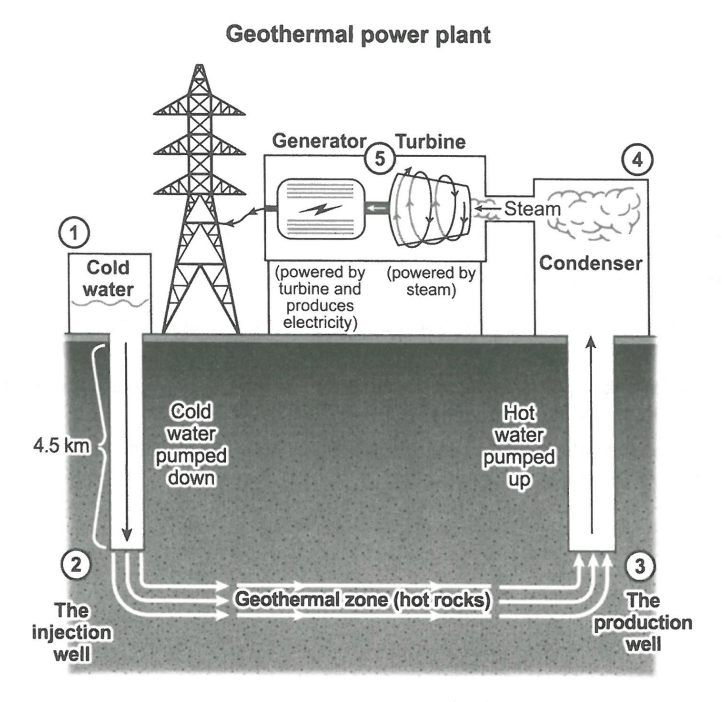
The diagram below shows how geothermal energy is used to produce electricity.
Summarise the information by selecting and reporting the main features, and make comparisons where relevant.
Student answer (Band 6.0)
The provided flow chart illustrates how electricity is produced by using geothermal energy.
Overall, electricity is produced mainly in 5 steps. Starting from cold water and ended on a generator which moves the tubine and forms electric current.
In the first step, cold water is stored before pumped down 4.5 km. In the second step, the water is stored in the injection well before water go through the geothermal zones(hot rocks) and colded water turned into hot water. In the third step, hot water which is stored in the production well moved upward quickly. In the fourth step, hot water is stayed in the condenser and water is transformed into gaseous state.
In the fifth step, the steam is entered into a turbine. Due to high pressure of steam, the turbine starting running. A powerfull generator is attached to the turbine when turnine started rotating, the generator generates the electricity. The electricity is then go to the transformer which is placed on the huge tower and electric current runs in wires.
AI examiner evaluation
| Criterion | Band |
|---|---|
| Task Achievement / Task Response | 6.0 |
| Coherence and Cohesion | 6.5 |
| Lexical Resource | 6.0 |
| Grammatical Range and Accuracy | 5.0 |
| Overall | 6.0 |
Task Achievement / Task Response: Band 6.0
The response covers the main sequence from cold-water injection through heating underground, steam production, and electricity generation, and the overview identifies the process as having five stages. The 4.5 km depth is reported accurately. However, some details are unclear or inaccurate: the water is not “stored in the injection well” or “stored in the production well”; it flows through these wells. The account also says the generator “moves the turbine,” whereas the steam drives the turbine and the turbine powers the generator. The final reference to a “transformer” is not supported by the diagram, which shows power lines leading to a transmission pylon. More precise descriptions of these stages would make the coverage more complete.
Coherence and Cohesion: Band 6.5
The response has a clear overall arrangement: an introduction and overview are followed by the process in sequence, with “In the first step” through “In the fifth step” helping the reader follow the stages. Paragraphing also separates the early underground process from the final electricity-generation stages. This logical progression is a strength. However, the repeated step-by-step framing can feel mechanical, and some links between actions are not fully clear, particularly in the second stage, where the movement from the injection well through the hot rocks is compressed into one sentence. The final sentence also shifts abruptly from generation to transmission. Use a wider range of linking expressions and make each stage’s relationship to the next explicit.
Lexical Resource: Band 6.0
The response uses an adequate range of process vocabulary, including “injection well,” “geothermal zone,” “condenser,” “steam,” and “turbine.” These terms are relevant and help convey the diagram’s technical sequence. There are also attempts at more specific description, such as “transformed into gaseous state.” However, several word choices or forms are inaccurate or unnatural: “colded” and “powerfull” are misspelled, “moves the turbine” does not express the intended relationship, and “electric current runs in wires” is awkward. “Transformer” is also an unsupported label for the pylon. Check spelling and collocation, and prefer precise process verbs such as “flows,” “is heated,” and “drives” to improve clarity.
Grammatical Range and Accuracy: Band 5.0
The response attempts both simple and more complex structures, including the relative clause in “hot water which is stored in the production well” and the time clause beginning “when.” The sequence is generally understandable, but some errors in verb forms, tense, agreement, and sentence construction remain. For example, “before pumped down” needs a passive form, “water go through” requires subject–verb agreement, and “the turbine starting running” should use a finite verb form. In “The electricity is then go to the transformer,” the auxiliary and main verb are incompatible. The sentence beginning “A powerfull generator is attached” also lacks clear punctuation between its clauses. Review passive constructions and ensure each clause has a correctly formed verb.
See this exact question answered at other band scores. The same prompt compared across bands.
Browse more IELTS Writing model answers or get your own writing scored by the same AI examiner.