Band 5.0 IELTS Writing Task 1 Model Answer
Overall Band Score: 5.0 · Cambridge IELTS 12 · 2026-11-19
IELTS Writing Task 1 question
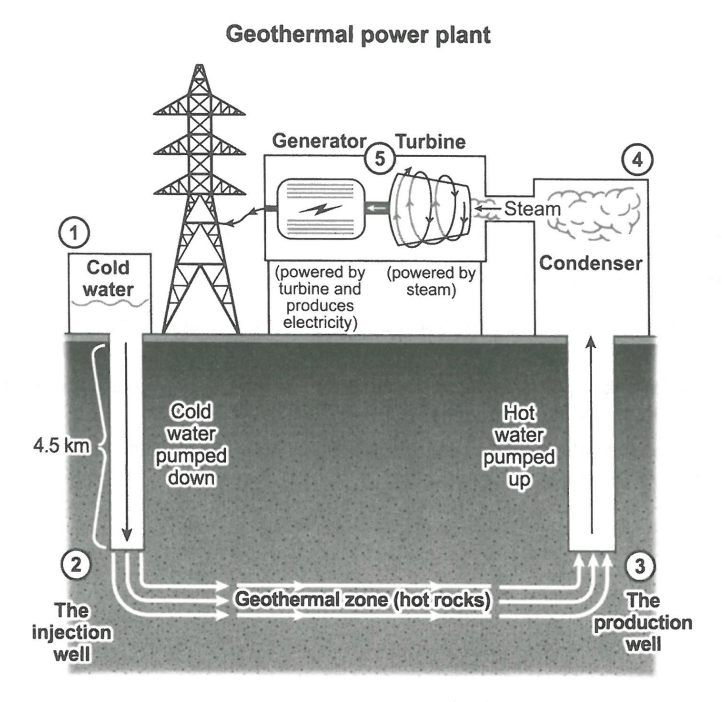
The diagram below shows how geothermal energy is used to produce electricity.
Summarise the information by selecting and reporting the main features, and make comparisons where relevant.
Student answer (Band 5.0)
The given diagram illustrates how Geothermal energy is used to produced electricity, thats we use in daily routine.
Overall, the given diagram illustrates how we produce electricity by cold water. All the process that we do to produce electricity.
The step1 we make a hole of 4.5km and then full it with cold water, the cold water pumped down. Step2 the injection well , and geothermal zone (hot rocks) . Then step3 ,we heat the cold water under earth. Step 4 condenser its means, steam the hot water. And after that, step 5 Turbine (powered by steam) and than Generator (powered by turbine and produces electricity). And than, electricity is ready for use and than we produce this electricity in the plants.
After that we use this electricity in our daily life in different tasks.
AI examiner evaluation
| Criterion | Band |
|---|---|
| Task Achievement / Task Response | 4.5 |
| Coherence and Cohesion | 5.0 |
| Lexical Resource | 5.0 |
| Grammatical Range and Accuracy | 4.5 |
| Overall | 5.0 |
Task Achievement / Task Response: Band 4.5
You identify the general subject and mention several relevant components, including the injection well, geothermal zone, condenser, turbine and generator. However, the account only partially explains the process and contains important inaccuracies: the 4.5 km measurement is the depth of the injection well, not a hole that is then filled, and the water is heated as it passes through hot rocks before rising through the production well. The overview is also vague (“All the process that we do”) rather than summarising the main transformation from cold water to electricity. The final comments about everyday use and producing electricity “in the plants” are not shown in the diagram. The response is also 15 words below the required minimum. Explain the stages accurately and focus on the diagram’s information.
Coherence and Cohesion: Band 5.0
There is a basic attempt to organise the response into an opening, an overview and a sequence of stages, and the reader can follow some of the process through “Step1,” “Step2” and “After that.” However, the progression is not consistently clear: the injection well is introduced after the first step, and the production well is omitted, making the movement of water difficult to trace. Several transitions, especially repeated “And than” and “After that,” are mechanical, while the overview repeats the introduction instead of guiding the reader through the main stages. The final sentences about daily use also interrupt the process description. Group the stages in a clear order and use precise links such as “next,” “as it passes through,” and “finally.”
Lexical Resource: Band 5.0
The response uses some relevant process vocabulary, including “geothermal zone,” “cold water,” “condenser,” “steam,” “turbine” and “generator,” so the topic is generally recognisable. However, the range is limited and several phrases are imprecise or repetitive, such as “we make a hole,” “full it with cold water,” and “its means, steam the hot water.” “Daily routine” and “different tasks” add little useful detail for describing a technical diagram. There are also noticeable word-form and spelling problems, including “produced” where “produce” is needed and “thats” and “than” used for “that’s” and “then.” Use accurate process verbs such as “pump,” “heat,” “rise,” and “drive,” and name each well consistently.
Grammatical Range and Accuracy: Band 4.5
Most sentences rely on short, simple patterns, and attempts to connect ideas often produce faulty structures. For example, “Overall, the given diagram illustrates how we produce electricity by cold water” has an unclear grammatical relationship between the water and electricity, while “All the process that we do to produce electricity” is a fragment. The sequence also contains errors in verb forms and sentence construction, as in “we make a hole … and then full it” and “the cold water pumped down.” Punctuation is inconsistent, with spaces before commas and sentence fragments joined by repeated “And than.” These errors sometimes make the process difficult to interpret. Practise complete sentences with accurate passive forms, for example, “Cold water is pumped down the injection well,” and vary sentence structures carefully.
See this exact question answered at other band scores. The same prompt compared across bands.
Browse more IELTS Writing model answers or get your own writing scored by the same AI examiner.