Band 6.0 IELTS Writing Task 1 Model Answer
Overall Band Score: 6.0 · Cambridge IELTS 12 · 2026-11-24
IELTS Writing Task 1 question
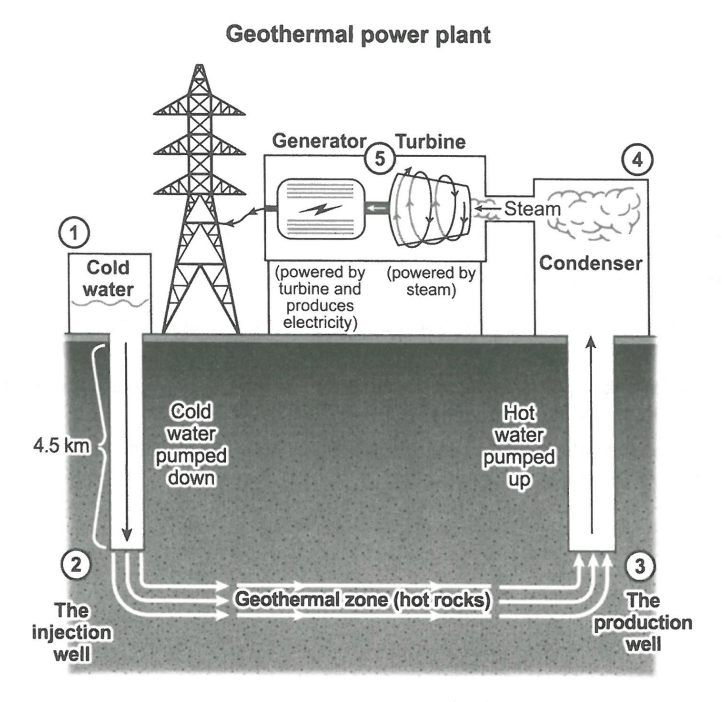
The diagram below shows how geothermal energy is used to produce electricity.
Summarise the information by selecting and reporting the main features, and make comparisons where relevant.
Student answer (Band 6.0)
The figure illustrates on how electricity is produced by the help of geothermal energy.
Overall, the whole process consists of several different equipments such as a generator, condenser and a turbine. In addition, cold water is quite essential too as it is then heated and turned into hot water by the help of hot rocks.
The process begins with the cold water that is pumped down at a distance of 4.5 km beneath the surface. Following this, that cold water goes through a geo-thermal zone which helps heat the water that is pumped down. Next, the hot water is pumped up by the help of the production well. Furthermore, the hot water is then condensed by the help of a condenser, it helps turn that hot water into steam. The obtained steam then helps the turbine to do it's job. The last step concludes with the generator which is powered by the turbine, which then help create the required electricity.
AI examiner evaluation
| Criterion | Band |
|---|---|
| Task Achievement / Task Response | 6.0 |
| Coherence and Cohesion | 6.5 |
| Lexical Resource | 6.0 |
| Grammatical Range and Accuracy | 6.0 |
| Overall | 6.0 |
Task Achievement / Task Response: Band 6.0
The response identifies the main stages in the correct order: cold water is sent underground, heated by hot rocks, brought back up, converted to steam, and used to drive a turbine and generator. It also includes the important depth of 4.5 km and gives a brief overall summary. However, some features are less fully reported: the injection and production wells are not clearly distinguished in the first part, and the final connection to electricity transmission is omitted. The description of the condenser is also unclear, since it says hot water is “condensed” rather than explaining that the water is converted into steam. A more precise overview and clearer explanation of each stage would make the process more complete.
Coherence and Cohesion: Band 6.5
The response has a clear overall arrangement, with an overview followed by a chronological account of the process. Sequencing expressions such as “The process begins,” “Following this,” “Next,” and “The last step” help the reader follow the stages, and the ideas progress logically. This meets the lower-band expectation of coherent organisation and shows some of the flexibility associated with stronger cohesion. However, transitions are somewhat mechanical and repetitive, particularly the repeated use of “by the help of.” The long sentence beginning “Furthermore” also joins two ideas with a comma, making the relationship less controlled. Use a wider range of linking structures and clearer sentence boundaries to improve flow.
Lexical Resource: Band 6.0
There is adequate vocabulary to describe the process, including relevant terms such as “geothermal zone,” “production well,” “condenser,” “steam,” and “turbine.” The writer also attempts more formal process language, for example “illustrates” and “concludes.” Some word choices and collocations are inaccurate or imprecise, however: “illustrates on how” is not natural, “different equipments” uses an uncountable noun as a plural, and “the condenser” is said to “condense” hot water when the intended change is to steam. Repeated phrases such as “by the help of” also limit flexibility. More precise process verbs and natural collocations would strengthen the description without changing its clear meaning.
Grammatical Range and Accuracy: Band 6.0
The response uses a mix of simple and complex forms, including a relative clause in “which then help create the required electricity” and sequencing clauses that support the process description. Most meanings remain clear, but some grammatical errors occur. For example, “illustrates on how” has an unnecessary preposition, “it helps turn” creates a comma splice after the preceding clause, and “which then help create” has a subject–verb agreement error. The apostrophe in “it's job” is also incorrect for the possessive form. There is some control of sentence variety, but greater accuracy in clause joining, agreement, and possessives would make the writing more reliable.
See this exact question answered at other band scores. The same prompt compared across bands.
Browse more IELTS Writing model answers or get your own writing scored by the same AI examiner.