Band 6.0 IELTS Writing Task 1 Model Answer
Overall Band Score: 6.0 · Cambridge IELTS 12 · 2026-11-25
IELTS Writing Task 1 question
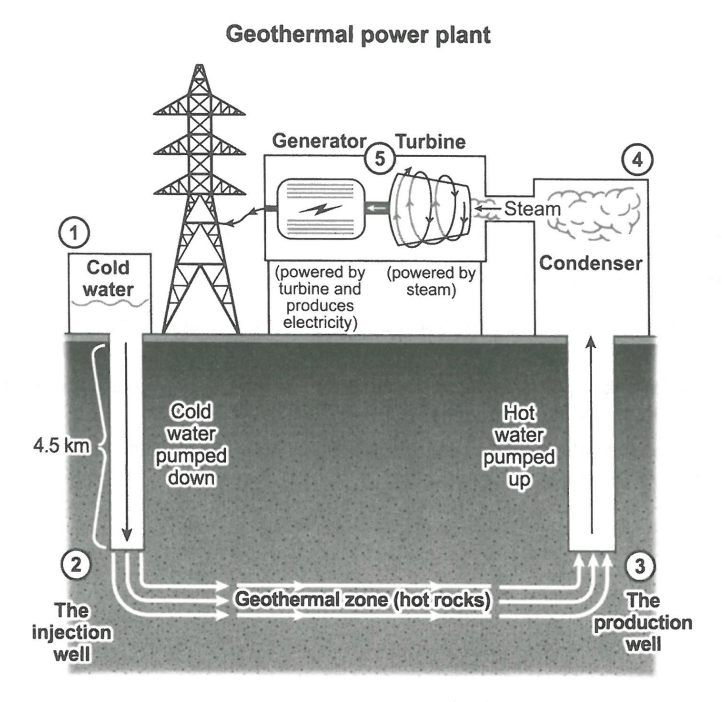
The diagram below shows how geothermal energy is used to produce electricity.
Summarise the information by selecting and reporting the main features, and make comparisons where relevant.
Student answer (Band 6.0)
The diagram illustrates the process of producing electricity by using geothermal energy.
Overall, the whole process contains five different steps. Thi first step shows storing cold water where at the end, a generator produces electricity powerd by a turbine.
Looking at the flow chart in more detail, it seems that the initial attempt is to store the cold water. After collecting the cold water, it is pumped down approximately 4.5km under the earth surface. Then in second stage, there is an injection wall which carries the cold water. Next, from the injection wall the cold water passes through the geothermal zone which contains hot rocks. At the terminal point, in stage three, there is a production wall which is used to pump up the hot water into a condenser at stage four.
Consequently,in stage four, condenser creates stem from the hot water and transfers into a turbine which is denoted as stage five. Now ,in this last stage, a turbine runs by steam. Finally, a generator which is powered by the turbine produces the electricity and this electricity add in the network to provide the consumers.
AI examiner evaluation
| Criterion | Band |
|---|---|
| Task Achievement / Task Response | 6.0 |
| Coherence and Cohesion | 6.0 |
| Lexical Resource | 5.5 |
| Grammatical Range and Accuracy | 5.5 |
| Overall | 6.0 |
Task Achievement / Task Response: Band 6.0
You identify the process as electricity production from geothermal energy and describe its main sequence: cold water is sent underground, heated in the geothermal zone, brought back up, and used to generate electricity. The 4.5 km depth is also reported accurately. However, the overview is unclear and says there are “five different steps” without summarising the key transformation from cold water to steam and then electricity. Some details are imprecise: the water is stored before being pumped down, rather than the injection well itself carrying it as a separate stage, and the final claim that electricity is added to a network “to provide the consumers” is not shown in the diagram. A clearer overview and more exact stage descriptions would make the coverage more complete.
Coherence and Cohesion: Band 6.0
The response has a recognisable structure, moving from an introduction and overview to a description of the underground stages and then the equipment at the surface. Sequencing words such as “Next,” “Consequently,” and “Finally” help the reader follow the process. However, the progression is sometimes mechanical, and the stage numbering becomes confusing: the injection well is called the “second stage,” although the diagram labels it as stage two after the initial cold-water stage, while the production well is described as stage three. The overview’s “where at the end” construction also makes the relationship between the beginning and end unclear. Grouping the underground and surface processes more cleanly, and using clearer references to each stage, would improve cohesion.
Lexical Resource: Band 5.5
You use relevant process vocabulary, including “geothermal zone,” “condenser,” “turbine,” and “generator,” which allows the main stages to be identified. There is also some attempt to vary wording with phrases such as “pumped down” and “pump up.” However, several word choices or spellings reduce precision: “injection wall” and “production wall” should be “well,” “stem” should be “steam,” and “electricity powerd” contains a spelling error. Phrases such as “initial attempt” and “terminal point” are not natural descriptions of stages in a process. Choose standard technical terms and straightforward collocations to make the account more accurate and fluent.
Grammatical Range and Accuracy: Band 5.5
You use both simple sentences and some longer structures, including “After collecting the cold water, it is pumped down…” and “which is used to pump up the hot water…”. The overall meaning is generally understandable, but some grammatical and punctuation errors remain. For example, “this electricity add in the network” has an incorrect verb form, and “a generator produces electricity powerd by a turbine” needs clearer sentence construction. There are also awkward clause links in “where at the end,” and spacing around punctuation is inconsistent in “Consequently,in” and “Now ,in”. Aim for accurate verb forms and agreement, and check sentence boundaries and punctuation while retaining the useful variety of structures you already attempt.
See this exact question answered at other band scores. The same prompt compared across bands.
Browse more IELTS Writing model answers or get your own writing scored by the same AI examiner.