Band 6.0 IELTS Writing Task 1 Model Answer
Overall Band Score: 6.0 · Cambridge IELTS 12 · 2026-11-27
IELTS Writing Task 1 question
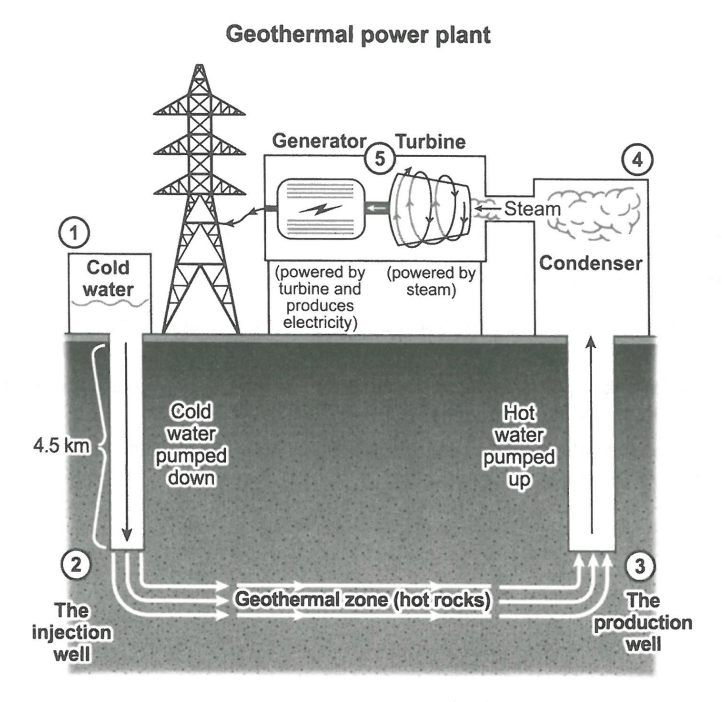
The diagram below shows how geothermal energy is used to produce electricity.
Summarise the information by selecting and reporting the main features, and make comparisons where relevant.
Student answer (Band 6.0)
The flow chart illustrates how electricity is produced by using geothermal energy.
Overall, five distinct stages are given in the diagram starting from the cold water entering to the earth to the generator in the final stage in which it produces electricity.
To begin with, the cold water pumped down from a tank to the earth on one side upto 4.5 kilometer where it injects well to Geothermal zone, then on the other side its production does well and it pumped up to the condenser.
Following this, when it reaches to the condenser, it creates steam due to too much hotness and then the steam goes to turbine and it starts circulating which is powered by steam. Moreover, in the final stage, turbine powers it and transfers to the generator and there it creates electricity. After it, the electricity spreads to the tall tower and then this spreads further everywhere.
AI examiner evaluation
| Criterion | Band |
|---|---|
| Task Achievement / Task Response | 6.0 |
| Coherence and Cohesion | 6.5 |
| Lexical Resource | 5.5 |
| Grammatical Range and Accuracy | 5.0 |
| Overall | 6.0 |
Task Achievement / Task Response: Band 6.0
You cover the main sequence from cold-water injection through heating, pumping, steam production and electricity generation, and your overview identifies the process as having five stages. The 4.5-kilometre depth is also reported accurately. However, some stages are described unclearly: “where it injects well to Geothermal zone” does not clearly explain that water travels through hot rocks, and “it creates steam due to too much hotness” gives an imprecise account of the condenser’s role. The final reference to electricity spreading “everywhere” is not a useful process detail; the diagram shows transmission lines and a pylon. Clarifying these points and describing the key transformations more precisely would make the account more complete.
Coherence and Cohesion: Band 6.5
The response has a clear overall arrangement: an introduction, an overview, and paragraphs that follow the process from water injection to electricity generation. Sequencing phrases such as “To begin with,” “Following this,” and “in the final stage” help the reader track the stages, and the progression is generally logical. This already provides a coherent account, though some links are mechanical and a few references are difficult to follow. For example, “it” in “it starts circulating” and “turbine powers it” has no clear referent, while “After it” is an awkward transition. Use more precise nouns such as “the steam” or “the turbine,” and connect each stage without adding an unclear final claim about electricity spreading everywhere.
Lexical Resource: Band 5.5
You use relevant process vocabulary, including “geothermal energy,” “condenser,” “turbine,” and “generator,” which allows the reader to recognise the main equipment and stages. However, several word choices or collocations are imprecise or unnatural, limiting the clarity and flexibility of the description. “It injects well” and “its production does well” do not accurately name the wells, while “too much hotness” is an informal and unsuitable way to describe heating. “Circulating” is also not the clearest verb for the steam’s movement through the system. Choose standard technical phrases such as “injection well,” “production well,” “heated by hot rocks,” and “flows through a pipe” to improve precision.
Grammatical Range and Accuracy: Band 5.0
You attempt a mixture of simple and longer sentences, including a sequence joined with “when” and “then,” and the overall process can usually be understood. However, control of sentence structure and grammatical forms is uneven. In “the cold water pumped down … where it injects well,” the clause lacks a clear grammatical construction, and “it pumped up” is missing the auxiliary verb “is.” The phrase “turbine powers it and transfers to the generator” also has unclear pronoun reference and an incomplete construction. Some sentences run together through repeated “and” or “then.” Practise forming accurate passive clauses for process descriptions—for example, “The water is pumped down” and “It is then heated”—and check articles, verb forms, and sentence boundaries.
See this exact question answered at other band scores. The same prompt compared across bands.
Browse more IELTS Writing model answers or get your own writing scored by the same AI examiner.