Band 6.0 IELTS Writing Task 1 Model Answer
Overall Band Score: 6.0 · Cambridge IELTS 12 · 2026-11-27
IELTS Writing Task 1 question
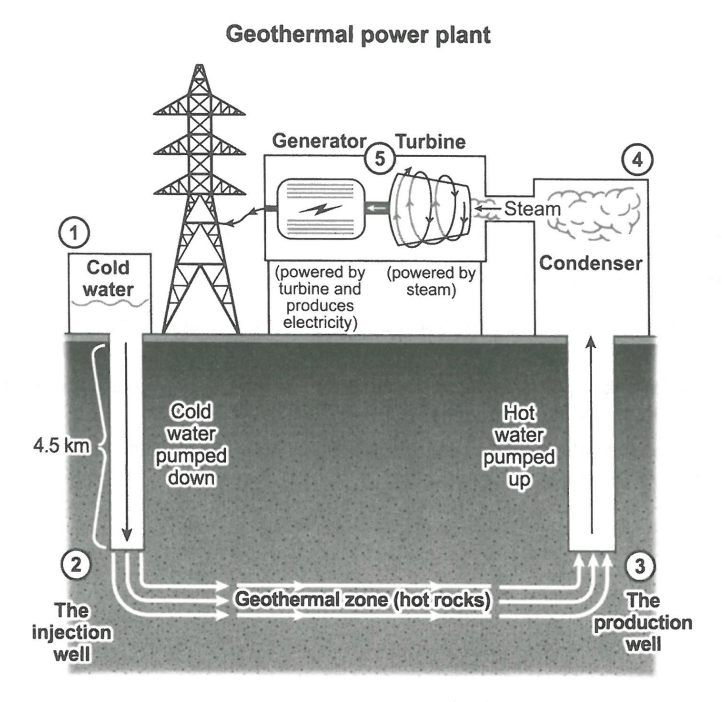
The diagram below shows how geothermal energy is used to produce electricity.
Summarise the information by selecting and reporting the main features, and make comparisons where relevant.
Student answer (Band 6.0)
The diagram illustrates the process of how electricty is produced from geothermal energy.
Overall, the process consists of five steps. It begins by pumping the cold water down into the injection well, and ends with production of electricty.
Initially, the cold water is taken .Then the cold water is pumped down into the injection well . The water passes through the injection well and reached the bottom area which is called geothermal zone. The hot rocks are placed in the geothermal zone. Next the water passes through the geothermal zone and becomes hot . After that the production well begins. The hot water is pumped up by the prodution well into the condenser. As the water reached the condensor, steam is produced out of the water . Then it passes into generator turbine, which is powered by steam and turbine, Resultantly, the electricty is produced from the water through this process of geothermal energy.
AI examiner evaluation
| Criterion | Band |
|---|---|
| Task Achievement / Task Response | 6.0 |
| Coherence and Cohesion | 6.5 |
| Lexical Resource | 5.5 |
| Grammatical Range and Accuracy | 5.5 |
| Overall | 6.0 |
Task Achievement / Task Response: Band 6.0
You identify the diagram as a geothermal electricity process and give a basic overview, noting that cold water is pumped down and electricity is produced at the end. The main stages are mostly represented, including heating in the geothermal zone, the upward movement of hot water, and steam reaching the machinery. However, some details are unclear or inaccurate: “Initially, the cold water is taken” does not explain its source, and the description says the water passes into a “generator turbine,” whereas the diagram shows steam powering a turbine, which in turn drives a separate generator. The overview also calls the process five steps without clearly summarising the conversion from water to steam and then electricity. More precise coverage of these stages would make the account more complete.
Coherence and Cohesion: Band 6.5
The response has a recognisable overall sequence, supported by “Overall,” “Initially,” “Next,” and “After that,” so the reader can follow the process from water injection to electricity generation. This logical ordering is a strength. However, the paragraphing is limited, and several transitions feel mechanical because nearly every stage is introduced with a simple sequencing phrase. Some links between ideas are also unclear: “After that the production well begins” does not clearly connect the well to the hot water being pumped upward, while “Then it passes into generator turbine” leaves the reference of “it” uncertain. Grouping the underground stages together and then describing the surface equipment in a separate paragraph, with clearer references, would improve progression and cohesion.
Lexical Resource: Band 5.5
You use relevant process vocabulary such as “injection well,” “geothermal zone,” “production well,” “condenser,” and “steam,” which helps communicate the main stages. There is also some attempt to describe movement and transformation, for example, water “passes through” the zone and “becomes hot.” However, the range is limited and some expressions are imprecise or unnatural, including “electricty is produced from the water” and “steam is produced out of the water.” Spelling errors in “electricty,” “prodution,” and “condensor” are noticeable, and “generator turbine” does not accurately name the separate components. Use precise process collocations and check spelling to make the description clearer and more natural.
Grammatical Range and Accuracy: Band 5.5
You attempt both simple and more developed sentences, including “The water passes through the geothermal zone and becomes hot” and a relative clause in “which is powered by steam and turbine.” The sequence is generally understandable, but some grammatical errors remain. For example, “As the water reached the condenser” shifts into the past tense, although the process should be described consistently in the present; “the production well begins” also gives the well an unclear action. There are punctuation and spacing problems, such as the spaces before full stops and the run-on construction after “Resultantly.” Try to maintain present-tense passive forms for process descriptions and separate each stage into complete, clearly punctuated sentences.
See this exact question answered at other band scores. The same prompt compared across bands.
Browse more IELTS Writing model answers or get your own writing scored by the same AI examiner.