Band 7.0 IELTS Writing Task 1 Model Answer
Overall Band Score: 7.0 · Cambridge IELTS 12 · 2026-11-28
IELTS Writing Task 1 question
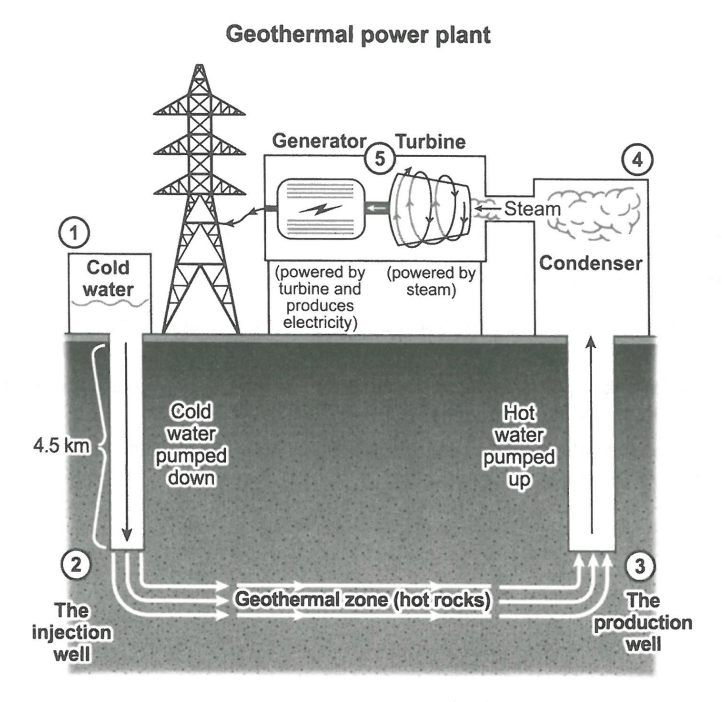
The diagram below shows how geothermal energy is used to produce electricity.
Summarise the information by selecting and reporting the main features, and make comparisons where relevant.
Student answer (Band 7.0)
The diagram illustrates the process of generation of electricity using geothermal energy.
The process involves digging of two boreholes inside the earth surface, namely injection well and production well. Cold water from storage tank is pumped into the injection well which is 4.5km deep, where it enters geothermal zone. Basically, there are hot rocks in this zone which are used to heat up the injected cold water. Cold water travels horizontally through geothermal zone, it becomes hot and is then pumped up through the production well.
Hot water from the production well enters the condenser where it is turned into steam. Steam is then fed to a unit which houses a turbine and a generator which are connected together through a shaft. Steam is used to rotate the turbine, its rotation is transmitted to the shaft. Generator is then used to convert this mechanical movement into electricity.
The electric power produced is then sent to the power grid from where it gets passed onto the consumer.
AI examiner evaluation
| Criterion | Band |
|---|---|
| Task Achievement / Task Response | 6.5 |
| Coherence and Cohesion | 7.5 |
| Lexical Resource | 7.0 |
| Grammatical Range and Accuracy | 6.5 |
| Overall | 7.0 |
Task Achievement / Task Response: Band 6.5
You cover the main sequence accurately: cold water is pumped down the 4.5-km injection well, heated as it passes through hot rocks, raised through the production well, and converted to steam to drive the turbine and generator. This gives the reader a clear account of how electricity is produced. However, some details are less fully grounded in the diagram: it does not show a storage tank explicitly, a shaft, or electricity being sent to consumers via a power grid. The overview could also state the process’s key transformation more directly, from cold water underground to steam-powered electricity. Keep the description focused on the stages and relationships actually shown, and avoid adding plausible but unlabelled details.
Coherence and Cohesion: Band 7.5
The response is organised in a clear progression, moving from the underground water cycle to the surface equipment and then the electricity output. Paragraphing separates these stages effectively, and linking expressions such as “where,” “then,” and “which” help show sequence and cause. The explanation is easy to follow overall. Some connections become slightly over-explanatory, particularly the turbine’s rotation being transmitted to a shaft and the final route to consumers, which are not necessary to the diagram’s progression. A more concise account that groups the heating and steam-generation stages, then explains the turbine-generator relationship, would make the cohesion feel more controlled and keep attention on the visual information.
Lexical Resource: Band 7.0
You use a suitable range of process vocabulary, including “injection well,” “production well,” “geothermal zone,” “condenser,” and “turbine.” Phrases such as “pumped up” and “turned into steam” communicate the stages clearly, while “generation of electricity” establishes the topic. There are occasional imprecise or less natural choices: “inside the earth surface” is awkward, and “a unit which houses a turbine and a generator” suggests a combined unit not specified in the diagram. “Mechanical movement” is also less precise than describing the turbine as driving the generator. Choose concise, diagram-specific terms and avoid adding technical-sounding details that the visual does not support; this would improve precision and collocational control.
Grammatical Range and Accuracy: Band 6.5
You use a mix of simple and complex sentences, including subordinate clauses such as “where it enters geothermal zone” and “which are connected together through a shaft.” Most meanings remain clear, and the sequence is generally expressed with appropriate present-tense forms. Some grammatical inaccuracies persist: “inside the earth surface” has an incorrect article/preposition pattern, and “where it enters geothermal zone” needs an article before “geothermal zone.” The sentence beginning “Cold water travels horizontally through geothermal zone, it becomes hot” joins two independent clauses with only a comma. Review articles and sentence boundaries, and vary the structures without overloading sentences with several linked clauses. These refinements would make the otherwise understandable description more consistently accurate.
See this exact question answered at other band scores. The same prompt compared across bands.
Browse more IELTS Writing model answers or get your own writing scored by the same AI examiner.