Band 6.0 IELTS Writing Task 1 Model Answer
Overall Band Score: 6.0 · IELTS Predictions Nov 2026 · 2026-11-22
IELTS Writing Task 1 question
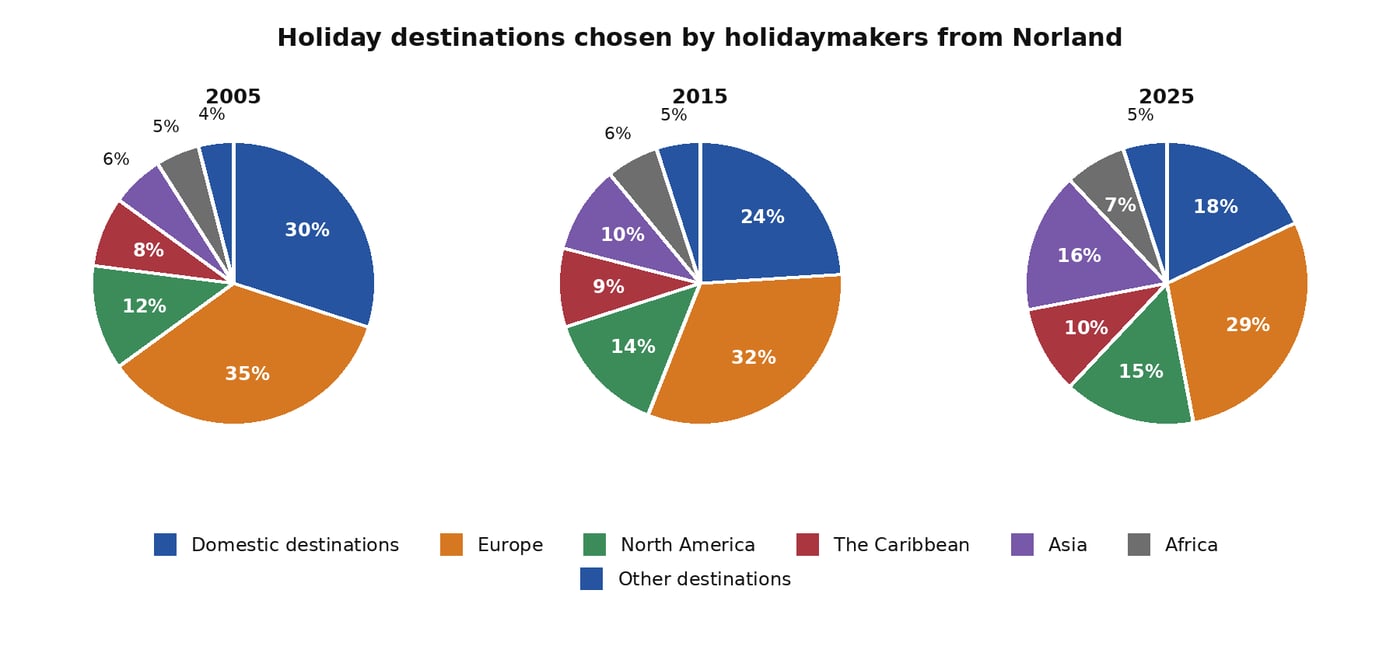
The pie charts below show the destinations chosen by holidaymakers from Norland in 2005, 2015 and 2025.
Summarise the information by selecting and reporting the main features, and make comparisons where relevant.
Student answer (Band 6.0)
The given pie charts illustrate the location chosen by vacationmakers from Norland in 2005, 2015 and 2025.
Overall, Domestic destinations and Europe were leading the top two favourite places over the given period of time by almost half of the people. Despite small share of percentage, all other destinations showed slight increase in the percentage over the given three years.
On the one hand, 35% of people choose Europe as the most favourite place to visit in 2005, following by Domestic destinations at 30%. They showed significant decrease in the popularity among the visitor by 2025 with 29% and 18% respectively.
On the other hand, All other destination showed slight increase in the popularity. North America, which was at increased by 3% untill 2025. Similarly, Asia also showed rise in the popularity by people and became the third most favourite place by 2025 with almost 16% from the 6% in 2005.
AI examiner evaluation
| Criterion | Band |
|---|---|
| Task Achievement / Task Response | 6.0 |
| Coherence and Cohesion | 6.5 |
| Lexical Resource | 6.0 |
| Grammatical Range and Accuracy | 5.5 |
| Overall | 6.0 |
Task Achievement / Task Response: Band 6.0
You identify the main pattern that Europe and domestic destinations were the two largest choices, and you accurately report their 2005 and 2025 figures. You also select Asia’s marked rise, correctly noting its increase from 6% to 16% and its position as the third-largest destination in 2025. However, the overview is partly unclear: “by almost half of the people” does not accurately describe the combined share, which was 65% in 2005 and 47% in 2025. The claim that all other destinations increased is also too broad, since “Other destinations” remained at 5% from 2015 to 2025. Several categories receive little detail, and the North America comparison would be clearer with its actual values. A more precise overview and fuller selection of key changes would strengthen the report.
Coherence and Cohesion: Band 6.5
The response has a clear overall structure: an introduction, an overview, and two body paragraphs that group the leading destinations separately from the other choices. This makes the main comparisons easy to follow, and linking phrases such as “Overall,” “On the one hand,” and “Similarly” help signal the progression. The organisation is coherent, though some connections are mechanical or imprecise. For example, “On the other hand” suggests a contrast, but the paragraph mainly adds further increases; “In addition” would fit better. The reference “They” in “They showed significant decrease” is understandable but could refer more explicitly to Europe and domestic destinations. More consistent grouping and clearer references would make the progression smoother.
Lexical Resource: Band 6.0
You use an adequate range of topic vocabulary, including “destinations,” “popularity,” “share,” and “increase,” and the meaning is generally clear. There are also attempts at more descriptive phrasing, such as “third most favourite place.” Some word choices and collocations are unnatural or imprecise, however: “leading the top two favourite places” is redundant, and “the popularity among the visitor” is not idiomatic. “All other destination” also has a number-form error in word choice, while “untill” is misspelled. Repeated use of “showed” and “popularity” limits variety. Aim for concise chart language such as “accounted for,” “rose,” and “declined,” and use precise terms for proportions rather than general claims about popularity.
Grammatical Range and Accuracy: Band 5.5
You attempt a mix of simple and more complex forms, including the overview sentence beginning “Despite…” and the relative clause “North America, which…”. The main trends remain understandable, but some grammatical errors recur. In “35% of people choose Europe,” the past-tense reporting requires “chose”; “following by” should be “followed by”; and “showed significant decrease” needs an article. The sentence “North America, which was at increased by 3% untill 2025” is structurally faulty and obscures the comparison. Capitalising “All” after a comma is also incorrect. Practise accurate past-tense reporting and complete sentence patterns, especially when describing changes, while retaining the range of sentence forms you are attempting.
See this exact question answered at other band scores. The same prompt compared across bands.
Browse more IELTS Writing model answers or get your own writing scored by the same AI examiner.