Band 6.0 IELTS Writing Task 1 Model Answer
Overall Band Score: 6.0 · IELTS Predictions Nov 2026 · 2026-11-23
IELTS Writing Task 1 question
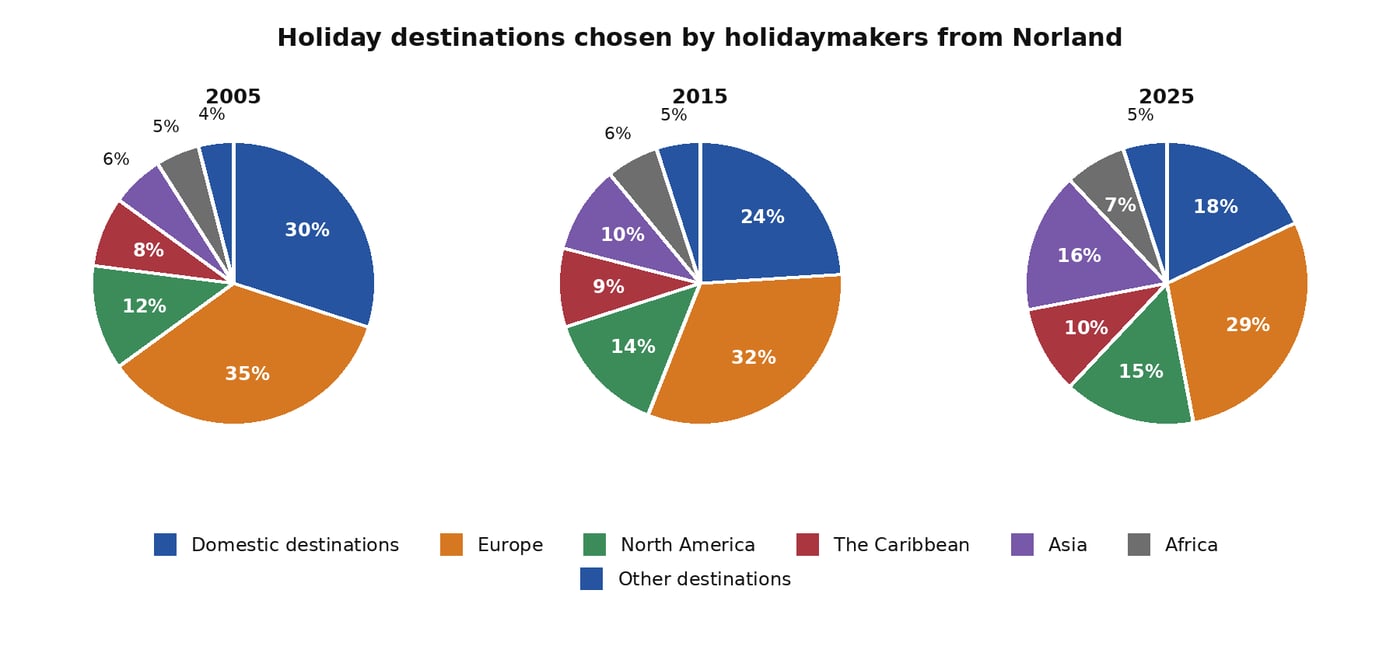
The pie charts below show the destinations chosen by holidaymakers from Norland in 2005, 2015 and 2025.
Summarise the information by selecting and reporting the main features, and make comparisons where relevant.
Student answer (Band 6.0)
The pie charts illustrate the tourist destinations chosen by the tourists from Norland in three different decades in 2005, 2015 and 2025.
Overall, it can be seen that Europe has been the favourite tourist spot for the holidamakers throughout three decades though it kept declining, while domestic tourism has declined as well over the years but still it holds the second position.
Europe as a holiday destination has been the most popular spot in three different decadeds followed by the local destinations but their popularity has been declining as local tourism is almost halved. While other destinations were chosen by almost same number of people.
On the other hand, popularity of rest of the destinations have increased with Asia being explored by more people and its popularity has increased by almost threefold from 6% in 2005 to 16% in 2025. Followed by the Caribbean with the numbers keepin the smooth transition from 8% in 2005 to 9% in 2015 and then 10% in 2025.
AI examiner evaluation
| Criterion | Band |
|---|---|
| Task Achievement / Task Response | 6.5 |
| Coherence and Cohesion | 6.0 |
| Lexical Resource | 6.0 |
| Grammatical Range and Accuracy | 5.5 |
| Overall | 6.0 |
Task Achievement / Task Response: Band 6.5
You identify the main pattern accurately: Europe is the largest category in all three years, while both Europe and domestic destinations decline, and Asia rises markedly. The figures for Asia and the Caribbean are also reported correctly. This gives the response a clear overview and relevant comparisons. However, the overview says domestic destinations remain second, which is not true in 2025: Asia reaches 16%, ahead of domestic travel at 18%? Actually domestic remains second at 18%, so this is accurate; the comparison would be stronger if stated explicitly. Some categories receive little or no detail, especially North America, Africa and other destinations, and “other destinations” is described vaguely as chosen by almost the same number without figures. More precise coverage and development of these changes would strengthen the report.
Coherence and Cohesion: Band 6.0
The response has a recognisable structure: an introduction, an overview and two paragraphs describing the main trends. The progression from the leading destinations to the rising alternatives is generally easy to follow, and phrases such as “Overall” and “On the other hand” help signal relationships. However, the second and third paragraphs repeat the point that Europe and domestic travel are declining, while the final sentence begins with “Followed by” and is not a complete sentence. The contrast marker “On the other hand” is also somewhat mechanical because the preceding paragraph does not establish a clear opposing argument. Grouping all declining categories together and all rising or stable categories together, with clearer links between sentences, would make the organisation more efficient.
Lexical Resource: Band 6.0
You use an adequate range of topic vocabulary, including “favourite tourist spot,” “local destinations,” “popularity,” and “explored,” and the meaning is generally clear. There are also attempts to vary expressions for destinations rather than repeating the chart labels throughout. However, some choices are imprecise or unnatural for a data report: “tourists” is repeated where “holidaymakers” would be more suitable, and “smooth transition” does not accurately describe a gradual increase in percentages. Spelling errors such as “holidamakers,” “decadeds,” and “keepin” also reduce accuracy. Aim for concise, conventional reporting language and use the category names consistently; this will make comparisons more precise and improve control of spelling and collocation.
Grammatical Range and Accuracy: Band 5.5
You attempt a mix of simple and complex structures, including a contrast with “though” and a clause beginning “as.” Most of the intended meaning remains understandable. Some grammatical errors, however, affect sentence control. For example, “the popularity of rest of the destinations have increased” has an article and subject–verb agreement problem, while “with the numbers keepin the smooth transition” does not form a correct clause. “Followed by the Caribbean…” is a fragment, and “in three different decades” is not an accurate grammatical description of the three years shown. Work on complete sentence structures, agreement between subjects and verbs, and accurate tense and time expressions. More consistently controlled complex sentences would improve the range as well as accuracy.
See this exact question answered at other band scores. The same prompt compared across bands.
Browse more IELTS Writing model answers or get your own writing scored by the same AI examiner.