Band 6.5 IELTS Writing Task 1 Model Answer
Overall Band Score: 6.5 · IELTS Predictions Nov 2026 · 2026-11-10
IELTS Writing Task 1 question
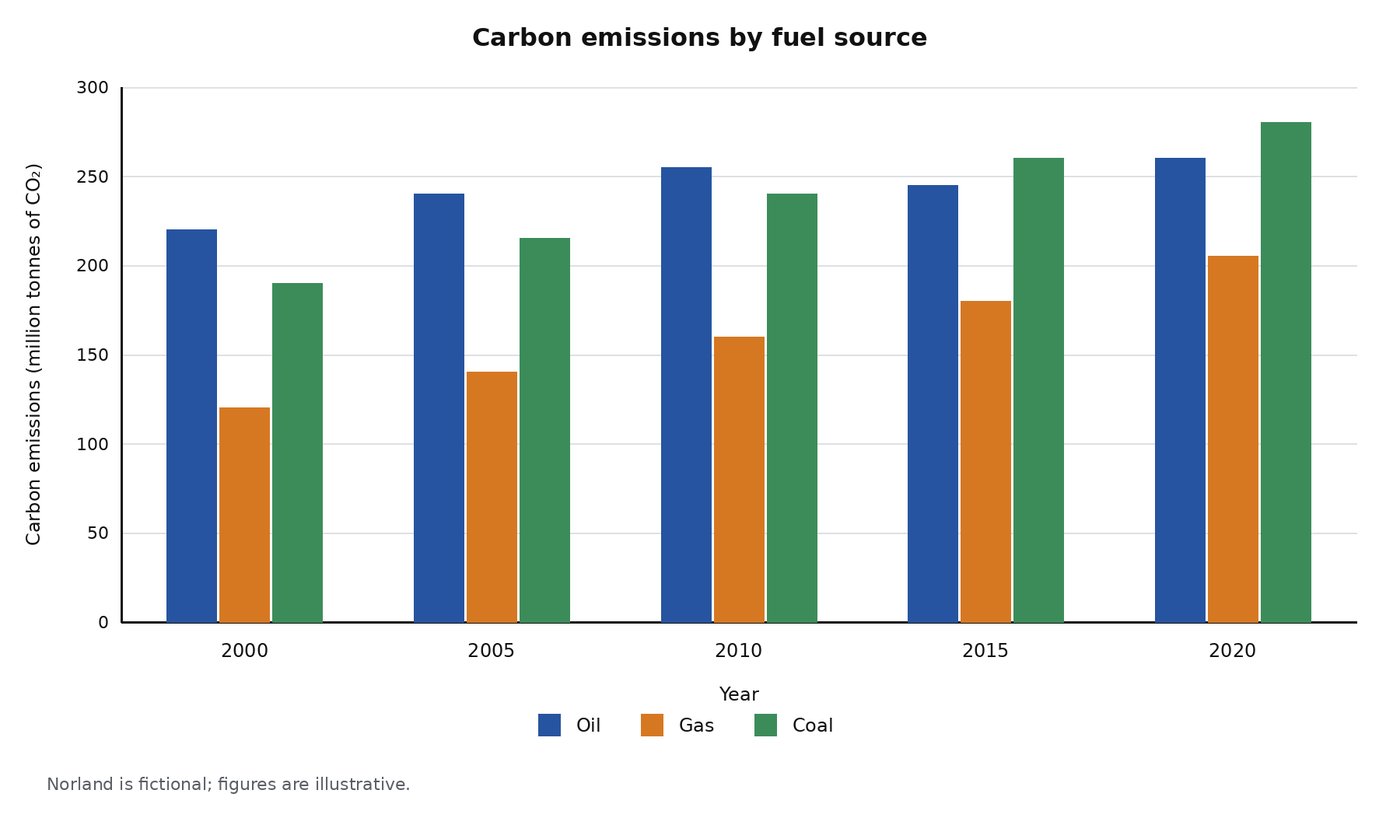
The bar chart below shows how much carbon dioxide was released by oil, gas and coal in the fictional country of Norland from 2000 to 2020.
Summarise the information by selecting and reporting the main features, and make comparisons where relevant.
Student answer (Band 6.5)
The bar chart illustrates how much carbon dioxide was emitted from three natural resources ( oil, gas and coal) in the unreal country between 2000 and 2020.
Overall, the emission of CO2 from all the three sources increased throughout the period. At the beginning oil was the major sorce of Co2 release while in the end coal overtook its place became the largest co2 releasing source. Gas remained the smallest emitter of the CO2 over the period.
In 2000, carbon emissions by oil was around 230 millions tonnes, followed by coal almost 190 millions tonnes, while gas emitted smallest amount oover 120 millions tonnes. After a decade, emission of CO2 by each of three sources rose to over 260, 230 and 160 respectively.
In 2015, emission of co2 by oil decreased slightly to under 250 million tonnes before rising and reaching 270 in 2020, while other two coal and gas increased to 270 and 180 and finally peaking at 280 and 210 respectively in 2020
AI examiner evaluation
| Criterion | Band |
|---|---|
| Task Achievement / Task Response | 6.5 |
| Coherence and Cohesion | 6.5 |
| Lexical Resource | 6.0 |
| Grammatical Range and Accuracy | 6.0 |
| Overall | 6.5 |
Task Achievement / Task Response: Band 6.5
You identify the main overall pattern: emissions rise for all three fuels, oil leads initially, and coal becomes the largest source by 2020, while gas remains lowest. These are relevant features and your overview gives the reader a clear summary. Several details, however, are inaccurate or not fully developed. For example, oil in 2020 is reported as 270 rather than about 260, and the 2010 figures are described as over 260, 230 and 160, whereas the chart shows about 255, 240 and 160. The statement that all sources increased throughout also overlooks oil’s dip in 2015, which you mention later. More precise reporting and a clearer account of the crossover between coal and oil would strengthen the response.
Coherence and Cohesion: Band 6.5
The response has a coherent overall arrangement: an introduction, a broad overview, and two paragraphs describing figures over time. The progression from the starting point to later years is generally easy to follow, and phrases such as “At the beginning” and “In 2015” help orient the reader. However, the final paragraph compresses several years and comparisons into one long sentence, making the sequence less clear; the ending also lacks a full stop. Some linking is mechanical, and “while” is used to connect several different comparisons. Separate the 2015 changes from the 2020 figures and use clearer reference to each fuel so that the progression is more consistently controlled.
Lexical Resource: Band 6.0
You use a suitable range of topic vocabulary, including “carbon emissions,” “emitted,” “increased,” “decreased slightly,” and “largest.” This is enough to communicate the chart’s main trends, and some variation in wording is evident. At times, however, word choice and collocation are inaccurate or repetitive: “CO2 releasing source” is awkward, and “natural resources” is less precise than “fuel sources.” There are also spelling errors such as “sorce,” “oover,” and “Co2,” alongside inconsistent capitalisation of CO₂. Aim for standard chart language and accurate spelling, and avoid repeating “emission of CO2” when a concise alternative such as “emissions” would be clearer.
Grammatical Range and Accuracy: Band 6.0
You attempt both simple and more complex sentence forms, including the contrast in “At the beginning … while in the end …” and the sequence describing changes in 2015 and 2020. The main meaning is generally understandable, but some grammatical errors remain. For instance, “carbon emissions by oil was” has a subject–verb agreement problem, and “gas emitted smallest amount” needs an article. The final sentence is difficult to control because several clauses and comparisons are joined together, and it ends without punctuation. There are also inconsistencies in singular and plural forms, as in “millions tonnes.” Review agreement, articles, and sentence boundaries, then check punctuation so that longer comparisons remain accurate and easy to read.
See this exact question answered at other band scores. The same prompt compared across bands.
Browse more IELTS Writing model answers or get your own writing scored by the same AI examiner.