Band 5.5 IELTS Writing Task 1 Model Answer
Overall Band Score: 5.5 · IELTS Predictions Nov 2026 · 2026-11-08
IELTS Writing Task 1 question
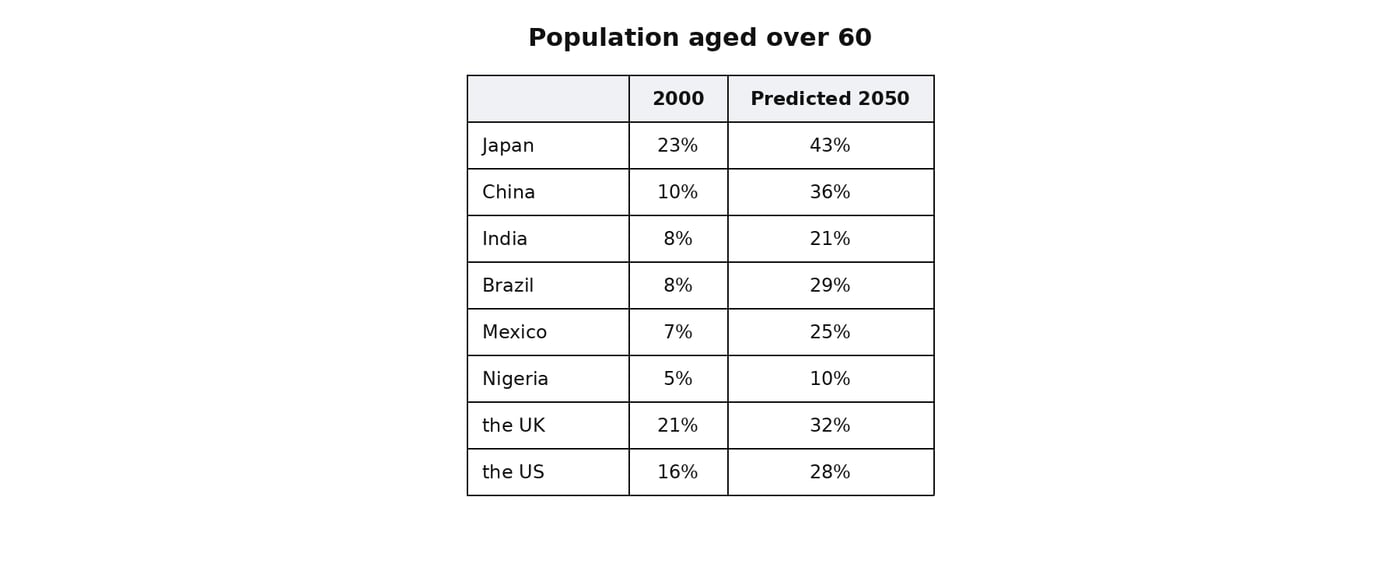
The table below shows the percentage of the population aged over 60 in 2000 and in the predicted year 2050 in eight countries.
Summarise the information by selecting and reporting the main features, and make comparisons where relevant.
Student answer (Band 5.5)
The table below repersent the population of the countrie over the age of 60 in 2000 and it also showes in predicted at the year 2050 in eight countries. overall, Japan has the highet percentage as at the year 2000 the percentage of the population aged over 60 was 23% and it was also the highest in the predicted year 2050 as it was 43%.
If we look at the countries China and India. In 2000 the percentage of the population over the age of 60 in China was 10% which was 2% more then India. However, it was the same was predicted year 2050 as China had a grater percentage then India. This is because in China it was 36% but in India it was 21%.
Now if we look at the countries Mexico and Nigeria it has the lowest percentage comparing to other countries. Furthermore, in Mexico the percentage of the population aged over 60 in 2000 was 7% and in Nigeria it was less then Mexico which was 5%. In the predicted year 2050 the in the predicted year 2050 in Nigeria was 10% which was 15% less then Mexico.
AI examiner evaluation
| Criterion | Band |
|---|---|
| Task Achievement / Task Response | 5.0 |
| Coherence and Cohesion | 5.5 |
| Lexical Resource | 5.5 |
| Grammatical Range and Accuracy | 5.0 |
| Overall | 5.5 |
Task Achievement / Task Response: Band 5.0
You identify Japan as the highest in both years and correctly report its figures, and your comparisons of China with India and Mexico with Nigeria are relevant. However, the response covers only four of the eight countries, leaving out the UK, the US and Brazil, and it does not give a sufficiently broad overview of the main changes. The statement that China was “the same” in 2050 appears to mean that it remained higher than India, but the comparison is not clearly expressed. Also, the final comparison gives Nigeria’s 2050 figure but not Mexico’s, so the stated 15-point difference is difficult to verify. Include the full range of key patterns and make comparisons precise.
Coherence and Cohesion: Band 5.5
The response has a basic paragraph structure: an opening with an overview, followed by comparisons of two pairs of countries. Phrases such as “However” and “Furthermore” show an attempt to connect ideas. Nevertheless, the progression is limited because the discussion moves through only selected pairs and does not organise the figures into a fuller account of the table. Some linking is repetitive or awkward, particularly “Now if we look at” and the repeated “in the predicted year 2050.” References such as “it” in “it was the same” are also unclear. Group the countries by meaningful patterns, use clear topic sentences, and avoid repeating the same time reference.
Lexical Resource: Band 5.5
You use relevant task vocabulary, including “percentage,” “population aged over 60,” “predicted,” and “highest,” so the main subject is generally understandable. However, the range is limited and several spelling and word-choice errors reduce precision: “repersent,” “countrie,” “showes,” “highet,” and “grater.” Some phrasing is also unnatural, such as “the lowest percentage comparing to other countries” and “the same was predicted year 2050.” Aim for accurate spelling and more natural expressions for describing data, such as “compared with,” “by 2050,” and “a larger proportion.” This would make the comparisons clearer and more appropriately formal.
Grammatical Range and Accuracy: Band 5.0
You attempt both simple and more complex sentences, including clauses beginning “as” and “which,” but control is inconsistent. Errors occur in sentence structure and verb forms, for example, “it also showes in predicted at the year 2050” and “the in the predicted year 2050 in Nigeria was 10%.” The sentence “Now if we look at the countries Mexico and Nigeria it has the lowest percentage” also has unclear agreement and punctuation. These problems sometimes make the intended comparison difficult to follow. Practise forming complete, direct comparison sentences, and check subject–verb agreement, articles, and punctuation. For example: “In 2050, Nigeria is predicted to reach 10%, compared with 25% in Mexico.”
See this exact question answered at other band scores. The same prompt compared across bands.
Browse more IELTS Writing model answers or get your own writing scored by the same AI examiner.