Band 5.0 IELTS Writing Task 1 Model Answer
Overall Band Score: 5.0 · IELTS Predictions Nov 2026 · 2026-11-13
IELTS Writing Task 1 question
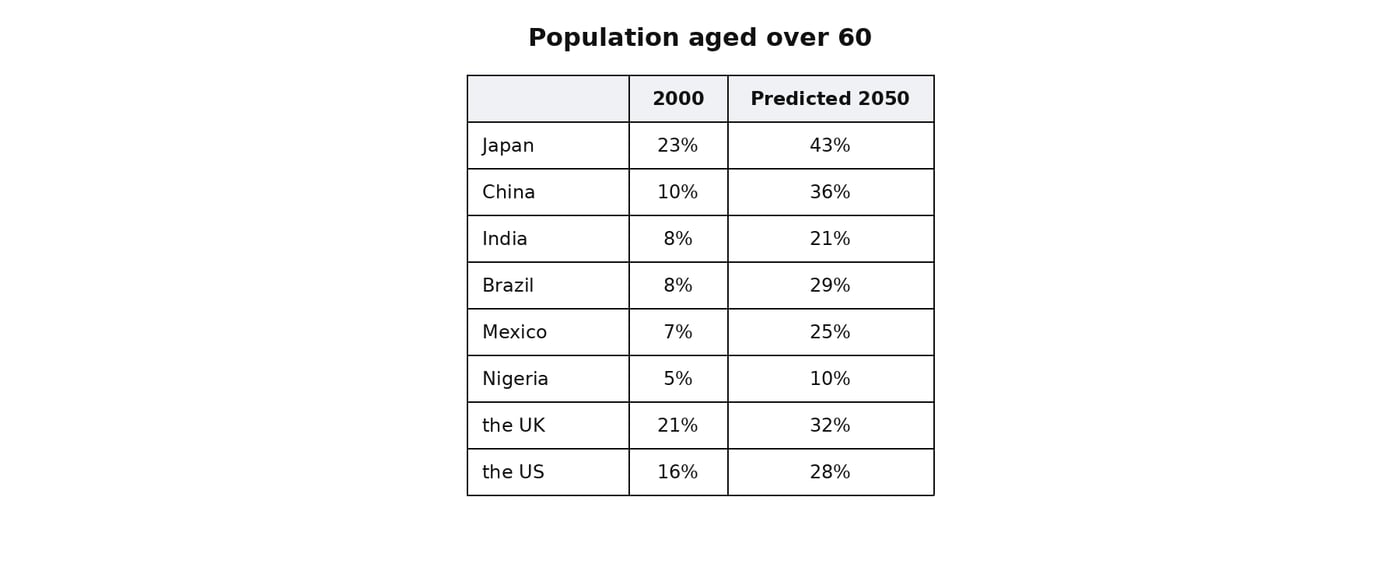
The table below shows the percentage of the population aged over 60 in 2000 and in the predicted year 2050 in eight countries.
Summarise the information by selecting and reporting the main features, and make comparisons where relevant.
Student answer (Band 5.0)
The table illustrates the percentage of the population aged over 60 in 2000 and in the predicted year 2050 in eight countries.
Looking at the table, it is clear that overall, in all countries over aged population increase with passage of time. The maximum aged increase occurred in japan people. At second old public maximun in china and they move down ward at last in the US minimum aged public living in future.
Initially, the most noticeable change occurred in life of Mexico people in 2000 their age 7% and in 2050 it reached about 25%. Brazil in 2000 about 8% aged folks but significantly increase take place in 2050 they percentage reached at 29. For India in past 8% individuals but in 2050, 21% population would aged. In China 10% aged population living in 2000 but in 2050 its number increased about 36%.
Furthermore, in Japan 23% over aged people living in 2000 but in 2050 their population rised and reached at 43%. For the US in 2000,16% over aged population living and in 2050 about 28% population is over aged.
AI examiner evaluation
| Criterion | Band |
|---|---|
| Task Achievement / Task Response | 5.5 |
| Coherence and Cohesion | 5.0 |
| Lexical Resource | 5.0 |
| Grammatical Range and Accuracy | 5.0 |
| Overall | 5.0 |
Task Achievement / Task Response: Band 5.5
You identify the table’s subject and give a general overview that the proportion aged over 60 rises in every country. You also report several figures accurately, including Japan’s 23% to 43%, China’s 10% to 36%, and Mexico’s 7% to 25%. However, the overview is unclear in places, and the claim that Japan has the “maximum aged increase” is not accurate: China has the largest rise, from 10% to 36%, compared with Japan’s 20-point increase. The response also omits Nigeria and the UK, and the comparison that the US has the minimum future proportion is incorrect; Nigeria is lowest at 10%. Select the main highs, lows, and largest changes, and compare them accurately to make the summary more complete.
Coherence and Cohesion: Band 5.0
The response has a basic structure: an introduction, an overview, and two paragraphs of country details. “Initially” and “Furthermore” signal some progression, and the figures are generally grouped into readable sentences. However, the overall sequence is difficult to follow because the overview’s comparisons—such as “At second old public maximun in china”—are unclear, and the country details do not follow a consistent comparison pattern. The UK and Nigeria are omitted, leaving the coverage uneven. Some linking phrases feel mechanical rather than showing precise relationships. Organise the body around clear comparisons, such as the highest and lowest figures or the largest and smallest increases, and use explicit references to connect each comparison.
Lexical Resource: Band 5.0
You use some relevant vocabulary, including “percentage,” “population,” “increase,” and “reached,” so the topic is recognisable. However, the range is limited and several word choices or collocations make the meaning difficult to understand. Phrases such as “over aged population,” “aged folks,” “old public,” and “their age 7%” are not natural ways to describe the data. There are also spelling errors, including “maximun” and “rised,” and “life of Mexico people” does not convey the intended comparison clearly. Use standard demographic terms consistently, such as “people aged over 60” or “the proportion of older people,” and choose precise verbs such as “rose” or “increased.”
Grammatical Range and Accuracy: Band 5.0
You attempt both simple and longer sentence forms, and the opening sentence is a clear, accurate description of what the table presents. However, the range is limited, and errors occur frequently in sentence structure, agreement, articles, and verb forms. For example, “in all countries over aged population increase” lacks a clear subject and has incorrect agreement, while “their population rised and reached at 43%” contains an incorrect verb form and an awkward grammatical pattern. The sentence beginning “At second old public maximun” is also difficult to parse. Build reliable comparison sentences using patterns such as “The proportion in Japan rose from 23% to 43%” and check subject–verb agreement, past-tense forms, and punctuation.
See this exact question answered at other band scores. The same prompt compared across bands.
Browse more IELTS Writing model answers or get your own writing scored by the same AI examiner.