Band 5.5 IELTS Writing Task 1 Model Answer
Overall Band Score: 5.5 · IELTS Predictions Nov 2026 · 2026-11-19
IELTS Writing Task 1 question
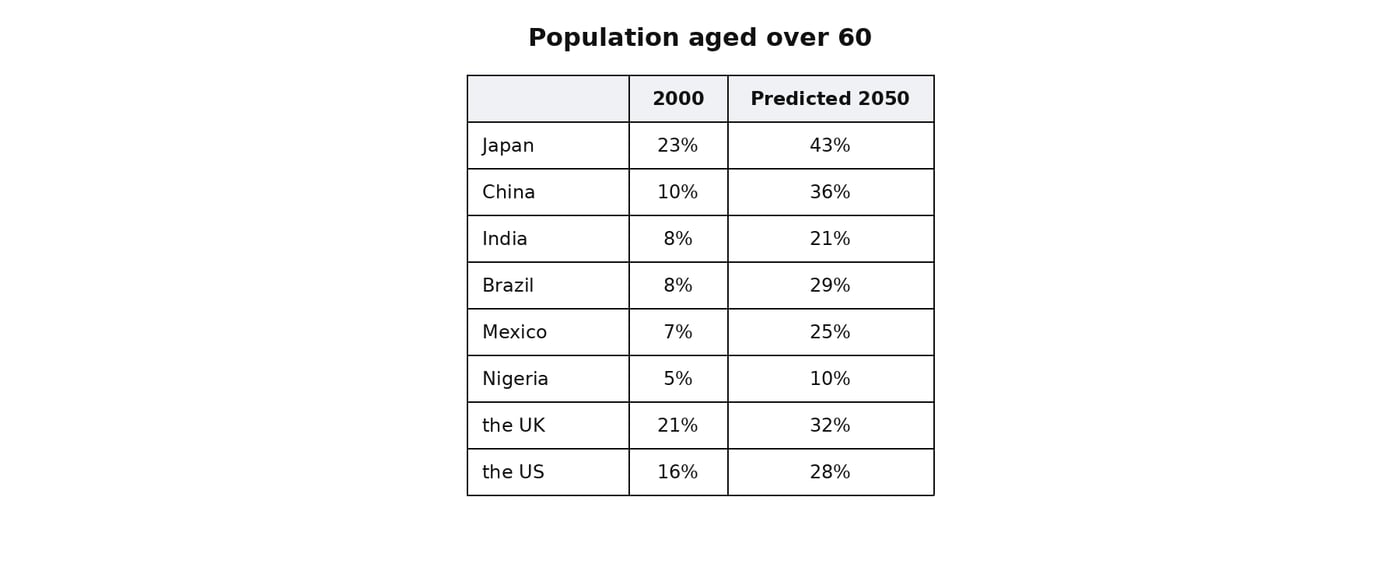
The table below shows the percentage of the population aged over 60 in 2000 and in the predicted year 2050 in eight countries.
Summarise the information by selecting and reporting the main features, and make comparisons where relevant.
Student answer (Band 5.5)
The table depicts the proportion of population of elderly people , who are above 60 years, in 2000 and predicted the year in 2050 in eight countries.
Overall, Japan contributed the highest proportion and predicted the same in future, while Nigeria had the lowest proportion of elderly people initially but it is expected to be doubled in future. However China had fewer aged people initially but more than thrice in percentage are expected to be raise after a half century.
In 2000, Japan represented the highest proportion with 23% and it is predicted to remain in top with just under a half proportion. China had only one ten of total population who were elderly people but it is predicted to become the second highest with almost one third proportion.While Uk were the second highest initially with 21% but it rose gradually and expected a raise about 10% by 2050 and the usa started with 16% in 2020 and predicted by 12% increase in 2050
AI examiner evaluation
| Criterion | Band |
|---|---|
| Task Achievement / Task Response | 6.0 |
| Coherence and Cohesion | 6.0 |
| Lexical Resource | 5.5 |
| Grammatical Range and Accuracy | 5.0 |
| Overall | 5.5 |
Task Achievement / Task Response: Band 6.0
You provide a relevant overview, identifying Japan as the highest in both years and Nigeria as the lowest in 2000, and you make useful comparisons involving China, the UK and the US. Several reported figures and trends are accurate: Japan rises from 23% to 43%, China from 10% to 36%, and the UK from 21% to 32%. However, the overview is not fully precise: Nigeria is predicted to double from 5% to 10%, but it is not the only notable trend, and China’s 2050 figure is 36%, rather than almost one third. The US comparison also refers to 2020 instead of 2000. The response addresses the task, but coverage is uneven: India, Brazil and Mexico are omitted, and some comparisons would benefit from clearer, accurate reporting.
Coherence and Cohesion: Band 6.0
The response has a recognisable structure: an introduction, an overview and a paragraph of selected details. This gives the reader a coherent overall route through the information. Linking expressions such as “Overall,” “while” and “However” show an attempt to connect comparisons, but some links are awkward or unclear. For example, “However China had fewer aged people initially but more than thrice…” combines contrasting ideas without a clear relationship, and “While UK were the second highest…” is left as a fragment before the next clause. The final paragraph also moves between countries without a consistent grouping or a clear closing point. Organise the details into meaningful comparisons—such as the highest figures, then the remaining countries—and use complete sentences with clearer transitions.
Lexical Resource: Band 5.5
You use relevant vocabulary for describing a table, including “proportion,” “predicted,” “highest,” “lowest” and “increase.” These choices make the general topic clear, and you attempt some less common phrasing. However, several expressions are inaccurate or unnatural, such as “contributed the highest proportion,” “one ten of total population,” “remain in top” and “expected a raise.” These collocation and word-form problems sometimes make the intended comparison less precise. Repetition of “proportion” and “elderly people” also limits flexibility. Aim for standard data-reporting phrases, such as “accounted for,” “one tenth,” “remain the highest” and “is projected to rise.” More precise vocabulary would help distinguish a percentage-point increase from a general increase.
Grammatical Range and Accuracy: Band 5.0
You attempt both simple and complex sentences, including clauses joined with “while” and “but,” and the main message is generally understandable. However, errors in sentence construction and verb forms are frequent enough to affect clarity. For example, “predicted the year in 2050” lacks a suitable preposition, “it is expected to be doubled” uses an awkward passive construction, and “it is predicted to become the second highest” needs a clearer grammatical subject. The sentence beginning “While Uk were…” is incomplete, and the final sentence shifts from “started” to “predicted” without a consistent tense pattern. There are also missing articles and inconsistent capitalisation. Practise complete sentence structures and use consistent past and future forms when comparing the two years.
See this exact question answered at other band scores. The same prompt compared across bands.
Browse more IELTS Writing model answers or get your own writing scored by the same AI examiner.