Band 5.0 IELTS Writing Task 1 Model Answer
Overall Band Score: 5.0 · IELTS Predictions Nov 2026 · 2026-11-25
IELTS Writing Task 1 question
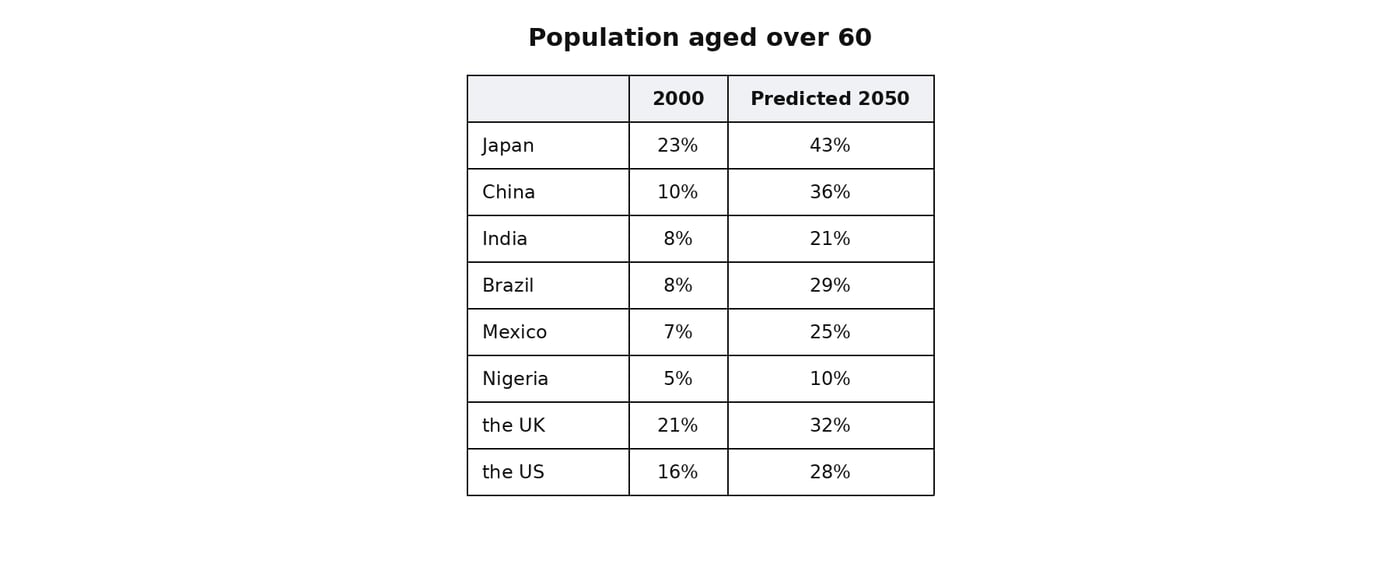
The table below shows the percentage of the population aged over 60 in 2000 and in the predicted year 2050 in eight countries.
Summarise the information by selecting and reporting the main features, and make comparisons where relevant.
Student answer (Band 5.0)
This table illustrates the percentage of the population aged over 60 in 2000 and in the predicted year 2050.It compares the population of different countruies over 60. Firstly, begin with Japan and China show different percentage of population in present time Japan has a higher percentage of people aged over 60 compared with China.China has a small percentage of poeple aged 60. in year 2050 predicted that japan will have higher population in future as compared to china. secondly, compared two more countries india and brazil. In present time both countries have same population but in future it is predicted that brazil will have more population than india. Comparing two more countries mexico and nigeria these both have low rate of population in going period but it is predicted that in future they will have highest rate than present period. lastly, the comparing the UK and USA in present time UK has more population than USA. In the year2050 it is predicted that the UK will also has more population.
AI examiner evaluation
| Criterion | Band |
|---|---|
| Task Achievement / Task Response | 4.5 |
| Coherence and Cohesion | 5.0 |
| Lexical Resource | 5.0 |
| Grammatical Range and Accuracy | 5.0 |
| Overall | 5.0 |
Task Achievement / Task Response: Band 4.5
You identify the table’s topic and make several relevant comparisons, including Japan versus China, India versus Brazil, and the UK versus the US. However, the response reports very few figures and does not give a clear overview of the main pattern across all eight countries. Some statements are inaccurate or too vague: Mexico and Nigeria are described as having the “highest rate” in the future, although Japan is projected to lead at 43%, and the UK is not compared with the US using the actual values. Include key figures and summarise the overall rise, noting Japan’s leading position and Nigeria’s lowest figures, to make the report more complete and precise.
Coherence and Cohesion: Band 5.0
The response follows a basic sequence, moving through pairs of countries, and signposts such as “Firstly,” “secondly,” and “lastly” help show the intended order. However, this organisation is mechanical and does not create a clear overall progression from an overview to supporting details. Several transitions are awkward, for example, “Comparing two more countries mexico and nigeria,” and the repeated country-by-country pattern makes the report feel like disconnected observations. Use separate paragraphs for an overview and grouped comparisons, and connect related information more naturally. Clearer sentence boundaries and references would also help readers follow which country or year each statement concerns.
Lexical Resource: Band 5.0
You use relevant basic terms such as “percentage,” “predicted,” “higher,” and “compared,” so the subject is generally understandable. However, vocabulary is limited and repetitive, particularly the repeated use of “population” and “more population” where the table concerns the proportion of people aged over 60. Some choices are imprecise, such as “low rate” and “highest rate,” and spelling errors include “countruies” and “poeple.” Aim for more accurate task vocabulary, including “proportion,” “share,” and “increase,” and check spelling. This would make comparisons clearer and reduce the effort required to interpret some phrases.
Grammatical Range and Accuracy: Band 5.0
The response attempts comparisons and some longer sentence forms, but grammatical control is inconsistent, and errors frequently affect clarity. For example, “Firstly, begin with Japan and China show” combines incompatible sentence structures, while “the UK will also has” uses an incorrect verb form. There are also problems with articles, agreement, and sentence boundaries, as in “in year 2050 predicted that japan” and the run-on transition “China.China.” Most sentences rely on simple patterns, with longer attempts often becoming difficult to follow. Build accurate short sentences first, then practise joining them with clauses such as “whereas” or “while,” and check verb forms and punctuation.
See this exact question answered at other band scores. The same prompt compared across bands.
Browse more IELTS Writing model answers or get your own writing scored by the same AI examiner.