Band 5.5 IELTS Writing Task 1 Model Answer
Overall Band Score: 5.5 · IELTS Predictions Nov 2026 · 2026-11-25
IELTS Writing Task 1 question
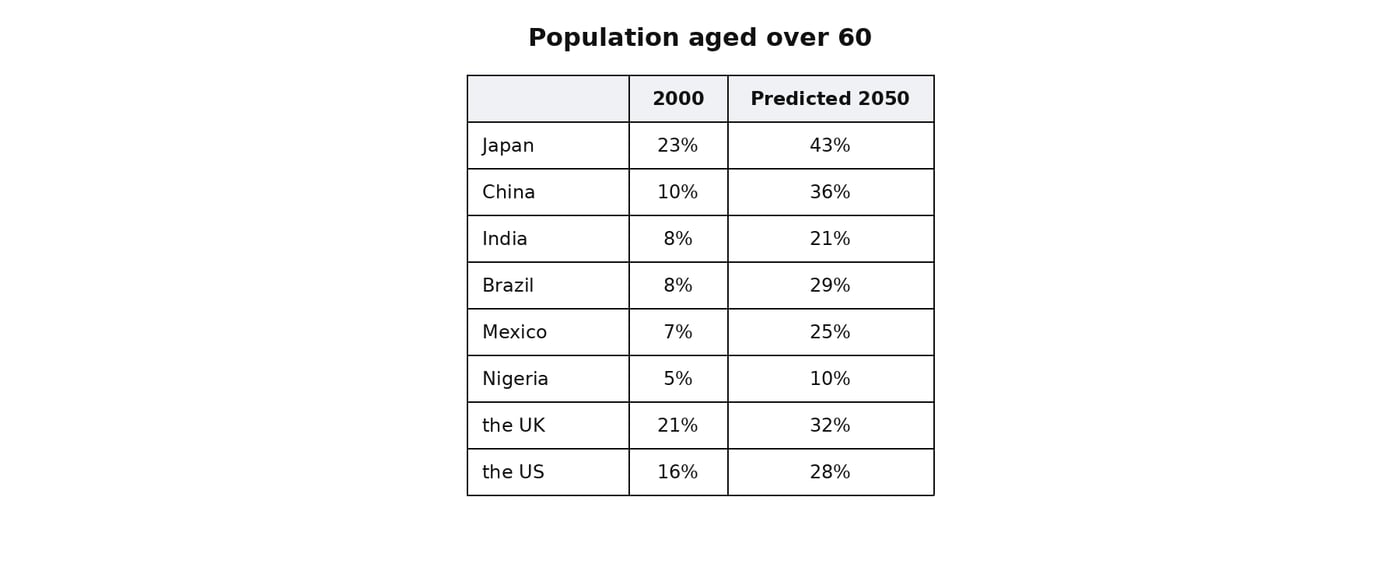
The table below shows the percentage of the population aged over 60 in 2000 and in the predicted year 2050 in eight countries.
Summarise the information by selecting and reporting the main features, and make comparisons where relevant.
Student answer (Band 5.5)
The chart illustrates the proportion of the population aged above sixty in 2000 and in the estimated year 2050 in 8 countries. Overall, the lowest percentage was recorded in Nigera, while the highest ratio in Japan in 2000. In predicted year, 43 percent adults of Japan will be crossed age of 60.
In 2000, 5% of people was over 60 in Nigeria, whereas 7% recorded in Mexico. Eight percent of generation was higher than sixty in Brazil as well as India. 10%, 16% was in China and the US. 21 percent of the UK population was above 60, while 23% reached in Japan.
In 2050, almost 10% will be crossed the adult's age in Nigeria. 21% will have in India, 25% will in Mexico. Approximately 28% of the uk people will be sixty year old, while 29% will in Brazil. Moreover, 32% and 36% of the puplis will be above 60 in the UK as well as China. Finally, the maximum percentage will be in Japan as 43%.
AI examiner evaluation
| Criterion | Band |
|---|---|
| Task Achievement / Task Response | 5.0 |
| Coherence and Cohesion | 6.0 |
| Lexical Resource | 5.5 |
| Grammatical Range and Accuracy | 5.0 |
| Overall | 5.5 |
Task Achievement / Task Response: Band 5.0
You identify the two years and report figures for all eight countries, and the overview correctly notes that Nigeria is lowest in 2000 and Japan is highest in both years. However, the overview is incomplete: it does not clearly summarise the broad rise across all countries or highlight that China has one of the largest increases. There is also a significant reporting error in the 2050 paragraph: you assign 32% to the UK and then 36% to China, but 32% is the UK figure and 36% is China’s; the earlier statement that the UK will be about 28% is incorrect, as 28% belongs to the US. These inaccuracies and the limited overview leave some key features unclear. Grouping the main increases and checking each country-value pairing would make the summary more complete.
Coherence and Cohesion: Band 6.0
The response has a coherent overall arrangement: an opening and overview are followed by separate paragraphs for 2000 and 2050. This makes the time-based comparison easy to follow, and linking expressions such as “whereas,” “while,” and “Moreover” help connect details. However, the progression within the 2050 paragraph becomes confusing because the UK is given first as approximately 28%, then as 32%, while China is assigned 36%. The repeated listing of figures also makes the paragraph read more like a sequence than a comparison of the main patterns. Use clearer grouping—for example, compare the highest values, the lowest values, and the largest rises—and ensure references to countries remain unambiguous.
Lexical Resource: Band 5.5
You use a range of task-related terms, including “proportion,” “estimated,” “percentage,” and “recorded,” and the meaning is generally recoverable. However, several word choices and collocations are inaccurate or unnatural, such as “43 percent adults … will be crossed age of 60,” “almost 10% will be crossed the adult’s age,” and “21% will have in India.” “Generation” and “pupils” are also unsuitable for describing a country’s population, and “ratio” is less precise here than “proportion” or “share.” There are spelling errors in “Nigera” and “puplis,” as well as inconsistent capitalisation of “UK.” Aim for standard demographic vocabulary and use it consistently; this will make the information clearer and more precise.
Grammatical Range and Accuracy: Band 5.0
You attempt some complex sentence forms, including comparisons with “whereas” and “while,” and the response is divided into clear sentences. However, grammatical control is uneven, with errors in verb forms, agreement, and sentence construction. For example, “5% of people was over 60” should use a plural verb, while “will be crossed age of 60” and “21% will have in India” do not form grammatical clauses. The sentence “In predicted year” also needs an article, and “43 percent adults” needs a determiner or a different structure. These problems sometimes make the intended meaning difficult to interpret. Practise accurate patterns such as “the proportion will rise to…” and “X% of the population will be over 60,” alongside your comparison clauses.
See this exact question answered at other band scores. The same prompt compared across bands.
Browse more IELTS Writing model answers or get your own writing scored by the same AI examiner.