Band 5.5 IELTS Writing Task 1 Model Answer
Overall Band Score: 5.5 · IELTS Predictions Nov 2026 · 2026-11-06
IELTS Writing Task 1 question
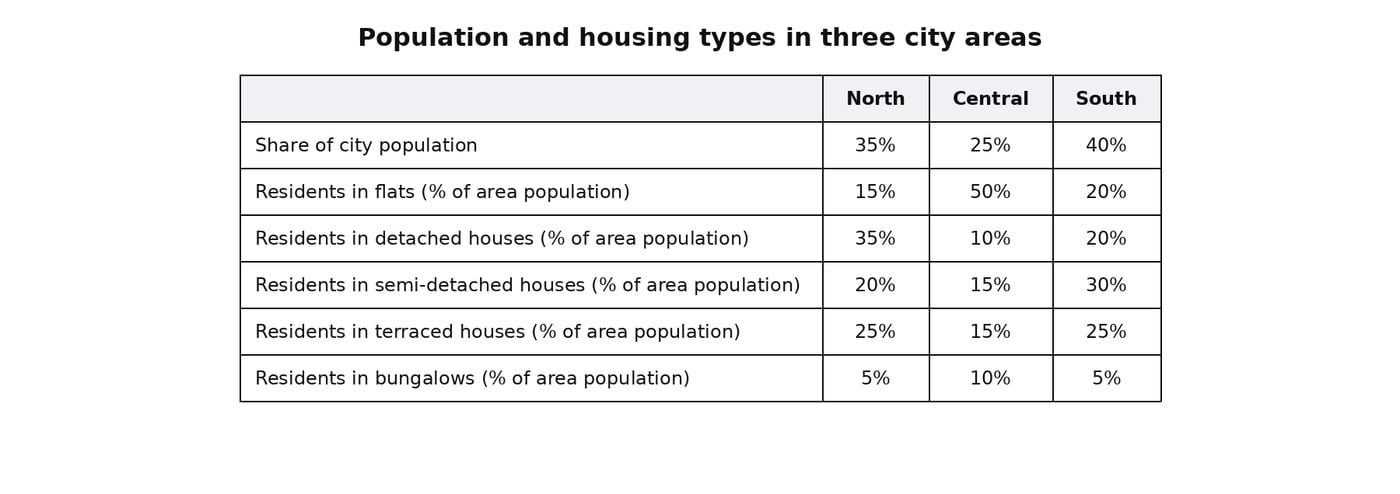
The table below shows each area's share of the city population and the percentages of its residents living in five types of home.
Summarise the information by selecting and reporting the main features, and make comparisons where relevant.
Student answer (Band 5.5)
The provided diagrame provides an overview of the city population share of three area's, namely, north, central, south and the proportion of residents in different types of home.
Broadly speaking heighest recomended area where people are living is south side afterward north side is also popular among people while least amount of people lives in central area.
This diagram summarises that portion of city population is 35% in north, 25% in central and 40% which is huge in south. As diagram shows all of these proportion describe by different residents houses namely, flats, detached houses, semi-detached houses, terraced houses, and bungalows. Following this, the largest proportion of residents living in flats and higher portion 20% of them living south side while mainly population of detached houses live in north at 35%. In comparing detached houses residents, the largest figures 30% of semi-detached houses residants are living in south side.
similarly, the terraced houses residents are living in two sides with same portion 25% in north and south while this figure is low in central
AI examiner evaluation
| Criterion | Band |
|---|---|
| Task Achievement / Task Response | 5.5 |
| Coherence and Cohesion | 5.5 |
| Lexical Resource | 5.0 |
| Grammatical Range and Accuracy | 5.0 |
| Overall | 5.5 |
Task Achievement / Task Response: Band 5.5
You identify the three areas and report the population shares accurately: South has the largest share at 40%, followed by North at 35% and Central at 25%. You also select some relevant housing comparisons, including North’s 35% in detached houses and the equal 25% figures for terraced houses in North and South. However, the overview is unclear and partly inaccurate: saying South is the “highest recommended area” does not describe the data, and the claim that the largest proportion of flat residents is in South is incorrect; Central has the highest figure at 50%. The account also omits the bungalow figures and does not clearly compare the housing patterns across all areas. A more precise overview and accurate selection of key contrasts would make the response more complete.
Coherence and Cohesion: Band 5.5
The response has a basic overall structure, moving from an introduction to a broad statement and then to housing details. Some linking expressions, such as “Broadly speaking,” “Following this,” and “similarly,” show an attempt to guide the reader. However, progression is not consistently clear: the overview is difficult to interpret, and the paragraph of details shifts between housing types without a systematic comparison of the three areas. Phrases such as “In comparing detached houses residents” do not clearly signal the relationship between the figures that follow. The final sentence also ends without a complete comparison or concluding point. Grouping the data by notable patterns—for example, the leading area for each housing type—and using clear references would improve cohesion.
Lexical Resource: Band 5.0
You use some task-relevant vocabulary, including “proportion,” “detached houses,” “semi-detached houses,” and “terraced houses,” so the reader can generally identify the subject of each comparison. However, the range is limited and several choices are inaccurate or unnatural, such as “highest recommended area,” “huge,” and “living south side.” Repetition of “portion,” “residents,” and “living” also makes the description less precise. There are noticeable spelling and word-form errors, including “diagrame,” “heighest,” and “residants,” which reduce the accuracy of the report. Aim for standard data-reporting collocations and use precise terms such as “accounted for,” “the largest share,” and “residents in the South.”
Grammatical Range and Accuracy: Band 5.0
You attempt both simple and longer sentence forms, including a sentence beginning “As diagram shows” and a comparison introduced by “while.” However, complex sentences are often not controlled successfully, and errors recur in articles, agreement, and sentence construction. For example, “As diagram shows” needs an article, while “the largest figures 30% … are living” has an unclear grammatical relationship between the subject and the percentage. The opening sentence also contains awkward punctuation and possessive construction in “three area's.” Some sentences are incomplete or difficult to follow, particularly the final sentence, which lacks a clear ending. Practise building accurate comparison sentences with a clear subject and verb, such as “South had the highest proportion of residents in semi-detached houses, at 30%.”
See this exact question answered at other band scores. The same prompt compared across bands.
Browse more IELTS Writing model answers or get your own writing scored by the same AI examiner.