Band 6.0 IELTS Writing Task 1 Model Answer
Overall Band Score: 6.0 · IELTS Predictions Nov 2026 · 2026-11-12
IELTS Writing Task 1 question
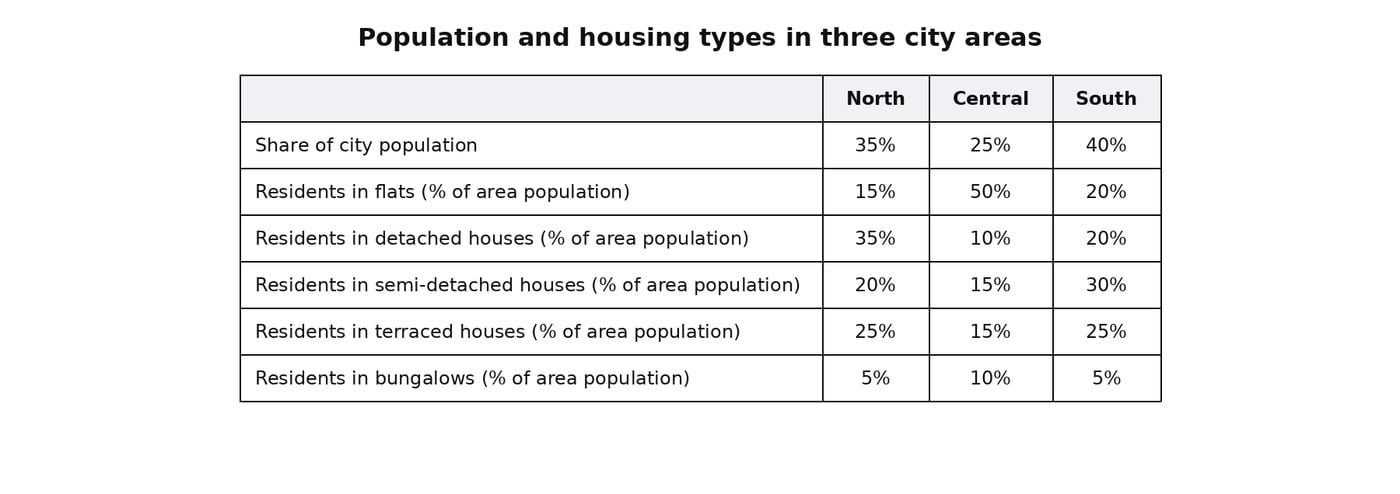
The table below shows each area's share of the city population and the percentages of its residents living in five types of home.
Summarise the information by selecting and reporting the main features, and make comparisons where relevant.
Student answer (Band 6.0)
The table illustrates the proportion of city population in three areas such as north, central, south and its dwellers living in five types of home.
Overall, it is clear from the table that the highgest number of people live in southern part of the city, follwed by northern part. By contrast, the lowest number of people live in central area.
To begin with north where 35 percent of city population live. Among those population, 35 percent reside in detached houses, whereas on 5 percent reside in bungalows. The remaing populations live in flats, semi-detached and trerraced houses.On the other hand, 25 percent population live in central part of the city, among those 50 percent reside in flats, followed by 15 percent for both semi detached and terracd houses respectively. The figures for bunglows and detached houses are 10 percent for each.
Finally, 40 percent population live in south part of the city, among those 30 percent reside in semi detached houses, followed by 20 percent for both flats and detached houses respectively. The figures for terraced houses and bungalows are 25 and 5 percent respectively.
AI examiner evaluation
| Criterion | Band |
|---|---|
| Task Achievement / Task Response | 6.0 |
| Coherence and Cohesion | 7.0 |
| Lexical Resource | 5.5 |
| Grammatical Range and Accuracy | 5.5 |
| Overall | 6.0 |
Task Achievement / Task Response: Band 6.0
You cover the population shares and housing patterns in all three areas, and the overview correctly identifies the South as the largest area and Central as the smallest. Most reported figures are accurate, including North’s 35% in detached houses and Central’s 50% in flats. However, there are important inaccuracies: in Central, detached-house residents account for 10%, not 10% alongside bungalows as your wording implies; the 15% figures apply to semi-detached and terraced homes. Also, the North paragraph leaves three housing figures unspecified, and the overview could compare the areas’ dominant housing types. Select and report the main contrasts more fully, while checking that each figure is clearly matched to its category.
Coherence and Cohesion: Band 7.0
The response has a clear overall structure: an introduction, a summary of the population distribution, and separate paragraphs for North, Central and South. Sequencing is easy to follow, and transitions such as “To begin with,” “On the other hand” and “Finally” guide the reader through the areas. The main limitation is that some linking is mechanical, and the North paragraph ends with a broad statement that the remaining residents occupy three types of housing without giving the relevant figures. The Central paragraph also combines its figures in a way that makes the comparison less clear. Use more direct links between the key contrasts, and ensure each sentence clearly identifies the area and housing category it describes.
Lexical Resource: Band 5.5
You use relevant task vocabulary, including “proportion,” “reside,” “detached houses” and “semi-detached,” so the topic is generally clear. However, spelling and word-choice errors are noticeable, for example “highgest,” “follwed,” “remaing,” “trerraced” and “bunglows.” Some expressions are also awkward or imprecise: “among those population” and “the figures for” are repeated, while “the highgest number of people” is less suitable for describing a share. These issues do not prevent understanding, but they limit precision and naturalness. Check spelling carefully and use accurate collocations for percentages, such as “accounted for” or “made up,” alongside a wider range of comparison language.
Grammatical Range and Accuracy: Band 5.5
You attempt both simple statements and longer sentences with subordinate clauses, as in “Among those population, 35 percent reside in detached houses, whereas…” This gives the response some structural variety, and the main comparisons remain understandable. However, some grammatical errors recur, including missing articles and awkward noun phrases in “in southern part” and “in south part,” as well as “25 percent population.” The sentence beginning “The figures for bunglows and detached houses…” also needs clearer grammatical construction to show that both values are 10%. Improve article use and sentence framing, and vary the repeated “among those” pattern. More consistently accurate complex sentences would make the information easier to process.
See this exact question answered at other band scores. The same prompt compared across bands.
Browse more IELTS Writing model answers or get your own writing scored by the same AI examiner.