Band 6.0 IELTS Writing Task 1 Model Answer
Overall Band Score: 6.0 · IELTS Predictions Nov 2026 · 2026-11-19
IELTS Writing Task 1 question
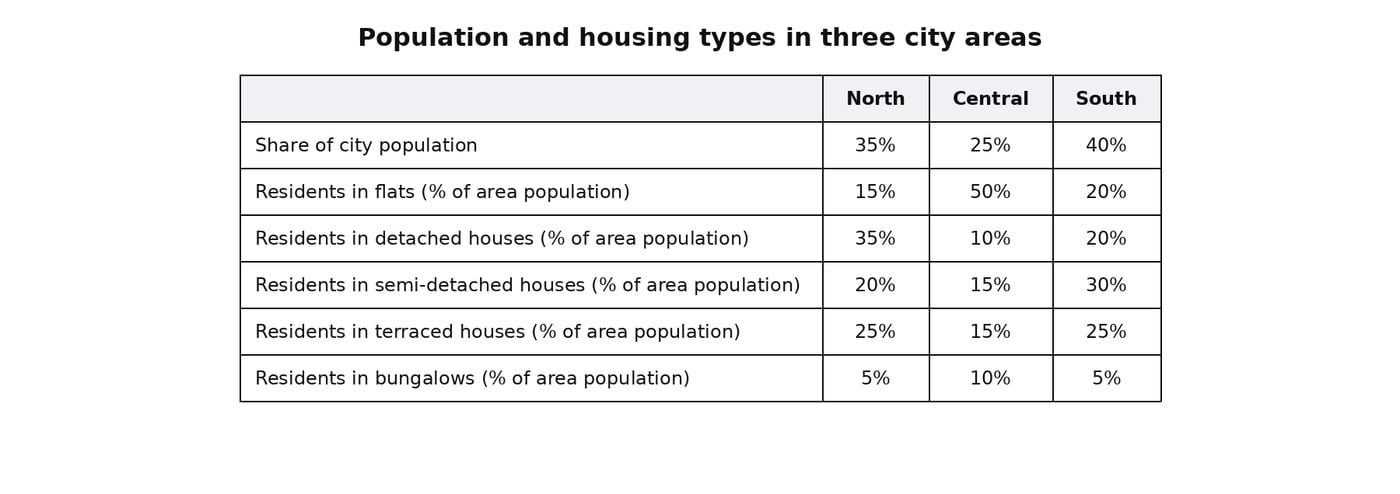
The table below shows each area's share of the city population and the percentages of its residents living in five types of home.
Summarise the information by selecting and reporting the main features, and make comparisons where relevant.
Student answer (Band 6.0)
The table depicts the distribution of city population in north ,central and south and the proportion of residents who are living in five types of home.
Overall, South area's population covered the highest proportion of the city. On the other hand, the residents who live in flats and located in the central area contributes the highest proportion whereas residents in bungalows represents the lowest proportion.
Mostly people in the city are located in the southern part, which is 40% while residents who live in north and central part of the city are 35% and 25%, respectively.
In central area, about an half percentage of the population is living in flats. 15% and 20% of the population lives in North and South area, respectively, while the lowest number of people is living in bungalows, which is same in both North and South, 5% only and 10% in Central area. In North area, people prefer to live in detached houses and more than one-third proportion is spending life there and only 10% and 20% family lives in Central and South area.
AI examiner evaluation
| Criterion | Band |
|---|---|
| Task Achievement / Task Response | 6.0 |
| Coherence and Cohesion | 6.0 |
| Lexical Resource | 6.0 |
| Grammatical Range and Accuracy | 5.5 |
| Overall | 6.0 |
Task Achievement / Task Response: Band 6.0
You identify the main population shares accurately: the South has the largest share at 40%, followed by the North at 35% and Central at 25%. You also report the key contrast that flats are most common in Central, and give several housing figures correctly. However, the overview is incomplete and partly unclear: bungalows are not the lowest category in every area, and the response does not highlight that detached houses lead in the North while semi-detached houses are most common in the South. The final paragraph also omits useful comparisons for semi-detached and terraced homes. A fuller overview and more balanced coverage of the housing types would make the summary more complete.
Coherence and Cohesion: Band 6.0
The response has a recognisable structure, moving from an introduction and overview to details about population shares and housing. This gives the reader a generally coherent route through the information. However, the overview and detail paragraphs do not clearly separate the main patterns from supporting figures, and the final paragraph combines several categories in a way that is difficult to follow. For example, the sentence beginning “In central area” shifts from flats to bungalows and then compares areas without a clear organising principle. Use one paragraph for the main overview and group detailed comparisons by housing type or by area. More precise linking and reference would also reduce the slightly mechanical use of “while” and “which”.
Lexical Resource: Band 6.0
You use an adequate range of task-related vocabulary, including “distribution,” “proportion,” “detached houses,” and “bungalows,” so the data is generally understandable. There are also attempts at more formal phrasing, such as “covered the highest proportion.” Some choices are inaccurate or unnatural, however: “population covered” is not a suitable collocation, “Mostly people in the city are located” is awkward, and “spending life there” does not naturally describe residence. Repetition of “proportion” and “residents” also limits flexibility. Choose precise reporting verbs and natural housing-related collocations, such as “accounted for,” “lived in,” and “the largest share.” These improvements would make the vocabulary more accurate and fluent.
Grammatical Range and Accuracy: Band 5.5
You attempt both simple and more complex sentences, including comparisons with “while” and a relative clause beginning “which is same in both North and South.” The main information is usually understandable, but some grammatical errors remain. Examples include “South area's population covered,” where the possessive construction and verb form are faulty, and “the residents … contributes,” where the subject and verb do not agree. Articles and sentence structure also need attention in “about an half percentage” and “which is same.” Several long sentences join multiple comparisons, making grammatical control less secure. Practise accurate subject–verb agreement, articles, and complete sentence patterns, then check punctuation and capitalisation of area names.
See this exact question answered at other band scores. The same prompt compared across bands.
Browse more IELTS Writing model answers or get your own writing scored by the same AI examiner.