Band 5.0 IELTS Writing Task 1 Model Answer
Overall Band Score: 5.0 · IELTS Predictions Nov 2026 · 2026-11-22
IELTS Writing Task 1 question
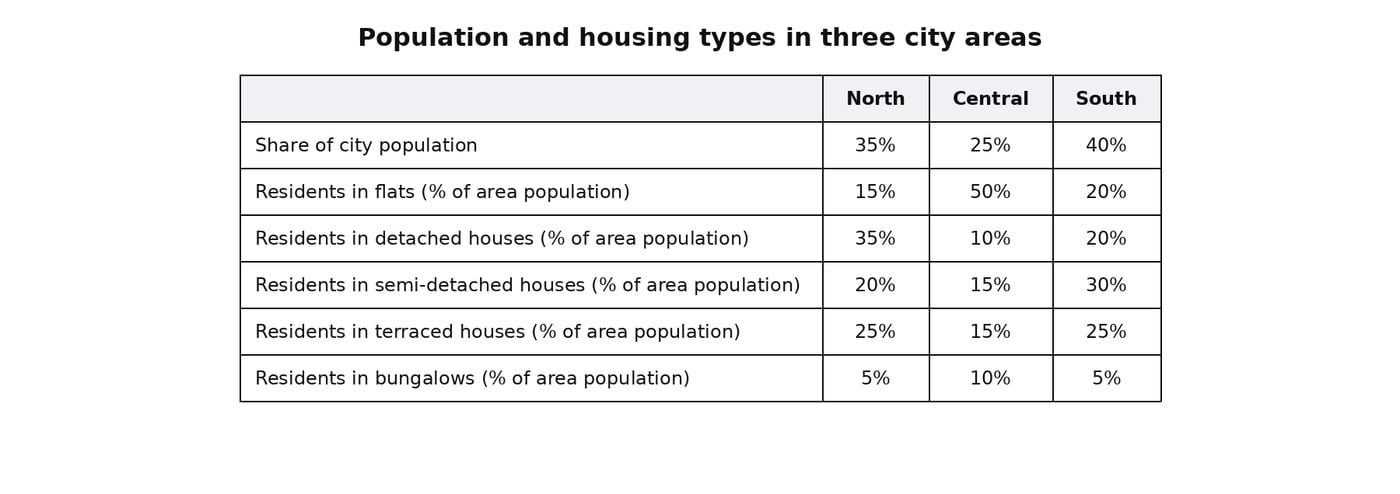
The table below shows each area's share of the city population and the percentages of its residents living in five types of home.
Summarise the information by selecting and reporting the main features, and make comparisons where relevant.
Student answer (Band 5.0)
This table illustrates the population of cities in diiferent types of residents of homes in nothern, central and sutheren areas.there is three main city areas of housing population.There is highest population of city is in south side as compared to other two cities.residents in falts have more population almost 50% in central area rathen than north and south. residents in detached houses, semi-detached houses and terraced houses has averege population in cities of north, south and central.the bungalows residence has least area population as compared to all other residence area population.
AI examiner evaluation
| Criterion | Band |
|---|---|
| Task Achievement / Task Response | 5.0 |
| Coherence and Cohesion | 4.5 |
| Lexical Resource | 5.0 |
| Grammatical Range and Accuracy | 4.5 |
| Overall | 5.0 |
Task Achievement / Task Response: Band 5.0
You identify relevant features, including the South having the largest population share and flats being especially common in Central. However, the response only partially summarises the table: it gives no exact figures for the population shares and makes broad claims such as “average population” without explaining the differences between housing types. The statement that bungalows have the least area population is not a clear comparison across the table; they account for 5% in North and South and 10% in Central. The response also lacks a developed overview and is substantially below the required 150 words. To improve, report the key figures accurately and compare the main contrasts, such as North’s higher detached-house share and South’s higher semi-detached share.
Coherence and Cohesion: Band 4.5
The response follows a basic sequence: it introduces the table, mentions the largest population share, then comments on housing types. This gives the reader some sense of the topic, but the ideas are compressed into one paragraph and do not develop in a clear progression. There are no effective linking expressions to show how the comparisons relate, and the repeated use of “population” makes the relationships between area size and housing type difficult to follow. For example, “residents in detached houses, semi-detached houses and terraced houses has averege population” groups several categories without explaining their differences. Use separate sentences or paragraphs for the overview and key comparisons, and connect them with clear phrases such as “By contrast” and “Meanwhile.”
Lexical Resource: Band 5.0
You use some relevant task vocabulary, including “detached houses,” “semi-detached houses,” “terraced houses,” and “bungalows,” so the reader can recognise the categories being discussed. However, the range is limited and several word choices or spellings reduce clarity. “Population of cities in different types of residents of homes” is an awkward description of the table, while “average population” does not accurately express the proportions shown. There are also noticeable spelling errors, including “diiferent,” “nothern,” “sutheren,” and “falts.” Aim for precise terms such as “share,” “proportion,” and “accounted for,” and check spelling carefully. This would make the comparisons clearer and more appropriate for an academic summary.
Grammatical Range and Accuracy: Band 4.5
The response attempts to communicate several comparisons, but it relies on a narrow range of sentence patterns, and frequent grammatical errors make some relationships unclear. For example, “there is three main city areas” has incorrect subject–verb agreement, while “residents … has averege population” also uses an incorrect verb form and does not form a clear grammatical comparison. Articles and sentence boundaries are often missing, as in “there is highest population of city is in south side.” Capitalisation and punctuation are inconsistent, with sentences beginning in lowercase and several ideas joined without full stops. Practise building accurate simple sentences first, then add comparison clauses, for example: “South accounts for 40% of the city’s population, compared with 35% in North.”
See this exact question answered at other band scores. The same prompt compared across bands.
Browse more IELTS Writing model answers or get your own writing scored by the same AI examiner.